

A concrete Ethereum implementation of the Alberta Buck Architecture, in six contracts:
- BUCK_CREDIT (ERC-721) – one NFT per insured asset, with deterministic depreciation and piecemeal client activation.
- IdentityRegistry – per-address Pointcheval-Sanders credentials and ElGamal-encrypted identity points, verified on-chain via the BN254 precompiles. Trust anchor for every BUCK transfer.
- BUCK (ERC-20) – identity-bound, single-slot per-account state with signed raw balances,
continuous demurrage on positive holdings, and NFT-backed credit headroom that lets the raw
balance go negative up to
creditLimit(a) = totalCurrentValue(a) * currentBuckK / 1e18.mint(N)activates NFT-backed coverage and pays the insurance pool principal out of the holder's credit (no BUCK is delivered to the holder's raw balance); the holder spends the new headroom by transferring out, driving the signed raw negative.balanceOfreportsheld + unused crediton non-Carrying accounts, so the ERC-20 view answers "what can I spend right now". - BuckBasket – USD-free basket registry and direct-mint orchestrator. Custodies a single
full-range Uniswap-V3 LP position per TOKEN/BUCK pool, mints BUCK against deposited basket
tokens at the current pool spot price, and on redemption withdraws proportionally from
overweight pools, hands the depositor the TOKEN side(s) and recycles the BUCK side "sell high /
buy low" into the most underweight pool as treasury LP. Publishes
basketValueInBuck() = sum( basketAmount_i * pool_price_in_BUCK_i )as the direct-embodiment process variable forBUCK_K. - BUCK_K – the value-stabilization factor for credit-limit computation. Three implementations
ship today:
BuckKControllerStatic(governance-set constant),BuckKControllerDirect(USD-free PID; setpoint = 1.0 BUCK by definition, process variable =BuckBasket.basketValueInBuck()), andBuckKController(PID against an external four-pool USDT/USDC basket of Uniswap-V3 TWAPs, with a BUCK/USDT TWAP as the BUCK price). The PID mechanics – priming, setpoint-shift (dS) compensation, long-gapdTMaxclamp,fundingFactor()counter-cyclical insurance view – live in a sharedBuckKControllerBasefollowing the ezpwd::pid pattern;Buck.mintandBuck.burndrivecompute(), andBuckBasketholds the privileged hook toreprime()after constituent additions. - Notes – privacy-preserving denomination on top of BUCK. Mint and spend via Groth16 SNARKs over a Tornado-style incremental Poseidon Merkle tree.
This is the first implementation, prioritizing clarity over breadth of standards. Subsequent documents will examine ERC-1155, ERC-3643, and ERC-4626 alternatives for individual layers.
Contract Architecture
The six contracts compose into a single transfer pipeline gated on identity. IdentityRegistry
is the trust anchor: mint, approve and transfer all consult it before mutating state. Every
account and contract that touches BUCK carries an identity binding – EOAs via register,
contracts via bindContract – so bilateral identity-checked transfers always have a verifiable
counterparty on both sides.
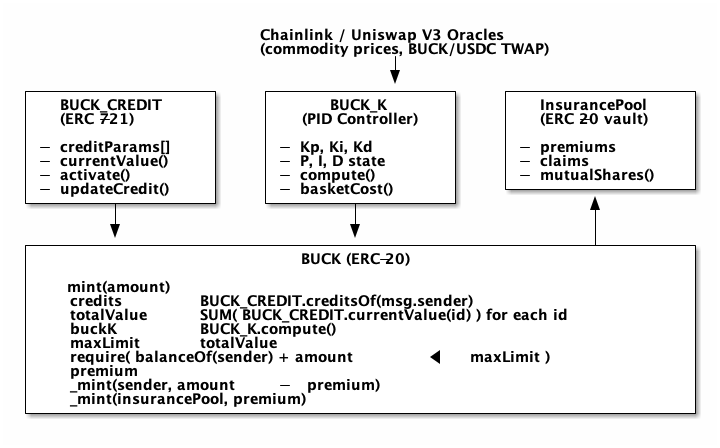
A Wallet (EOA) is the only initiator. It registers once with IdentityRegistry and then
mints, burns, transfers, deposits or spends via the contract entry points in the second
row. Every contract that moves BUCK – Buck, BuckBasket, Notes – consults
IdentityRegistry.isVerified on both counterparties before settling. BuckCredit
(ERC-721) is mutated only by insurers (createCredit, updateCredit) and by Buck itself
(activateFromBuck / deactivateFromBuck during mint and burn); the dependency is one-way
– BuckCredit never calls back into Buck. BUCK_K is private
infrastructure: Buck calls compute() on every mint/burn, and BuckBasket is the
privileged caller of reprime() and the source of basketValueInBuck() that the
Direct variant integrates against. External dependencies (not shown): Uniswap V3 (LPs
custodied by BuckBasket; TWAPs read by the External variant of BUCK_K); the BN254
EVM precompiles (pairings for IdentityRegistry, modular arithmetic for the
Mint/SpendVerifier contracts); circom / snarkjs for off-chain Notes proof generation.
The flow is:
- A client names an insurer it will accept credits from (
setCreditIssuer), and that insurer mints aBUCK_CREDITNFT for the client's asset, setting face value, depreciation schedule, andpremiumRate(annual basis points of activated coverage). A credit only lands where its recipient asked for it, and only from an insurer whose regulator has attested it – see The Insurer Gate. - There is no separate activation step, and no public
BuckCredit.activate. Coverage is activated only insideBuck.mint, atomically with the insurance principal that funds it – see Activation = Mint, Deactivation = Burn. While coverage is live the credit cannot change hands. - Before touching BUCK, the client
registerswithIdentityRegistry, posting a blinded presentation(A, B)of its PS credential, an ElGamal-encrypted identity point and a proof tying the two to the account key. The registry verifies the proof via BN254 pairings (443,892 gas measured, paid once per address). BUCK.mint(amount[, tokenIds])draws coverage cheapest-first across the client's NFTs, activates it, and debits the mutual-insurance pool principal – 10x the annual premium on the coverage – from the client's signed raw balance intoinsurancePool. No BUCK is delivered to the client's raw balance; what the client gains is spendable headroom. The arithmetic is in mint(N) and burn(N).- To send BUCK, the sender
approveswith a Chaum-Pedersen receipt that re-encrypts the sender's identity under the spender's public key.transfer/transferFromthen bilateral- identity-check both sides and emitBuckTransferReceiptcarrying only ciphertext hashes. - To denominate as private notes, the client calls
Notes.mintwith a Groth16 proof binding the depositedtotalFaceto a batch of Poseidon commitments. Holders later callNotes.spendCoupledA1/A2/B1with a fresh nullifier, a SNARK proving inclusion under a recent root, and a deposit gate proving the depositor is the identity the note names, against a posted identity root. BuckBasketis the direct-mint orchestrator and the value anchor. Anyone holding a basket constituent (PAXG, cbBTC, XAUT, WBTC, etc., as wired by governance viaaddBasketToken) can callBuckBasket.depositTokento LP it into the corresponding TOKEN/BUCK Uniswap-V3 pool; the basket mints exactlytokenAmount * spotPriceworth of fresh BUCK against the deposit (via the privilegedBuck.mintFromBaskethook), pairs the two sides as full-range V3 liquidity, and hands the depositor an ERC-721 receipt (BuckBasketReceipt). Depositing already-minted BUCK is symmetric: the basket swaps it into the most underweight constituent's TOKEN and LPs there. OnBuckBasket.redeem, the value claim is allocated across overweight pools proportional to each pool's positive value-weight error; the basket withdraws L from each, transfers the entire TOKEN side to the depositor, burns the principal BUCK from the BUCK side, and routes the remaining "profit" BUCK into the most underweight pool's TOKEN as treasury LP – the "sell high on the way out, recycle to buy low" leg fires in the same transaction.BUCK_Kships in three forms today. The governance-set static variant is the simpler choice for early deployments where no on-chain price reference exists.BuckKControllerDirectis the USD-free embodiment: process variable =BuckBasket.basketValueInBuck(), setpoint = 1.0 BUCK by definition, error =1.0 - basketValue. The legacyBuckKControllerreads its process variable (BUCK price) from a BUCK/USDT TWAP and its setpoint (basket cost) from a four-pool USDT/USDC basket – XAUT/USDT, PAXG/USDC, cbBTC/USDC, WBTC/USDT, 25 % each – chosen for resilience against any single basis-currency or asset-token freeze.Buck.mintandBuck.burncallBuckK.compute()regardless of variant, so user activity drives and amortizes the PID; long quiet stretches are bounded bydTMax, andBuckBasketis the privileged caller ofreprime()afteraddBasketTokenso dilution discontinuities don't fire a one-cycle P/I spike.
ERC Standard Choice for BUCK_CREDIT
ERC-721 was the obvious starting point and the choice that ships. Each credit is genuinely unique
(specific asset, depreciation curve, insured value, premium schedule); ERC721Enumerable gives
BUCK.mint the tokenOfOwnerByIndex it needs to walk a holder's NFTs. ERC-3643 (T-REX) is a
plausible future move if regulatory KYC becomes a hard requirement; ERC-1155 helps only if
standardized credit classes emerge with shared depreciation parameters; ERC-4626 fits the
InsurancePool but not individual credits. None of those are revisited below – the rest of the
document specifies the shipped ERC-721 path.
BUCK_CREDIT: ERC-721 Insured Asset NFT
Each BUCK_CREDIT is an ERC721Enumerable token whose per-token CreditParams holds the insurer's
current offer and the client's activation state. Three roles touch it: the insurer mints and
updates, the client activates, BUCK reads the depreciated activated value to size mint
allocations. All monetary fields are in 6-decimal BUCK-equivalent units (USDC-compatible).
Data Model
Fields group by mutability:
Issuance is opt-in per (client, insurer) pair: createCredit reverts unless the client has
called setCreditIssuer(insurer, true), and – where the gate is configured – unless the
insurer's regulator has attested an envelope covering the credit (The
Insurer Gate). Nobody can put a credit in your hands uninvited, or write one beyond their
licence.
- Immutable at mint:
insurer(the address allowed to update this token),assetClass,createdAt. - Insurer-mutable via
updateCredit:faceValue,depreciationFloor,depType,depRate,depStartAt,premiumRate,lastUpdated.faceValuemay not be reappraised belowactivatedValue– see Insurer Updates. - Buck-mutable via
activateFromBuck/deactivateFromBuck:activatedValue(capped atfaceValue). The client never writes it directly.
DepreciationType is one of NONE (land, gold), LINEAR (constant annual reduction),
DECLINING_BALANCE (continuous-compounded percentage), or MARKED (valued at its insurer's
latest mark: Marked Credits). Four events – CreditCreated,
CreditUpdated, CreditActivated, CreditMarked – record every state change.
A credit does not age. Jubilee relief accrues on the BUCK an account has actually drawn – its
lien, in Buck – not on coverage (Demurrage and Jubilee).
Depreciation Models
currentValue(tokenId) is a pure view that branches on depType:
NONE: returns the activated face value, unchanged.LINEAR: loss accrues atdepRatebp/year on the depreciable portion (faceValue - floor), clamped atdepreciationFloor.DECLINING_BALANCE: discrete whole-year compounding – the factor(BP - depRate)/BPis applied once per complete year via a loop capped at 100 years, then a linear interpolation bridges the trailing partial year. No transcendental approximations.
In every case the activated portion depreciates proportionally:
currentValue = depreciatedFace * activatedValue / faceValue.
| Asset | Type | Rate | Floor | 30yr value (of $100K) |
|---|---|---|---|---|
| Land | NONE | – | – | $100,000 |
| House (bldg) | LINEAR | 200bp | 20% | $52,000 |
| Vehicle | DECLINING_BALANCE | 1500bp | 5% | $5,725 |
| Farm equip | DECLINING_BALANCE | 1000bp | 10% | $13,815 |
| Gold in vault | NONE | – | – | $100,000 |
A residential property would typically have two BUCK_CREDITs: one for the land (NONE) and one for the structure (LINEAR or DECLINING_BALANCE with a salvage floor).
Marked Credits
Some collateral is revalued on-chain every block – a BuckBasket's equity is the case in point –
and no depreciation schedule describes it. A MARKED credit is valued at a mark its insurer
keeps current, mark(tokenId, value):
depreciatedFaceValue(tokenId) = min(faceValue, markOf[tokenId])        (MARKED)
currentValue(tokenId)         = depreciatedFaceValue * activatedValue / faceValue
so with the whole face activated, currentValue is the mark and the holder's creditLimit is
K x mark. Like depreciation, the mark moves the limit without touching the coverage: it may
fall below activatedValue, and a holder whose lien then exceeds its limit is under water – it
cannot spend further credit, and nothing is called back.
That is exactly what an insurer must never be able to do to someone else: a mark written down on another's credit would revoke a purchased policy, which Insurer Updates forbids. So three rules bound it:
- Self-issued only.
createCreditwithMARKEDrequiresclient =msg.sender=: the holder is its own insurer, and marks only its own collateral. - Fixed at creation.
updateCreditrefuses to switch a credit to or fromMARKED, so a scheduled credit cannot be converted and then marked down. - Gated like any model. Where the insurer gate is configured, the insurer's attested envelope
must permit
MARKED(bit 3 ofdepTypes), as it must permit any depreciation model.
A marked credit is activated like any other – one Buck.mint at zero premium, once the mark is
above zero (a credit appraised at zero insures nothing and is skipped) – and its holder's lien
earns relief like any other. Its face caps what the holder can ever draw, at K x face.
Activation = Mint, Deactivation = Burn
There is no public BuckCredit.activate() function. Activation – expanding activatedValue
and thus growing the holder's creditLimit – happens only atomically as part of
Buck.mint(N, [tids]), and deactivation happens only atomically as part of Buck.burn(N,
[tids]).
This is a deliberate consequence of the mutual-insurance pool model. Drawing take units of
coverage on an NFT generates annual_premium = take * premiumRate / BP per year. Instead of
charging that premium on a continuous schedule, the contract requires an upfront
poolPrincipal = annual_premium * POOL_ROI_INV deposit (where POOL_ROI_INV = 10 encodes the
insurer's assumed 10 % annual ROI on pool capital). At parity, the pool's investment yield on
poolPrincipal exactly funds the annual premium on take in perpetuity – so a policy is a
one-time purchase, not a recurring expense.
Therefore the surface BuckCredit exposes is restricted to (a) insurer-side creation /
re-appraisal (createCredit, updateCredit), (b) standard ERC-721 ownership operations
(transferFrom, balanceOf, ownerOf, …), and (c) two Buck-only entry points
(activateFromBuck, deactivateFromBuck) which Buck._allocateMint / _allocateBurn call as
part of their atomic sequences. Test fixtures that need to set up a holder with non-zero
creditLimit without exercising the mint() purchase path use the BuckCreditHarness
subclass's forceActivate – explicitly not present on production BuckCredit.
Buck.mint and Buck.burn are the only callers. Their per-NFT arithmetic, and the post-burn
solvency rule that goes with it, are in mint(N) and burn(N).
A credit that is backing BUCK cannot change hands. BuckCredit._update – the ERC-721 hook
every mint, transfer and burn passes through – refuses to move a token whose activatedValue is
non-zero, with BuckCredit: credit in use. Minting is exempt (from = address(0)=), so
createCredit still works, and a burn that takes coverage back to zero frees the credit to be
sold again.
The reason is that the two halves of a credit position live in different places. Buck derives
the holder's creditLimit from the activated value of the credits they own, while the BUCK
drawn against that limit stays as a negative raw balance on the account that drew it. Let the
token move and the two separate: the seller keeps an obligation with nothing behind it, and the
buyer receives headroom against coverage that has already been spent. The same activated value
would back BUCK twice.
activatedValue is the predicate rather than Buck's mintsBacked deliberately: it is local,
so BuckCredit enforces the property without consulting Buck at all, and the guarantee does not
depend on another contract being correct or even reachable. The two agree by construction –
activation happens only inside Buck._allocateMint, and updateCredit may not reappraise below
activated coverage.
totalCurrentValue(account) walks tokenOfOwnerByIndex and sums currentValue(tokenId) – the
single call Buck.creditLimit makes to size the holder's headroom (then multiplied by
currentBuckK and divided by 1e18). creditInfo(tokenId) returns
(faceValue, activatedValue, premiumRate) one NFT at a time;
batchCreditInfo(uint256[] tokenIds) returns a packed CreditSlice[] = (owner, faceValue, activatedValue, premiumRate)
for the entire list in one external call, used by Buck
_allocateMint / _allocateBurn to amortize per-NFT cross-contract dispatch overhead.
Buck Wiring
The dependency is one-way: Buck reads BuckCredit to size credit, and BuckCredit never
calls Buck. BuckCredit.setBuck(address) is a one-shot post-deployment authorisation record
– it names the single contract allowed to call activateFromBuck / deactivateFromBuck – and
nothing more.
Earlier drafts had BuckCredit notify Buck on every NFT mutation, so that a per-block
credit-limit cache in Buck could invalidate. Both the cache and the notification are gone; see
The Credit Limit Is Read Live for why the cache could not have been made correct.
Removing them left the call graph acyclic, which is worth more than the cache was: there is no
reentrant path from BuckCredit back into Buck, so Buck's reentrancy guard needs no
exemption for one.
The two-contract split, rather than collapsing into a single Diamond, is forced by the
ERC-20 / ERC-721 standards: balanceOf(address) and transferFrom(address,address,uint256) share
function selectors with incompatible semantics across the two standards, and the Transfer event
has different indexed-argument counts. A Diamond can dispatch one selector per signature;
whichever loses stops being standards-compliant and silently breaks wallets, indexers,
marketplaces, and routers. See Future Directions for the modularization paths that are
viable (intra-ERC-20 facets in Buck, independent UUPS for BuckCredit).
Insurer Updates
updateCredit(tokenId, newFaceValue, newDepreciationFloor, newDepType, newDepRate,
newDepStartAt, newPremiumRate)
is gated on msg.sender == credits[tokenId].insurer.
assetClass and insurer never change.
An insurer may reappraise down to the coverage the holder has already bought, and no further:
newFaceValue >= activatedValue, else BuckCredit: face below activated coverage. Activated
coverage is a completed purchase – its pool principal was paid up front and funds its premium in
perpetuity – so writing it down revokes a policy rather than revaluing an asset. An asset that
has genuinely lost value is what a claim is for; ordinary decline is what the depreciation
schedule is for, and that still moves the holder's credit limit continuously without touching the
coverage itself. Every other lever stays: faceValue down to the activated line, the schedule,
the floor, the premium rate.
The rule is also load-bearing for solvency. activatedValue lives in BuckCredit and
mintsBacked lives in Buck; the burn is sized from the second and checked against the first.
An earlier draft let a reappraisal clamp one without the other, and a holder whose credit was
written down could then never unwind the position – burnable only down to the clamped line, with
the remainder stuck and the credit permanently disqualified from backing BUCK again. Refusing
the clamp keeps the two equal by construction, which is also what makes the transfer lock in
Activation = Mint the right predicate.
A reappraisal, or ordinary depreciation, can still leave a holder's outstanding BUCK above their credit limit. That is a supported state, not a default: see Underwater Is a State, Not a Failure.
IdentityRegistry: On-Chain Trust Anchor
The IdentityRegistry is the binding between Ethereum addresses and the privacy-preserving
identity machinery described in the companion documents Identity with Anonymity,
Identity Example – Data Flow, and Cryptographic Proofs.
Every BUCK mint, approve and transfer consults this registry; an unregistered address cannot
hold or move BUCKs.
The registry stores per address: pk[a] (G_1 identity public key), E_addr[a] (ElGamal ciphertext
of the identity point M), isVerified (true after PS+NIZK pass on-chain or after bindContract),
isCarrying (controls Buck's transfer dispatch), and isPublicIdentity (true only for contracts
bound with the public-disclosure flag). Trusted-issuer PS public keys live in
trustedIssuers[issuerAddr], populated by governance. EOAs always self-register; contracts always
bindContract.
Cryptographic Surface
Four on-chain verifications, all reducible to BN254 precompile calls:
- PS credential presentation at registration: the holder publishes
(A, B) = (a * sigma_1, a * sigma_2 + b * Y1)for fresha, b, withY1 = y * Gthe issuer's G1 key component, and the registry checks the masked relatione(B, g_2) = e(A, X) * e(m * A + b * G, Y)through the proof in step 2 – one three-pair pairing product. The published pair is uniform whatever the identity, so no holder ofm(the issuer included) can test it; a rerandomized signature, which an earlier design published, would be a valid signature onmand testable by anyone holding it. - Schnorr-family NIZK binding the presentation to the ElGamal ciphertext and the account
key. Four response scalars over one credential commitment
C1 = m* A + b~ * G~ (so no field exposesm * Aalone), Fiat-Shamir bound to the action/version domain (AlbertaBuck/FiatShamir/IdentityRegistry/Register/v2),((A, B), E_new, pk_new, registrant_address), chain ID, and registry deployment. Total registration 443,892 gas measured (472,630 before the presentation), paid once per address;trustIssueradditionally checkse(Y1, g_2) = e(G, Y)once per issuer. - Chaum-Pedersen NIZK at
approve: proves the recipient's identity ciphertext re-encrypts the same M registered inE_aliceand that the sender holds the registered account key. Fiat-Shamir binds the registry deployment,msg.sender,spender,chainidand the.../Approve/v2domain word. ~29K gas per counterparty pair. - The Notes bindings, each a sigma over EIP-196 with its own v2 domain word: the public
issuer's batch Schnorr (
verifyIssuerSchnorr), the private issuer's recipient-blinded re-encryption (verifyIssuerReenc), and the bearer depositor's binding (verifyDepositorBinding). The addressed deposit gate is a folded Groth16 proof, not a sigma (Notes). - Public membership (
verifyPublicMembership): a Poseidon path through a public subtree and the aggregator, checked on chain for the insurer gate.
Every hash the protocol relies on carries a domain tag of the form AlbertaBuck/<Area>/<Name>/v2:
the Fiat-Shamir transcripts end in one, the identity scalar hashes one ahead of the certified
record, and each accumulator leaf leads with one as a field element.
Solidity Surface
src/IdentityRegistry.sol uses the BN254 helper for all curve math:
struct G1Point  { uint256 X; uint256 Y; }
struct G2Point  { uint256[2] X; uint256[2] Y; }

struct ElGamalCT { G1Point R; G1Point C; }      // (R, C) = (r*G, r*pk + M)
struct PSPresentation { G1Point A; G1Point B; }   // (a*sigma_1, a*sigma_2 + b*Y1)
struct PSPubKey  { G2Point X; G2Point Y; G1Point Y1; }   // Y1 = y*G, checked at trustIssuer

struct RegistrationProof { uint256 e, s_m, s_b, s_r, s_sk; G1Point C1, T_C, T_R, T_key; }
struct CPProof           { uint256 e, s1, s2;   G1Point T1, T2, T3;     }
struct ContractBindingProof { uint256 e, s;     G1Point T;              }
struct SchnorrProof, IssuerReencProof, DepositorBindingProof;   // the Notes bindings

function register(address issuer, G1Point pk, ElGamalCT E,
                  PSPresentation pres, RegistrationProof proof);
function authorizeContractBinding(address binder, G1Point pk, ElGamalCT E,
                                  bool isPublicIdentity_, bool isCarrying_);
function bindContract(address target, G1Point pk, ElGamalCT E,
                      bool isPublicIdentity_, bool isCarrying);
function bindContract(address target, address issuer, G1Point pk, ElGamalCT E,
                      PSPresentation pres, RegistrationProof credential,
                      ContractBindingProof holderAuthorization,
                      bool isPublicIdentity_, bool isCarrying);
function bindContractFromAdapter(address target, address operator,
                                 bool isPublicIdentity_, bool isCarrying);
function setBindingAdapter(address adapter, bool approved);        // governance
function trustIssuer(address issuer, PSPubKey ipk);                 // governance
function verifyApprove(address sender, address spender,
                       ElGamalCT E_bob, CPProof pi) view returns (bool);
function verifyIssuerSchnorr(...) / verifyIssuerReenc(...) / verifyDepositorBinding(...);

// The identity accumulator (see The Identity Accumulator)
function setRootAuthority(address next);                             // governance
function enrollSubtree(bytes32 id, uint32 slot, uint8 depth, bool isPublic,
                       address poster, string publication);          // root authority
function evictSubtree(bytes32 id);                                   // root authority
function setAggregator(address next);                                // root authority
function postIdentityRoot(uint256 root, bytes32 leafListHash);       // aggregator
function setMaxRootAge(bytes32 consumer, uint32 maxAge);             // governance
function acceptsRoot(uint256 root, bytes32 consumer) view returns (bool);
function verifyPublicMembership(bytes32 id, uint256 leaf, uint256[] subSiblings,
                                uint256 subIndex, uint256[] aggSiblings, uint256 root)
                                view returns (bool);
function markApproved(address spender);                              // Buck-only
function setBuck(address buck);                                      // governance, one-shot
A few non-obvious points:
verifyApprovereadsE_alicefrom registry storage so the caller cannot substitute a fake credential. Its transcript binds the verifying registry address, so a proof prepared for a different registry deployment is rejected. Here "registry" meansaddress(this)while the proof is verified: for a Diamond facet that is the stable Diamond proxy, not the replaceable facet implementation. Replacing a facet therefore does not invalidate proofs. Moving the registry to a different proxy requires unsubmitted registration/approve proofs to be regenerated (and registry state to be migrated), but does not alter already minted Notes or their receipts; those artifacts do not contain either proof.bindContractrequires both certification and target control. The compact overload copies a registered caller's exact stored identity after the target authorizes the full binder/identity/ policy tuple. The credential overload verifies PS certification plus holder authorization; target authorization remains mandatory on that path. Contracts with known provenance use a governance-approved, contract-specific adapter. The adapter proves canonical provenance and authority, while the registry copies the named operator's stored identity rather than accepting adapter-supplied keys. The first authorized binding is immutable.markApproved(called by Buck insideapprove) freezes the spender'sisCarryingflag the first time anyone successfully approves them, so the carrying flavor a sender consents to cannot be retroactively flipped.- Revocation does not un-register existing accounts; they were verified once and are never re-verified.
Public-Identity Contracts
DeFi infrastructure – AMM pools, vaults, oracles, the Notes pool – can't generate Chaum-Pedersen
proofs at approve time because the contract has no private key. Such contracts authorize and
bind a certified operator identity, or use an approved adapter with audited provenance and
authority semantics, with
isPublicIdentity_=true, isCarrying=true. Counterparties of a
Public-Identity contract still call the identity-bound approve (the always-CP rule applies
regardless of spender flavor), but the receipt-fragment check on the contract side is satisfied by
the deterministic _identityHash rather than a per-counterparty CP receipt. Public-Identity
contracts forfeit content privacy: their identity M is openable on subpoena via the operator's
off-chain attestation. Encrypted-Identity contract binding (isPublicIdentity_=false) is
supported by the surface but not yet used in production.
Issuer Trust
trustedIssuers is the only governance-controlled trust anchor. Adding an issuer admits a new
origin of registrable identities; removing one stops new registrations under that issuer. Existing
registrations are unaffected – they were verified at registration and never re-verified.
Whether a registered identity is in good standing is a separate, revocable fact: membership in its
registry's subtree of the identity accumulator, which every consumer that needs liveness proves
against a posted root of bounded age – see
Identity: Liveness Is Membership.
The Identity Accumulator
Governance appoints a rootAuthority (setRootAuthority), which enrolls each certifying
authority's subtrees at aggregator slots (enrollSubtree(id, slot, depth, isPublic, poster,
publication), evictSubtree) and appoints the aggregator (setAggregator). The aggregator
alone posts roots: postIdentityRoot(root, leafListHash) writes identityRoot and records the
root and its posting time in a ring of ROOT_RING_SIZE = 256, evicting the oldest. A consumer
names itself by a v2 tag and acceptsRoot(root, consumer) accepts a retained root posted within
that consumer's maximum age (setMaxRootAge; Notes seven days, the insurer gate one day, never
longer than the full ring covers). Paths are MEMBERSHIP_PATH_DEPTH = 32 levels: a subtree of
12 under an aggregator of 20. verifyPublicMembership(id, leaf, subSiblings, subIndex,
aggSiblings, root) checks a public subtree's path on chain, taking the aggregator index from the
subtree's enrolled slot rather than from the caller, and publicIdentityLeaf(M) is the tagged
unsalted leaf. Private (salted) membership is proven in zero knowledge inside the Notes gates.
register and bindContract refuse a caller-supplied leaf: admission is the authority's
certification, never a by-product of registration.
BUCK: ERC-20 Token
BUCK is an identity-bound ERC-20 with NFT-backed credit headroom, mutual-insurance-pool minting,
and continuous demurrage. All transfer-path state for an account fits in one storage slot, so a
transfer is one SSTORE per side. mint(N) opens enough NFT-backed insured-asset coverage to
deliver N units of spendable headroom to the holder (no BUCK is delivered to raw balance) and
simultaneously transfers a pool principal from the holder's signed raw to insurancePool,
sized so that at the insurer's assumed annual ROI the principal's investment yield exactly covers
the annual premium on the activated coverage. The holder spends the headroom by transferring
out, which drives their signed raw negative; burn(N) unwinds coverage most-expensive-first and
refunds principal back to the holder, lifting their signed raw toward zero. Every transfer
routes through the IdentityRegistry and emits BuckTransferReceipt(from, to, amount, fromHash,
toHash) – ciphertext hashes, no plaintext identity on chain.
Storage Layout
The transfer-path state for an account is one slot:
struct AccountState {
BuckQty balance; // int80 underlying; signed. Range = [-6.04e23, +6.04e23] raw
// = [-6.04e17, +6.04e17] BUCK at 6 decimals. Negative ==
// NFT-backed used credit; positive == held BUCK.
BuckSeconds buckSeconds; // uint120 underlying; |balance| * dt, read by sign:
// fee-seconds while positive, issuance-seconds (the
// lien over time) while negative, 0 at zero (I1)
uint40 timestamp; // last crystallisation (safe past year 36800)
uint16 flags; // bit 0: demurrage routed to demurragePayer[a].
// bits 1-15 reserved.
}
mapping(address => AccountState) internal _state;
BuckQty is a user-defined value type wrapping int80; constructors
toBuckQty(uint256) (bounds-checks against the positive cap) and toBuckQtySigned(int256)
(bounds-checks both endpoints) live in BuckTypes.sol so a future width change propagates to
Buck and BuckCredit in lockstep. BuckCredit always reads via asUint() (its face,
floor, and activated values are non-negative by construction); Buck reads via asInt() in
signed contexts and asUint() only after verifying non-negativity.
A bit in flags is the cheapest state this contract has: the word rides in the slot the transfer
path already loads and stores, so testing one is free. That is exactly why it is spent only on
hot-path dispatch. Cold-path bookkeeping – the count of accounts a demurrage payer carries –
lives in its own mapping instead.
A balance changes sign only at a write, after _crystallize has folded the old side's rectangle
through the current block, so the old side's seconds are settled there (a fee realized, or relief
paid) and the new side's start at zero. Invariant I1 – a zero balance holds no seconds – is
kept by every writer that can produce a zero, so the field's meaning is given by the sign alone.
The slots, grouped by concern:
| slot | variable | what it holds |
|---|---|---|
| 0 | _state |
the packed per-account word above |
| 1 | _totalSupply |
sum of the positive balances, the Jubilee fund's excluded |
| 2 | _allowances |
ERC-20 allowances |
| 3 | _receiptFragments |
the identity-bound approve's receipt per (from, to) |
| 4 | mintsBacked |
coverage outstanding per credit, in face units (= its activated value) |
| 5 | mintsPrincipal |
the insurance deposit held against it |
| 6 | _jubileeLastUpdate |
through when the fund has accrued |
| 7 | feesRealized |
fees taken out of circulation, cumulative |
| 8 | reliefRealized |
relief paid out of the fund, cumulative |
| 9 | demurragePayer |
an account's accepted fee payer |
| 10 | demurragePayerRequest |
a pending payer election |
| 11 | sponseeCount |
how many accounts a payer carries |
Tests that seed state by slot number (where the public path would need the identity machinery)
go through test/harness/BuckSlots.sol, and test/BuckSlots.t.sol pins each slot against the
live layout. Nothing derived is stored. An account's credit limit, and therefore
its balanceOf, is recomputed from live BuckCredit state on every read; there is no cached copy
of it anywhere. mintsPrincipal is not an exception – it is a record of what was actually paid,
which no amount of present-day state can reconstruct once the appraisal or the rate has moved.
BUCK implements IERC20 and IERC20Metadata directly – no OpenZeppelin ERC20 inheritance, so
the slot layout is explicit and the transfer paths are linear (no _update override re-entry).
Decimals are 6, matching USDC.
Signed Balances and balanceOf
signedRawBalanceOf(a) returns the raw int80 directly; rawBalanceOf(a) clamps negatives to
zero for legacy ERC-20-style readers; signedBalanceOf(a) subtracts demurrage from positive raw
(returns raw directly for negative raw, since used credit accrues no demurrage). balanceOf(a) –
the ERC-20 view – answers "what alice can spend right now":
held(a) = max(0, signedRaw(a) - feeOwing(a)) // Non-Carrying
used(a) = max(0, -signedRaw(a))
unusedCredit(a) = max(0, creditLimit(a) - used(a))
balanceOf(a) = held(a) + unusedCredit(a) // Non-Carrying
balanceOf(a) = max(0, signedRaw(a)) // Carrying
Carrying accounts (AMM pools, Notes pool, Jubilee) hold no BuckCredit NFTs, so
creditLimit == 0 and the signed-balance machinery degenerates to the prior unsigned model.
feeOwing and balanceOfFees clamp to zero on negative raw – demurrage is a per-second
property of held BUCK, not used credit.
The Credit Limit Is Read Live
creditLimit(a) = totalCurrentValue(a) * currentBuckK / 1e18 is computed from scratch on every
read. This is the point of BUCK_CREDIT, not an oversight: a holder's spendable balance is meant
to move when they acquire a credit, when an insurer reappraises one, when an asset depreciates on
its schedule, and when BUCK_K moves under the whole system. A balanceOf that did not move with
those would be reporting the wrong number.
An earlier draft cached the product per block, invalidated by an NFT-mutation hook from
BuckCredit. That could not have been made correct. BUCK_K moves inside any mint or burn
that advances the PID – from any account, with nothing to announce it – so two transactions in
one block were enough to read a stale limit; and no hook can cover depreciation at all, which is
continuous. The cache never populated in practice, and it was removed along with the hook rather
than repaired.
The cost lands where it should:
creditLimit(a) for … |
gas |
|---|---|
| an account with no credits | 6,327 |
an account with 10 credits, NONE schedule |
27,603 |
one credit, 40 years into DECLINING_BALANCE |
11,925 |
An account holding ten insured assets pays for ten insured assets on every outbound transfer. An account with a plain positive balance pays one external call that returns zero, and a Carrying account never reaches the credit path at all. That distribution is deliberate: drawing on insured collateral is a more expensive operation than spending cash, and it should read that way on the gas meter.
mint(N) and burn(N)
mint(uint256 amount) and mint(uint256 amount, uint256[] calldata tokenIds) are the two
overloads. The no-arg form runs an internal cheapest-first selector (insertion sort over the
caller's NFT list – typically a handful) to minimise premium cost; the second form takes a
caller-supplied order an off-chain optimizer pre-computes against effective rate, depreciation, or
coverage midpoint.
amount is spendable, at the K the mint runs at. mint(amount) raises the caller's
balanceOf by amount: it activates whatever coverage, and pays whatever deposit, that takes at
today's BUCK_K. A caller who wants 50,000 to spend asks for 50,000, whatever K is; the coverage
it activates is the dependent quantity, larger when K is lower. A mint for more than the listed
credits can give reverts ("insufficient credit allocation"), with one exception:
mint(type(uint256).max) delivers everything they can give, activating their whole faces. That
is how a holder opens all of a credit at once – a SimLP seeding a pool, or a
BuckBasketEquity opening its marked credit – without computing
K x face first and racing K to the block.
burn(uint256 amount) mirrors the overload pair: it lowers the caller's spendable by amount at
the K it runs at, releasing coverage and refunding its deposit. It moves no held BUCK; the
caller must still be within their limit afterwards. The default selector walks the holder's NFTs
most-expensive-first – the dearest insurance is released first, returning the largest pool
principal per BUCK released and freeing expensive coverage capacity for re-use. The asymmetry
is not arbitrageable: at one K the per-NFT inversion is symmetric (the same K - e on both
sides), so a mint-burn round-trip on the same NFT restores both its mintsBacked and
activatedValue, to rounding.
The Per-Credit Inversion
Two quantities have to be kept apart, and the whole inversion turns on the difference.
activatedValue is denominated in face units – a slice of the asset as appraised at issue.
What is actually insured today is that slice scaled by rho = depreciatedFace / faceValue. That
is proportional coinsurance, and it is the right shape for a depreciating asset: the holder's
share of the asset stays constant while its worth tracks the asset. creditLimit reads the
scaled figure, so the allocator inverts in present insured value and grosses back up into face
units at the end.
Each credit carries an annual premiumRate in basis points, and the premium is charged on what
is actually insured – the present value, not the face slice. You pay for the cover you have,
not for the cover the asset used to be worth. A unit of present insured value raises the credit
limit by K and costs a deposit of e = r * POOL_ROI_INV / BP, so it yields K - e of
spendable. Given a target spendable amount, rate r and today's K:
e = r * POOL_ROI_INV / BP the deposit per unit of cover (K > e, or the credit is skipped)
V = ceil(amount / (K - e)) present insured value that yields `amount`
principal = floor(K * V) - amount the deposit, ~ e * V
take = ceil(V * faceValue / depreciatedFace) face units that carry V
At POOL_ROI_INV = 10 the pool deposit is ten times the annual premium on V, so at the
insurer's assumed 10 % ROI its yield funds that premium in perpetuity; the insurer keeps any
return above 10 % as profit. When rho = 1 the last line is the identity and this reduces
exactly to the undepreciated case; at K = 1 it is V = amount / (1 - e), principal = V -
amount. A credit whose deposit rate reaches K (e >= K: a premium of 750bp at K 0.75) can
deliver nothing and is skipped.
Charging the premium on present value is not merely fairer, it is the only formulation that does
not fall over. Charge on the face slice instead and the inversion becomes
take = amount / (rho * K - e), which is unsatisfiable once rho * K <= e: a 200bp credit would
become unmintable at any price below 20 % of face at K = 1, because depreciation had eaten the
premium margin. With the premium on V, K - e is independent of rho, every credit with a
non-zero appraisal still works, and the cost per BUCK delivered stays e / (K - e) however old
the asset is. That last property is why cheapest-first by premiumRate remains the correct
selector: depreciation changes how much capacity a draw consumes, never how much it costs.
The allocator (_allocateMint) walks BuckCredit.batchCreditInfo(tokenIds) once, then iterates
in memory. Per credit the available present value is capV = (faceValue - mintsBacked) * rho
and the spendable it can yield is capV * (K - e); the credit is either fully consumed or
partially consumed via the closed form above to land exactly on remaining. A credit whose
appraisal has reached zero insures nothing and is skipped. For each credit touched,
_allocateMint calls BuckCredit.activateFromBuck(tid, holder, take_i) to grow
activatedValue and mintsBacked in lockstep – the activation and the principal payment are
the same atomic operation.
Releasing: the Deposit Comes Back
The release side is deliberately not the mirror of the draw.
Drawing prices coverage: how much deposit does this much cover cost, at today's appraisal and today's rate. Releasing does not re-price anything. It hands back the deposit the coverage is carrying, pro rata on the face units let go:
capV = mintsBacked * rho present value of the outstanding cover
netCap = K * capV - mintsPrincipal spendable it can release: its limit less the deposit
units = ceil(amount * mintsBacked / netCap) face units to deactivate
refund = mintsPrincipal * units / mintsBacked the deposit those units carryThe distinction only shows once the appraisal moves, and then it is the whole point. A holder who buys cover at one appraisal and releases it at a lower one gets their whole deposit back, not the fraction the shrunken cover would cost today.
That follows from what the deposit is. The pool's yield on it funds the premium in perpetuity – that is what makes a policy a one-time purchase rather than a recurring expense – so what the holder actually pays for cover is the opportunity cost of the deposit, not the deposit. Re-pricing on the way out would charge them twice for one decline: the pool has already been compensated for holding an over-sized deposit against shrinking cover, because it earned its assumed ROI on the full deposit the whole time while owing premium only on what was still insured. Keeping the surplus principal as well would be helping itself twice.
The deposit is stored, in mintsPrincipal[tokenId], rather than recomputed. It cannot be
recovered from present-day state: it is the sum over past draws of V_i * effRate_i / BP, and
both the appraisal and the premium rate may have moved between them, so mintsPrincipal /
mintsBacked is a weighted average with no closed form.
Two properties fall out. K * capV <= mintsPrincipal means the position has no spendable left
in it – the holder is underwater and must repay before releasing, which is the same rule the
post-burn solvency check enforces, reached from the other direction. And when the holder holds
no loose BUCK, netCap == creditLimit - used == balanceOf: burning exactly their spendable
closes the position and squares the deposit. A mint and an immediate burn of the same amount
cancel exactly; partial releases floor, so the dust stays in the pool until the final release
hands it back.
Per-NFT bookkeeping: mintsBacked[tokenId] tracks the cumulative outstanding allocation against
each NFT, capped at faceValue. The invariant mintsBacked[tid] == activatedValue[tid] holds
at every observation point, kept by two rules: activation happens only inside _allocateMint
(there is no public BuckCredit.activate()), and updateCredit may not reappraise below
activated coverage. They grow together on mint and shrink together on burn. The burn allocator
sizes its unwind from min(mintsBacked, activatedValue) anyway – with the rules above they
cannot differ, and the clamp is there so that any future divergence costs the system a rounding
rather than costing a holder their exit. A mint-burn round-trip on the same NFT order at one K
is rate-neutral and not arbitrageable – both sides hit the same K - e.
The shipped mint sequence:
isVerified(msg.sender)guard.buckK.compute()– advances the PID ifdThas elapsed; otherwise returns the cached value. Mint and burn together amortize PID work across user activity.- Capture
fundingFactorand – when it is non-zero – the minter's pre-activationbalanceOf. The reserve is measured before this mint activates the credit it pledges, so the freshly-activated headroom cannot satisfy its own reserve. _allocateMint(amount, tokenIds, K)readsBuckCredit.batchCreditInfo(tokenIds)once, walks the slice array, callsBuckCredit.activateFromBuck(tid, holder, take_i)per NFT (growsactivatedValueandmintsBackedin lockstep), returns(totalCoverage, poolPrincipal).-
Counter-cyclical funding-factor reserve, enforced now that
poolPrincipalis known:require(preActivationBalanceOf >= poolPrincipal * fundingFactor / 1e18, "BUCK: insufficient mint funding")The reserve scales with the insurance principal this mint pays into the pool – NOT the gross BUCK minted, nor the credit limit applied for. Its job is to put a gentle base-level demand under BUCK exactly when many credit-holders come online to mint (each must hold a little BUCK sized to its insurance cost), not to impede issuance – which a gate on the whole credit limit would. A zero-premium credit yields
poolPrincipal =0= ("zero-cost insurance"), so the requirement is zero and the mint is exempt (the basket / LP bootstrap mints freely). On a non-Carrying accountbalanceOf = held + unusedCredit;fundingFactoris 0 under the static controller (gate disabled), ~1.0 at parity, and rises above 1.0 when BUCK is undervalued, so it bites hardest on bootstrapping insured credit from a thin reserve while the market already signals too much BUCK. Its schedule and its precedents are in The Funding-Factor Reserve. _accrueJubilee(), crystalliseinsurancePoolandmsg.sender, debitpoolPrincipalfrom the sender's signed raw (_subBalanceis signed-aware – the raw goes negative if the sender had no positive holdings), creditpoolPrincipaltoinsurancePool._totalSupplyis maintained automatically by_setBalanceSignedso that_totalSupply == sum_a max(0, signedRaw(a))holds.- Emit
Transfer(0, insurancePool, poolPrincipal),Minted(sender, totalCoverage, poolPrincipal, creditValue, buckKValue, newLimit).
End-state arithmetic for a fresh mint against a zero-balance, non-credit-using holder:
signedRawBalanceOf(holder) = -poolPrincipal (used = principal paid to pool)
creditLimit(holder) = K * sum V_i (= K x the activated cover's present value)
balanceOf(holder) = creditLimit - used = sum (K * V_i - principal_i)
= sum amount_i
= amount (modulo rounding)
totalSupply += poolPrincipal (only the pool's positive contribution grows)
A depreciated credit delivers in full, and so does a low K. The allocator inverts in present
insured value at today's K and grosses the face units back up by faceValue / depreciatedFace,
so the last line above holds whatever the appraisal and the controller have done. Depreciation
and a low K cost the holder capacity on the credit – the same spendable consumes more face
units – never spendable on the mint.
Worked through on a 300,000 structure, LINEAR 200bp/yr on a 60,000 floor, three years in (appraisal 285,600, so rho = 0.952), premium 200bp (e = 0.2), at K = 0.75:
mint(50,000) -> V = 90,909.090910 present insured value, ceil(50,000 / (0.75 - 0.2))
principal = 18,181.818182 = floor(0.75 * V) - 50,000 (= 0.2 * V)
take = 95,492.742553 face units, ceil(V * 300,000/285,600)
balanceOf = 50,000 exactly what was asked forThe premium is charged on the 90,909 actually insured, not on the 95,493 face slice that carries it: at the assumed 10 % ROI the 18,182 deposit yields 1,818/yr, which is 200bp of 90,909. Charged on the face slice it would have been 1,910/yr, and the holder would have been paying for cover the asset no longer has.
burn(amount[, tokenIds]) mirrors the math – spendable falls by amount at the K it runs at –
but with the most-expensive-first default selector: unwind dearest NFT first, call BuckCredit.deactivateFromBuck(tid, holder, unwind_i) which
shrinks activatedValue and mintsBacked in lockstep, debit poolRefund from insurancePool,
credit poolRefund to the holder's signed raw (climbs toward zero from used credit, or further
positive from a positive balance). quoteMint and quoteBurn are read-only views that return
(totalCoverage, poolPrincipal) or (totalUnwind, poolRefund) for the same allocator math at
today's stored K, so an off-chain optimizer can size required limits and refunds before
submitting. (The mint itself runs at the K compute() returns, which can step if a PID
interval has elapsed.)
The Funding-Factor Reserve, and Its Precedents
Step 5 above asks a minter to already hold poolPrincipal * fundingFactor before a mint
succeeds, where the controller's factor is counter-cyclical in BUCK's deviation from the basket:
factor = max(0, 1 + 10 * (basket - BUCK) / basket)| BUCK price (basket = 1.00) | Factor | Reserve, as a share of the principal this mint pays |
|---|---|---|
| 1.10 | 0.0 | none – BUCK is scarce, issuance is welcome |
| 1.05 | 0.5 | half |
| 1.00 | 1.0 | the whole principal |
| 0.95 | 1.5 | one and a half times |
| 0.90 | 2.0 | twice |
The reserve is a check, not a deposit. It is measured on the pre-activation balanceOf – held
BUCK plus unused credit from earlier activations – and nothing locks it afterwards. A first-time
minter has no unused credit, so it must acquire BUCK first, and that purchase is demand for BUCK
sized to the insurance it is about to buy, largest when the market already says there is too
much BUCK. A zero-premium credit pays no principal and so needs no reserve, which is how the
supply is seeded. Treating the reserve as permanently set aside is a strategy, not a rule, and a
poor one: in the equilibrium simulations, borrowers that never released it starved their own
later issuance until supply froze, and borrowers that let it go as their positions retired kept
the loop closed (alberta_buck/sim/EQUILIBRIUM.md).
The mechanism is old; only its trigger is new.
- Initial margin. Opening a leveraged position requires posting cash as a fraction of the notional, and exchanges raise that fraction in stressed markets – a counter-cyclical brake on credit expansion. The factor rises the same way when BUCK trades below the basket, but it moves with the market price rather than by an exchange's decision.
- Reserve requirements. Central banks have required commercial banks to hold a fraction of deposits in reserve, raising it to tighten credit creation and lowering it to loosen. The reserve here applies the same lever to the individual minter rather than to an institution.
- Gesell's stamp scrip. Freigeld required monthly stamps, bought in the same currency, to keep a note valid, which made the currency its own continuous source of demand. BUCK's demurrage is Gesell's direct heir; the reserve is its issuance-side cousin, demand that arises from the act of creating credit.
- Friendly-society buy-ins. Mutual-aid societies, and the cooperative banks descended from them, required new members to pay in before drawing benefits. A minter is by construction a contributor to the mutual insurance pool – the principal it pays in – and the reserve is sized to that contribution.
- Tax-driven demand. The chartalist account holds that a currency is valued because taxes must be paid in it. The reserve is a structural sink of the same kind: whoever wants BUCK credit must first hold BUCK, in proportion to the system's monetary stress.
- Token pre-sales. Young networks gate participation on pre-purchased tokens. The reserve aligns new entrants the same way without a one-shot sale, and the entry price is never paid away: it stays in the holder's balance.
Underwater Is a State, Not a Failure
The burn-side solvency check: after refund and deactivation, the holder's remaining used credit
must still fit under the shrunken creditLimit, else the burn reverts with BUCK: post-burn
credit used exceeds limit.
Releasing A units of headroom gives back A/(1-eff) of coverage but refunds only the
difference, so the limit always falls faster than the debt does. A holder standing exactly at
their limit – the normal end state of mint-then-spend – therefore cannot burn at all until they
repay. That is the intended order of operations, and the same one any loan imposes: repay the
credit, then release the collateral. Acquiring BUCK and receiving it is the repayment; it
lifts the signed raw toward zero, and the unwind then fits.
A holder can also be pushed under the line by events they did not choose – a reappraisal, or simply the insured asset depreciating on schedule. Doing nothing about it is a supported outcome, and costs them nothing acutely:
- The insurance stays in force. Its premium was paid up front, in perpetuity, and no path
cancels it.
activatedValuedoes not move. - The exposure shrinks on its own. Jubilee relief accrues against the lien – the BUCK the
credit actually put into circulation – at ~2 %/year, so what closing the position eventually
costs declines year on year with no action from the holder. Over ten years a 1,000 BUCK
lien's
redeemCostfalls to ~800 BUCK. Undrawn credit earns nothing.
So there is no liquidation, no margin call, and no forced sale. The position simply becomes cheaper to close the longer it is carried – which is the whole point of the Jubilee.
The balanceOf(sender) > amount= spendable check on transfer-out is where credit headroom
becomes a real BUCK flow: a transfer larger than held but at-or-below held + unusedCredit
drives the sender's signed raw negative, and the recipient receives freshly-issued BUCK.
_setBalanceSigned grows _totalSupply by exactly the amount of the positive contribution
created on the recipient side (offsetting nothing on the sender side, whose positive contribution
just shrank from held toward zero or further into used credit).
Identity-Bound approve()
approve(spender, amount, E_bob, pi_CP) is the identity-bound form, and the only one that lays
down a receipt fragment. Both sender and spender must be isVerified. The CP proof is
required regardless of the spender's identity
flavor (Public-Identity or Encrypted): the always-CP rule produces a uniform per-pair audit
record openable on subpoena, and engages the spender's BN254 identity key for forward security
under future identity rotation. Full rationale in
Why approve Is Always CP-Bound.
On success, _receiptFragments[sender][spender] = keccak256(E_bob), the standard ERC-20
allowance is written, and markApproved(spender) freezes the spender's isCarrying flag in the
registry (so the carrying flavor consented to cannot retroactively flip). Per-pair cost is ~97K
gas (29K CP verify + 46K allowance + 22K receipt SSTORE), paid once. Subsequent transfers
between the same pair add only the bilateral check and the receipt event (~5K above an
ERC-20-baseline transfer).
The plain 2-arg approve(address, uint256) is also supported, and sets nothing but the
allowance. This is deliberate, and it costs no privacy: identity is enforced at transfer time,
never at approve time. A bare allowance only authorises the spender to initiate a
transferFrom; _identityCheckedTransfer then independently re-validates both from and to
and the receipt-fragment rule for that pair – and that gate keys on (from, to), never on
(from, spender). A plain-approved spender therefore cannot manufacture a transfer the rules
would not already permit: they still cannot move BUCK between two non-public parties without a
real CP receipt fragment laid down by the 4-arg form.
What it buys is that BUCK is a first-class citizen of stock router and Permit2 infrastructure,
which requires a plain approve(PERMIT2, max), without weakening any counterparty-privacy
invariant.
transfer() and transferFrom()
Both route through _identityCheckedTransfer, which enforces mutual
decryptability: every private (non-public) party must hold a per-pair CP
receipt fragment for its counterparty, established before the transfer by
the 4-arg identity-bound approve. Only public-identity contracts may
use the deterministic _identityHash fallback.
- Requires
isVerified(from)andisVerified(to). - For the
toside (_receiptFragments[from][to]): if zero, requires =isPublicIdentity(from)— reverts withBUCK: sender must identity-approve recipientotherwise. Falls back to_identityHash(to)whenfromis public. - For the
fromside (_receiptFragments[to][from]): if zero, requires =isPublicIdentity(to)— reverts withBUCK: recipient must identity-approve senderotherwise. Falls back to_identityHash(from)whentois public. - Both guards pass only when both parties are public-identity contracts. EOA-to-EOA transfers require bilateral CP-approve; EOA-to-Public and Public-to-EOA require the private party to CP-approve the public one.
After identity checks, transfer dispatch is automatic on the sender's isCarrying flag: Carrying
senders (AMM pools, the Notes pool, the Jubilee fund) take the _carryingTransfer path that
crystallises both sides through now and apportions the sender's live buckSeconds proportionally
to the value transferred; Non-Carrying senders take _nonCarryingTransfer, which crystallises
the sender, checks the amount against balanceOf(from) = held + unusedCredit, and shifts raw
balance. Because the sender is crystallised immediately before that check, the spendable figure
it reads is always settled through the current block.
BuckTransferReceipt(from, to, amount, fromHash, toHash) is emitted;
_identityHash(a) = keccak256(abi.encode(pk, E_addr)) is deterministic per account.
Reentrancy Guard
Every state-mutating entry point – transfer, transferFrom, the identity-bound approve,
both mint and burn overloads, mintFromBasket, burnFromBasket, and the delegated-demurrage
calls – is wrapped in a transient-storage mutex (EIP-1153; the build targets cancun).
TSTORE / TLOAD are 100 gas flat with no cold tier, so the guard costs ~600 gas per guarded
call against ~5,150 for the classic storage-slot guard, and it occupies no storage slot – the
layout is undisturbed. Transient state cannot survive the transaction, so a path that sets the
lock and returns without clearing it cannot brick anything.
A bit in the spare AccountState.flags word would be cheaper still (~390 gas, since the slot is
written anyway) and was measured and rejected. It guards the wrong thing: an attacker re-enters
from whatever address they like, so locking msg.sender stops nothing, and locking every account
an operation touches means publishing a lock SSTORE per account before every call-out. The bit
would also share a slot with the balance, and this contract's idiom is read-struct-into-memory /
write-struct-back – every such sequence silently clears a lock set after the read.
The guard has no exemptions. It needed one when BuckCredit called back into Buck through
the credit-limit hook – that call arrives from inside the very activateFromBuck a guarded mint
is executing, so guarding it deadlocked every mint. With the hook gone, the call graph between
the contracts runs one way and the question does not arise. The plain 2-arg approve is left
unguarded on purpose: it touches only the allowance map, calls nothing, and is the hottest entry
point for router integration.
Demurrage and Jubilee
BUCK accrues continuous demurrage to fund a perpetual Jubilee, and the Jubilee pays it back as
relief to whoever issued the BUCK: the relief equals the demurrage accrued. Each account's
buckSeconds field is the cumulative integral of (|raw balance| × dt) crystallised at
timestamp, read by sign: while the balance is positive it counts fee-seconds, while it is
negative (a lien: credit drawn) it counts issuance-seconds. The live fee owed and the live
relief accrued are
feeOwing(a) = (buckSeconds + balance * (now - timestamp)) * BASE_RATE_PER_SEC / SCALE   balance > 0
reliefOf(a) = min(lien, (buckSeconds + lien * (now - timestamp)) * BASE_RATE_PER_SEC / SCALE)
                                                              lien = -balance > 0
with BASE_RATE_PER_YEAR = 0.02 (2%/year) and SCALE = 1e27. Demurrage is a per-second property
of held BUCK; relief is a per-second property of issued BUCK. One field serves both because
an account never holds a fee when it crosses zero: every BUCK carries its fee to the end, and
the fee is realized – taken out of circulation – whenever the BUCK carrying it would
otherwise shed it:
- Spending past held BUCK into credit. The fee locked in the balance is paid first; the lien absorbs it, so the lien is exactly the credit drawn.
- Aged BUCK arriving at an account below zero. They repay the lien net of the fee they carry. A receipt that repays the whole lien also pays out the relief the lien earned.
- A basket burn. The burned BUCK take their share of the basket's age with them, and retire that much less of the basket's issuance.
Relief pays out of the fund when the lien is repaid, when the holder burns coverage, or when the
holder calls settleRelief() (only the holder: relief accrues linearly on the lien, so paying it
early is the holder's choice). It is capped at the lien, so a lien carried ~50 years closes free.
redeemCost(a) = lien - reliefOf(a) is the liability-side quote. (Until 2026-09-29 relief
accrued in BuckCredit on activated coverage, drawn or not – 1/K of what a fully drawn credit
issues, and more than the fund took in; doc/JUBILEE-ISSUANCE.org.)
Visible balance:
- Non-Carrying (default for EOAs):
balanceOf(a) = held + unusedCreditwhereheld = max(0, signedRaw - feeOwing)andunusedCredit = max(0, creditLimit - used). The locked fee stays inside the account's own slot; spendable on the held side shrinks over idle periods; unused credit shrinks ifBUCK_Kfalls. - Carrying (AMM pools, Notes, Jubilee, etc.):
balanceOf(a) = max(0, signedRaw). The account never loses visible balance to demurrage; instead, on every outflow the value-weighted age is folded into the recipient'sbuckSecondsso the locked fees ride with the BUCKs. Carrying accounts hold no BuckCredit NFTs and never go negative (the spendable check inside_carryingTransferrejects any transfer that would drive raw < 0).
_crystallize(a) folds the positive time rectangle into buckSeconds and bumps timestamp; it
never changes balance and tolerates negative signed raw (rectangle = 0). Carrying transfer
crystallises both sides through now, apportions liveBs * value / raw of the sender's live
integral to the recipient (where liveBs = buckSeconds + raw * (now - timestamp)), and settles
each side in one SSTORE.
The Jubilee is a normal account at address(this), treated as Carrying. On every mint or burn,
and on every transfer that draws or repays credit, _accrueJubilee writes
_state[address(this)].balance += totalIssued * BASE_RATE_PER_SEC * elapsed / SCALE
totalIssued = totalSupply - reliefRealized + feesRealized     (+ |basketIssued| if negative)
totalIssued is the BUCK issued – the liens plus the basket's net issuance – which the relief
accrues on, so the fund always holds the relief it owes. It follows from the only three things
that move the sum of the non-Jubilee signed balances: the basket's hooks, relief paid out, and
fees realized.
directly into Jubilee's slot via a raw slot write – bypassing _setBalanceSigned – so
totalSupply is not mutated. Demurrage is internal redistribution from positive-balance
holders into the system-wide Jubilee, not fresh minting. The exact invariant:
sum_a max(0, signedRawBalanceOf(a)) == totalSupply + jubileeActual()
Jubilee is the system-wide fee escrow. Every BUCK has exactly one fee owner: non-Carrying accounts
lock it silently inside their raw balance (balanceOf = raw - feeOwing); Carrying accounts (Notes
pool, AMM pools, Jubilee itself) show balanceOf = raw, so their fee portion sits in Jubilee
instead. When Carrying BUCKs flow to a holder via _carryingTransfer, the recipient absorbs
liveBs * value / raw as extra buckSeconds, where liveBs is the sender's full live integral
(crystallised history plus the current elapsed rectangle); flowing to an account below zero, that
fee is realized on arrival instead. JubileeAccrued(delta, newBalance) surfaces every accrual,
JubileeRedeemed(account, relief) every payout.
The Jubilee is the sink that funds default coverage, perpetual-ground-rent disbursement, or a periodic balance reset – all governance-driven on-chain disbursement paths land on top of this single accumulating slot.
Delegated Demurrage: a Designated Fee Payer
An account may route its demurrage to a designated payer, so that one Identity's several accounts concentrate their erosion in one place instead of each being eaten from underneath.
The mechanism is a transfer of buck-seconds, not a discount. Demurrage here is a lien, never a
movement: the fee is locked inside the account's own raw balance, and the aggregate of those
liens is what backs the Jubilee's accrual against totalSupply. Since
sum_a buckSeconds(a) tracks integral(totalSupply dt), destroying buck-seconds anywhere would
leave the Jubilee accruing against nothing. So at crystallisation the sponsored account's
(balance * dt) rectangle is moved into the payer's slot rather than its own. The total is
conserved exactly, and no raw BUCK moves at all – no supply invariant is touched by the
feature.
Absorption is capped at the payer's own lien capacity: the point at which feeOwing(payer) would
exceed rawBalanceOf(payer). Past that the lien would be uncollectible, which is precisely how
delegation would have become a way out of demurrage rather than a way to relocate it. Whatever
the payer cannot carry stays with the sponsored account, so the worst case is "no delegation at
all" – never uncollected demurrage.
Consent is two-sided. requestDemurragePayer(payer) elects; acceptDemurragePayer(account)
takes on the liability; either side may clearDemurragePayer. The payer's consent is what stops
anyone dumping unbounded fee exposure onto any balance. Neither party may be Carrying – a
Carrying account's balanceOf ignores its fee entirely, so its lien would not bite – and chains
are refused, since routing is one hop by construction and a chain only makes "who is actually
paying" unanswerable by inspection.
Settlement is lazy, on the sponsored account's next touch, which is the cadence at which BUCK
accrues everything else. Between touches the payer's own feeOwing does not yet include its
sponsees' pending rectangles – finding them would mean enumerating sponsees –
so settleDemurrage(account) is a permissionless poke that forces the transfer. No spend
decision ever uses a stale number: every balance-moving path crystallises the account it is about
to debit immediately before reading its balance.
Cost: nothing for accounts that do not opt in, since dispatch is a mask on the flags word the
transfer path already holds in memory; +863 gas warm and +8,434 cold for those that do.
Conservation is asserted against identical unsponsored control pairs; the residual is at most one
raw unit (1e-6 BUCK) per account merged, from flooring once over a pooled slot instead of twice,
and it always lands on the system's side of the ledger.
Integrating with BUCK
BUCK is a standards-compliant ERC-20 and works with stock routers, pools and Permit2. Three of its properties are unusual enough that an integration written against ordinary tokens should be checked against them.
Identity is enforced on transfer, and both sides must be registered. A transfer to an
unregistered address reverts. Any contract intended to hold BUCK must be bound via
IdentityRegistry.bindContract – typically with isPublicIdentity_ = true, isCarrying = true
for a pool or vault (see IdentityRegistry). This is the one change most
integrations need: deploy, then bind, before the first transfer in.
balanceOf moves on its own. For a non-Carrying account it is held + unusedCredit, and the
credit half is a live function of the holder's insured assets and of BUCK_K. It falls as those
assets depreciate, moves when an insurer reappraises one, and moves when the PID moves BUCK_K –
all without any transfer occurring. Demurrage moves the held half downward continuously for the
same reason. Consequences:
- Do not treat a stored
balanceOfsnapshot as still valid in a later block. - Do not derive a share price or a collateral ratio from an account's
balanceOfunless you intend it to track that account's insured assets. For custody questions userawBalanceOf/signedRawBalanceOf, which report only BUCK actually held. - Do not sample
balanceOffrom inside a callback you do not control: views are not covered by the reentrancy guard, and the ordinary read-only-reentrancy discipline applies.
Contracts bound as Carrying are exempt from all of this: balanceOf is exactly the raw
balance, no credit and no demurrage deduction. Every pool in this system is Carrying, which is
why nothing in-tree is affected.
Transfers may exceed balanceOf at the moment you read it, and may exceed held BUCK. A
transfer at or below held + unusedCredit succeeds by driving the sender's signed raw negative
and issuing fresh BUCK to the recipient. A pre-flight require(balanceOf(x) >= amt) in your own
contract is therefore redundant, and against a stale read it is wrong in both directions. Let
the transfer revert instead.
BuckBasket: Direct-Mint Orchestrator + USD-Free Value Anchor
/This section describes the pro-rata basket (BuckBasketProRata and its heirs BuckBasketOps,
BuckBasketFence, and the legacy BuckBasket). It mints and burns BUCK through basket hooks that
production Buck does not have; it runs in the simulations, on BuckWithBasketHooks, as the
baseline the production basket is measured against. The production basket is
BuckBasketEquity, an ordinary credit holder./
BuckBasket is the contract that closes the loop between BUCK and the real-world commodity tokens
it tracks. It registers a set of TOKEN/BUCK Uniswap-V3 pools (one per basket constituent),
custodies a single full-range Buck-owned LP position in each, lets anyone direct-mint BUCK by
depositing a constituent (or recycle already-minted BUCK into the most underweight constituent),
and on redemption pulls BUCK out of overweight pools while routing the surplus into the most
underweight pool as treasury LP. It is also the publisher of the USD-free process variable read
by BuckKControllerDirect.
Two Kinds of BUCK
In production every BUCK is issued against a lien: drawn on a BuckCredit through the standard
Buck.mint path (BUCK), gated by BUCK_K. The equity basket is no exception –
its credit is a marked credit on its own equity.
The pro-rata basket is the exception, and only in the simulations:
- Hook-minted BUCK – minted by the basket via
mintFromBasket(to, amount)when a depositor pledges a TOKEN, tracked intotalOutstandingBuck, burned on redemption. The gate is not a credit limit but the depositor's willingness to put TOKEN (or BUCK) in at the pool valuation.BuckWithBasketHooksrecords the hooks' net issuance (basketIssued) and the relief it has earned (basketRelief, recorded, not paid); a burn's BUCK carry their share of the basket's age out and retireamount - feeof that issuance. The fund accrues on it like any lien. - Credit-drawn BUCK – as in production; these reach the TOKEN/BUCK pools through arbitrage and are the lever the PID pulls on.
The two supply paths converge in the basket's BUCK-side balance. Price-up TOKEN moves leave
extra BUCK in the pool (TOKEN bought with BUCK by external traders); price-down moves draw BUCK
out. Combined with reinvested treasury BUCK from prior redemptions, the basket's NAV typically
exceeds totalOutstandingBuck – the spread is what compounds for depositors and underwrites the
"profit" side of the redemption split.
Constituents and Weights
Governance registers each basket constituent via addBasketToken(token, decimals,
initialPriceInBuck, weightBp, feeTier). weightBp is the declared target weight in basis
points; passing 0 defaults to an equal share (10000 / N). The call:
- Renormalizes every existing constituent's
targetWeightBpso the total across the N+1 constituents sums to 10000 bp, preserving each existing constituent's relative weight ratio. - Re-prices every existing constituent's
basketAmountat the current pool spot price so its contribution tobasketValueInBuckequals its declared weight share of 1.0 BUCK. - Finds or creates the BUCK/TOKEN V3 pool at the requested fee tier, initializes it at
initialPriceInBuck(silently no-ops if already initialized), and bumps the observation cardinality so TWAP reads are available immediately after the first swap. - Computes the full-range tick bounds for the pool's fee-tier spacing and stores the
constituent's
buckIsToken0ordering. - Calls
controller.reprime()so the controller absorbs the dilution-discontinuity inbasketValueInBuckwithout firing a one-cycle P/I spike.
A future rebalanceWeights(tokens[], weightBps[]) will let governance re-weight (or, with
weightBp = 0, remove) one or more constituents in a single call – recomputing all
basketAmount values from the current spot prices so each constituent's contribution again
matches its declared share of 1.0 BUCK.
Process Variable: basketValueInBuck()
basketValueInBuck = sum_i ( basketAmount_i * pool_price_in_BUCK_i / 1e18 )
This is the direct-embodiment "process variable" – the value of one basket bundle measured in
BUCK – and is what BuckKControllerDirect reads. TWAP-windowed reads (twapWindow seconds)
fall back to spot if the pool is too cold to satisfy the request, so the PID degrades gracefully
on a freshly-added constituent rather than freezing.
Direct-Mint: depositToken
depositToken(token, tokenAmount, maxDeviationBp) has two paths chosen on token:
- Basket TOKEN deposit: the depositor pledges a registered constituent.
BuckBasketreads the pool's spot price, mintstokenAmount * spotPriceworth of BUCK to itself viaBuck.mintFromBasket, and LPs the (TOKEN, BUCK) pair as full-range liquidity in that constituent's pool. An ERC-721 receipt (BuckBasketReceipt) records the (BUCK principal, TOKEN principal, original token, deposit time). - Already-minted BUCK deposit (
token =address(buck)=): the depositor's BUCK is pulled in, swapped on the most underweight pool for that pool's TOKEN, partner BUCK is freshly minted against the received TOKEN, and the full (TOKEN, BUCK) pair is LP'd into the underweight pool. This is the cross-pool rebalance arrow on the deposit side.
maxDeviationBp optionally guards against TWAP/spot divergence (set to 0 during bootstrap or
cold-pool deposits; non-zero rejects the deposit if |spot - TWAP| > maxDeviationBp / 10000).
Redemption: "Sell High, Recycle to Buy Low"
redeem(receiptId, redeemBp, maxDeviationBp) settles a value claim
valueClaim = redeemBuck * NAV / totalOutstandingBuck where NAV is the basket's total LP value
across all pools. The claim is split across constituents by _allocateRedemption, then settled in
seven phases:
- Validate + size the receipt; compute
redeemBuckas either the fullbuckPrincipalor a basis-point fraction. - Slippage guard on the depositor's original pool (the known gap: this guard should also fire
on every pool actually withdrawn from – tracked as
BUG #5). - Allocate
redeemValueacross pools. Each pool's "ideal" allocation isalloc_i = v_i - t_i * (NAV - redeemValue)wheret_iis the pool's natural value share at target. Heavily overweight pools contribute more than their proportional share; heavily underweight pools clamp to zero. Two passes handle the equilibrium case (proportional) and the rare "must dip into underweight" case. A small-redemption fast path takes the entire claim from the most overweight pool whenredeemValueis belowSMALL_REDEEM_BP(1 %) of that pool's value, saving the multi-pool gas in the dominant case. - Burn LP from each allocated pool. TOKEN and BUCK are held inside
BuckBasket; no transfers yet, so any aggregate BUCK shortfall (e.g. from a single pool dominating the allocation but carrying mostly TOKEN) can still reach back into the basket's TOKEN holdings. - Cover shortfall by greedy TOKEN→BUCK swaps on the pools with the most TOKEN balance left,
using exact-input swaps padded by
SHORTFALL_BUFFER_BP(2 %). Any residual gap belowMAX_ORPHAN_DUST_WEI(1 µBUCK) is tolerated; larger gaps revert with"pool depth too thin". - Pay depositor the surviving TOKEN side per pool, emit one
RedeemedFromPoolevent per touched pool (TOKEN-to-user, TOKEN-swapped, L burned). - Reinvest profit above the
MIN_REINVEST_BUCKfloor (0.001 BUCK): the BUCK side minus the principal burn is routed through_buckToLpinto the most underweight pool's TOKEN and LP'd as a treasury position. Sub-floor profit stays in the basket's BUCK balance and is swept by the next redemption (still treasury-owned, just not yet LP'd). ThenBuck.burnFromBasketburns the principal,totalOutstandingBuckdecrements, and the deposit is finalized (cleared on full redemption; both BUCK and TOKEN principals scale down proportionally on partial).
The depositor/treasury split is approximately 50/50: full-range V3 LP is roughly 50/50 by value at any price, so the TOKEN side (depositor) and BUCK side (treasury) are roughly equal. The principal burn comes out of the BUCK side, slightly favouring the depositor.
Invariant
After all deposits exit, totalOutstandingBuck = 0 and remaining LP value is entirely
treasury-owned – compounded TOKEN appreciation, accumulated AMM fees, and external-arb BUCK that
didn't get claimed. Modulo bounded MAX_ORPHAN_DUST_WEI per-redemption dust, this is the
liveness backstop the audit trail rests on.
Known Gaps
The contract carries BUG #N: tags for the redesign work still in flight:
- #5 – Slippage guard runs on the depositor's original pool, not on the pools actually withdrawn from.
- #6 –
_buckToLp/_swapTokenForBuckExactInswaps use the permissiveMIN/MAX_SQRT_RATIO ± 1price limit; should be TWAP-bounded to resist sandwich. - #7 –
_mostUnderweightPool/_mostOverweightPoolread spot prices; should use TWAP. - #8 –
_reinvestBuckLPs into a single most-underweight pool; should mirror the redemption's proportional allocation. - #9 – TOKEN deposits LP into the deposited token's own pool with no underweight-routing – asymmetric with the BUCK-deposit path.
- #10 –
Buck.mintFromBasketbypassesBuckK'sfundingFactorgate; document or fold basket-minted BUCK into the PID's accounting (see Dynamic Issuance below). - #11 –
_reinvestBuckemits no event; downstream observers can't distinguish treasury reinvestment from external arb trades. - #13 – Late-basket-life redemptions can revert
pool depth too thinwhen the basket NAV is too low to cover the remaining outstanding (genuine liquidity exhaustion, not dust); a graceful tail-redemption mode is future work.
Dynamic Issuance: Why BuckBasket Needs BUCK_K
BuckBasket mints BUCK at exactly the current pool spot price. That is value-neutral at the
moment of deposit, but it is also the cause of a structural deflationary pressure on BUCK:
- Direct-mint adds new BUCK only when a depositor wants to LP a constituent. External BUCK demand (somebody wants to buy a TOKEN and the cheapest path is BUCK -> TOKEN swap on the BuckBasket pool) does not mint new BUCK – it just rearranges existing BUCK between the pool and the swap-caller.
- The only path that produces "free" BUCK against assets outside the basket is
Buck.mint(amount, tokenIds)viaBuckCreditNFTs, gated bymaxLimit = totalCreditValue * currentBuckK / 1e18. When external arbitrageurs buy TOKEN with BUCK from the basket pools, BUCK gets scarce (price up vs. TOKEN ⇒ each TOKEN/BUCK pool quotes a higher TOKEN price in BUCK terms ⇒basketValueInBuckrises above 1.0).
Sign convention (inherited from BUCK_K):
basketValue > 1.0(BUCK undervalued / inflation: TOKEN expensive in BUCK):error < 0⇒buckKdecreases ⇒BuckCreditbacked mints shrink ⇒ BUCK supply contracts ⇒ basket value falls back toward 1.0.basketValue < 1.0(BUCK overvalued / deflation: TOKEN cheap in BUCK):error > 0⇒buckKincreases ⇒BuckCreditbacked mints expand ⇒ BUCK supply grows ⇒ basket value rises back toward 1.0.
So the closed-loop equilibrium picture is: BuckBasket establishes the TOKEN-side anchor and
publishes the deviation signal; BuckKControllerDirect integrates that deviation into a
credit-limit multiplier; Buck meters new supply against the multiplier; external arb agents
close the loop by moving BUCK between the basket pools and the wider market. Direct-mint
deposits are the value injector (asset coming in); BuckCredit backed mints under PID control
are the supply regulator (BUCK going out).
BuckBasketEquity: the Basket as a Credit Holder
The production basket holds shares of equity, one pooled lien, and a wallet its work wheel
places. Three contracts share one storage layout: the shell BuckBasketEquity (deposit, redeem,
the treasury, views), the components facet BuckBasketEquityWheel (the wheel's steps), and the
venue facet BuckBasketUniswapV3 (the pools). The shell delegatecalls the facets: wheelDue /
wheelStep to the components, every other unknown selector to the venue. A monetary desk, when
there is one, is a separate contract beside it (The Desk: Its Own Credit
Holder).
The rule the layout follows: independent machines get independent accounts and independent
wheels. Buck keys everything by address – one signed balance, one lien, one limit, one relief
quote per address – so bookkeeping "sub-accounts" inside one contract are invisible to it, and
it cannot hold one party within its own collateral. The basket's depositors and the desk are two
parties with two books of collateral, so they are two contracts, two BUCK accounts, two marked
credits, and two work wheels (one engine, BasketWheel, instantiated per machine with only that
machine's kinds, and its own reserve and callers). A caller who wants both turned in one
transaction batches the calls; nothing is shared to do it.
The Account and the Credit
The basket is an ordinary BUCK account – bound public and non-Carrying – and an ordinary credit
holder. openCredit (governance, once) has it issue itself one marked
credit: the basket is its insurer, the premium is zero, and the face caps all it may ever draw
at K x face. Before anything that spends – a deposit, an exit, every wheel step – the basket
marks the credit at its equity at the exit marks, and nothing else, so Buck enforces
creditLimit(basket) = K x equity – the depositors' equity. The credit is activated, with one Buck.mint,
at the first mark above zero.
It never mints or burns. Spending past its held BUCK (placing a position, buying TOKEN, paying an exit) draws on the credit; BUCK it receives (a position's BUCK side, a sale's proceeds, a deposit, fees) repay the lien. Its debt is its lien, which earns Jubilee relief like any other; the Daily step collects it.
Valuation
A position's fair value is twice its BUCK side at a price (full range: 2 L sqrtP). Three marks:
TWAP (the price), HIGH (each pool at the higher of spot and TWAP – the incumbents' side of an
entry) and LOW (the lower – their side of an exit).
gross(mark)  = sum over pools (position value at mark + idle TOKEN at mark)
equity(mark) = gross(mark) + signedBalance(basket) + reliefAccrued(basket)
where signedBalance is negative by the lien (or positive by BUCK held, net of its fee).
liquidity is what Buck lets the account spend – held BUCK plus headroom under the limit. Its
target is the larger of 1% of the gross and enough that half the target covers two sigma of the
daily net flow times 1 + K, capped at 20% of the gross.
Deposit
A deposit of TOKEN or BUCK is equity: valued at its pool's LOW mark (BUCK at par), against the
basket at its HIGH marks, less a charge – the pool fee on the swap the wheel will make to place
it: (1 - K)/2 of the pool fee for TOKEN, (1 + K)/2 of the dearest for BUCK. It buys shares,
lands in the wallet (BUCK straight into the account), and raises the mark: K x value of new
credit. Into an under-water basket (lien above its limit) the new credit first restores the
limit – an under-water account stops issuing.
Redemption
The treasury takes 25% of the receipt's gain over its cost basis, as shares. The rest leaves
at the exit marks, less the same charge as a BUCK deposit. The shell first marks the credit at
the equity that stays (equity(LOW) - pay), then pays in BUCK if Buck lets the account spend
it. Otherwise the exit is paid in kind: its fraction f of every position and of the
wallet's TOKEN, by transfer, with no swap. The BUCK its positions return repay its share of the
lien; what they returned beyond that share is paid in BUCK. Two corners: short of its lien share
(leverage above one) it leaves TOKEN behind worth the shortfall at the LOW marks; owed more BUCK
than an under-water account can spend, the rest stays in the receipt as shares at the
post-exit price. No charge in kind.
The Wheel's Components
Each step is bounded, marks the credit first, and trades at most 1% of a pool's depth
(swapCapBp), the arbitrage re-pinning between steps:
- Daily: fold the day's net flow into the flow EMA; collect the relief on the lien; the director's sample.
- Sync(i): collect pool i's fees (TOKEN to the wallet, BUCK into the account).
- Deploy(i): pair pool i's waiting TOKEN with its share of the credit beyond the target – pro rata to the TOKEN waiting in every pool – selling part of the TOKEN if the pair is short.
- Fund: buy the director's pick (or, past the parking room, the largest gap) with half of what it places; Deploy pairs it.
- Trim: when liquidity is below its floor, unwind a slice of a position (the director's pick, else the most overweight) and sell its TOKEN until liquidity is back at its target – including, after a K cut, the amount the basket is over its new limit; or trim what the director names.
The Director
EquityTurnDirector (optional) supplies leaning targets and two gates, per leg, from a ladder of
EMAs of each pool's TWAP tick against the basket's mean (The
BasketWheel, "The director"):
- The lean: the declared weights scaled by
exp(-tilt x excursion)and renormalized, the excursion being the leg's deviation from the basket's mean against its anchor EMA (1280 days) – a leg rich against its anchor is leaned down.tiltdefaults to 1. - The turn: six shorter EMAs (5 to 160 days) each vote when moving back toward the anchor;
quorumvotes (default 4) is a turn. A leg not turned is running. - mayTrim(i): true unless the leg is still running up – a run is let run – and true
regardless once its weight is over its declared target by the leash (
leashBp, 30% of the target). mayFund(i): the mirror, for a leg running down. The leash is measured against the declared targets, not the leaned ones.
With no director, the basket keeps its declared targets and trims or funds only beyond a plain weight band.
The Desk: Its Own Credit Holder
The monetary desk (MonetaryDesk: the four quadrants, the bounds, the stabilizer seam;
The BasketWheel, "The desk") beside
an equity basket is EquityDesk: its own contract, so its own account at Buck – bound public and
non-Carrying – and its own self-issued marked credit, marked before every operation at its own
net value: its TOKEN at the pools' low marks, plus its account and the relief accrued on it. Its
founding grant (capitalizeMonetary) is its own TOKEN, in its own contract, collateral for it
alone. It issues by spending its own credit, so Buck holds its lien within K x its own value;
BUCK it buys repay that lien (their fee on arrival is its own); the relief on its lien is its own,
collected before each operation, and melts its outstanding issuance.
From the basket it reads two things: its equity, which sizes the desk's bounds (as the ops shell's
NAV sized them), and its constituents, mirrored so the desk trades in the same pools through the
same venue facet (the desk's fallback delegatecalls to it). Nothing the desk holds or owes enters
the basket's books, mark, or limit. Its invoker is its own: monetaryOperation once per director
epoch, from a BasketWheel carrying only the ops kind (pointed at the desk) or a keeper.
(It was first built as a sub-account of the basket's one account, marked at the basket's equity
plus the desk's book. The desk's founding grant then raised the depositors' limit, and the
savings world levered its depositors to a lien of 6.3M on 5.8M of equity at K = 0.75. The
separation above is structural for that reason: two accounts, so Buck enforces each limit.)
Invariants
- E1:
equity = gross + signedBalance + reliefAccrued(clamped at zero), at any mark. - E2: every issuance is within
K x equity(LOW)of the depositors alone: the credit is marked at that equity, and nothing else, before any spend, and Buck enforces the limit. - E3: no margin calls: a K cut changes no lien; only the wheel's paced Trim repays.
- E4: an exit takes no more than its fraction: in BUCK, at most its value at the LOW marks less
the charge; in kind, exactly
fof the positions and TOKEN with its lien share repaid; the remaining holders' share price is whole, to rounding. - E5: the wallet's TOKEN is backed:
token.balanceOf(basket) >idleToken=. - E6: the mark after an exit is the equity that stays, read after its positions are burned.
And for the desk beside it:
- D1: the desk spends only after a mark at its own net value, so its lien stays within
K xthat value (Buck enforces it on the desk's own account). - D2: nothing the desk holds or owes enters the basket's books, mark or limit.
- D3: the relief on the desk's lien is the desk's, and melts its outstanding issuance.
BUCK_K: Value Stabilization Controller
BUCK_K is the loan-to-value cap on insured credit: a holder's credit limit is its activated
credit value times BUCK_K. Lowering it contracts every holder's borrowing capacity at once;
raising it expands it. The controller's job is to move that one number so that BUCK holds its
value against the commodity basket, and it is deliberately slow: BUCK_K is a structural lever
that glides over months, while private demand – arbitrageurs, the basket, holders managing their
own positions – does the fast stabilization.
Buck sees every controller through the three-function IBuckK interface: currentBuckK(),
compute() (run a cycle if one is due, and return BUCK_K), and fundingFactor() (the
counter-cyclical mint reserve of The Funding-Factor Reserve). Buck.mint and
Buck.burn call compute(), so user activity drives the controller and pays for its work; the
function is also permissionless, so a keeper can advance it through quiet stretches.
The Loop
The error is the BUCK-side reference minus the basket-side reference, and every shipped gain is positive:
- BUCK below the basket (inflation): the error is negative and
BUCK_Kfalls. Credit contracts, holders running near their limit burn, supply shrinks, and BUCK recovers toward the basket. - BUCK above the basket (deflation): the error is positive and
BUCK_Krises. Credit expands, holders can mint and sell into the premium, supply grows, and BUCK gives back value.
Sign-convention canary tests in each PID controller's suite fail within one cycle if a gain is ever negated.
The output is a neutral value plus proportional, integral and derivative trims, clamped to
governance-set rails. At a rail the integrator may only move back toward the interior, so a
railed controller does not wind up. The rails matter economically as well as numerically:
maximum system leverage is 1 / (1 - BUCK_K), so 1.0 is the infinite-leverage boundary, and an
upper rail below it keeps a railed controller solvent and makes "pinned" distinguishable from
"settled". The closed-loop simulations run an integral-dominant loop (an integral time of about
ninety days) around a neutral 0.75 with rails (0, 0.95).
Cycles are paced. dT is the minimum interval between cycles – within it compute() is a
single cached read, so the mints of one window share one cycle's gas – and dTMax treats a long
silence as a single bounded step rather than integrating a day of stale error at once. Price
references read from pools are time-weighted averages, which is the controller's resistance to
single-block manipulation: a flash-loan spike that moves spot to half its value leaves the TWAP
unmoved.
Governance tunes the loop without stepping its output. retune changes the gains and re-derives
the integrator so the next cycle reproduces the current BUCK_K (bumpless transfer); setRails
moves the rails and clamps the live value into them; setDT and setDTMax set the pacing.
Three Controllers
The PID machinery – state, pacing, rails, anti-windup, the funding factor and the governance
surface – lives in the abstract BuckKControllerBase. A concrete controller supplies only its
two references.
| Controller | BUCK side | Basket side | Role |
|---|---|---|---|
BuckKControllerStatic |
– | – | a governance-set constant |
BuckKControllerDirect |
1 BUCK, by definition | BuckBasket.basketValueInBuck() over TOKEN/BUCK |
the USD-free controller |
BuckKController |
BUCK/USDx Uniswap V3 TWAP | Chainlink feeds and V3 commodity-pool TWAPs | the USD-intermediated controller |
- Static. Holds one value that governance sets, and reports a funding factor of zero (the reserve gate disabled). It lets the identity, demurrage and Notes layers run where no price reference exists yet.
- Direct. Pairs with
BuckBasket: the setpoint is one BUCK, and the process is what the basket's constituents are worth in BUCK in their own TOKEN/BUCK pools, with no stablecoin in between. The loop runs in parts per million with gains scaled so the output lands directly inBUCK_Kunits, around a governance-set neutralbuckK0(itself adjustable bumplessly withsetBuckK0). Because the setpoint never moves, the derivative acts on the error itself. The basket is wired once (setBasket), andBuckBasketcallsreprime()after adding a constituent, so the one-block jump that dilution causes is not read as an error. - External-Basket. The original controller: BUCK's price and the basket's cost, both in USD,
from separate pools and feeds (the target basket is XAUT/USDT, PAXG/USDC, cbBTC/USDC and
WBTC/USDT, a quarter each – two golds and two bitcoins against two stablecoins, so no single
token or stablecoin freeze breaks it). Its output is 1.0 plus the trims. It is primed at
deployment so the first cycle at parity reproduces the deployed value, and its derivative
subtracts the basket's own movement, so a gold spike is not mistaken for BUCK moving. Pool
reads go through
UniswapV3OracleLib, a 0.8-compatible port of the V3 oracle helpers.
Notes: Privacy-Preserving Denomination
BUCK transfers carry a public (from, to, amount) quartet. Notes lift values, flavours, and
identity bindings off the public ledger by escrowing BUCK in a commitment pool: holders post
Poseidon-hash commitments via a Groth16 mint, then redeem any commitment later via a second
Groth16 spend with a fresh nullifier. The contract's public state is just a list of opaque 32-byte
commitments, a 30-slot recent-roots ring buffer, a nullifier set, and a running face-value total.
Full design in Notes and Proofs; this section documents the Ethereum surface only.
Mint Circuit (Batch, In-Circuit Merkle Insertion)
circuits/mint_batch.circom is a parameterised batch-mint circuit. Each pinned size N
(specialised at N ∈ {1, 2, 4, 8, 16, 32}, with the smaller sizes useful for unit tests and small
wallet flows) produces its own MintBatchN*Groth16Verifier.sol. The shipped Notes contract holds a single
mintVerifier adapter; per-N dispatch lives inside the adapter (a single IMintVerifier chooses
the right pinned verifier by cms.length). The public signals are:
| Signal | Description |
|---|---|
oldRoot |
Live note Merkle root the prover read from chain |
newRoot |
Root after folding cm[0..N-1] starting at nextLeafIndex |
nextLeafIndex |
Live tree size the prover read from chain |
totalFace |
Sum of note values, range-bounded to 128 bits |
cm[N] |
The commitments themselves, so the calldata is what the proof attests |
issuerMode[N] |
Per-leaf output: PUBLIC or PRIVATE, from the committed flavour |
The private-issuer sibling mint_batch_a2.circom (per-N MintBatchA2N*Groth16Verifier, behind
MintVerifierA2Adapter and setA2MintVerifier) replaces issuerMode with each leaf's eIss and
the binding's T as outputs, recomputing idHash = Poseidon-11(T_ID, eNote, eIss, T) in circuit:
7N + 4 public signals, so each A2 leaf's re-encryption binding is pinned to the leaf it names.
T_CM, T_ID and T_NF are the note hashes' v2 domain tags (circuits/note_tags.circom).
Per leaf, the circuit enforces a tagged Poseidon-6 commitment opening cm_i === Poseidon(T_CM,
flavor_i, v_i, rho_i, idHash_i, predicate_i), Num2Bits(128) range bounds on v[i] and
totalFace (closing field-overflow attacks), one sum check totalFace === sum v[i], and an N x
TREE_DEPTH Poseidon-2 dual Merkle walk: priorWalk consumes ZERO_VALUE at the insertion slot to
attest oldRoot, postWalk consumes cm[i] to advance rollingRoot to newRoot. Both walks
share prover-supplied siblings. About 21.9K R1CS per leaf, half of it the dual Merkle walk; 22,052
at N=1.
A batch of one mints for 513K gas end to end (NotesE2E, the public-issuer path with its
Schnorr); each further leaf adds its commitment and issuer mode to the Groth16 verification and
its calldata, tens of thousands of gas rather than a Poseidon insertion's ~800K.
Promotion to N >= 64 needs one of the three escape hatches in
alberta-buck-notes-rollup-mint.org (calldata-IC hash-pinned, sharded SSTORE2, plain SLOAD), with
calldata-IC the natural fit for the Holochain wallet.
The trusted setup in scripts/snark/setup.sh uses a fixed dev-only entropy string. Production
would run a multi-party ceremony per pinned N; the script is the scaffolding.
The Spend Proof and the Deposit Gates
circuits/spend.circom is the one note proof every spend reuses. Public inputs [noteRoot,
nullifier, face, recipient, chainId, flavor, issuanceCommitment]; private witness (flavor, v, rho,
idHash, predicate, pathElements[20], pathIndices[20]). It proves cm === Poseidon-6(T_CM, flavor,
v, rho, idHash, predicate) under noteRoot, the flavour-agnostic nullifier Poseidon-3(T_NF, rho,
idHash), face === v with both bounded to 128 bits, and that the public flavor is the committed
one; for B1 it exposes the commitment as issuanceCommitment so Notes can authenticate the public
issuer, and A1/A2 pass zero. About 12,000 R1CS.
The identity half of a spend is a separate gate, and its shape follows how many secrets the spender's two claims rest on:
- Addressed (A1, A2): one folded proof.
deposit_fold_a1.circom(3,309,276 constraints, 43 public inputs) anddeposit_fold_a2.circom(3,833,338, 42) prove over one witness that the receiving secret \( k \) opens the note's ciphertext and the spend's re-encryptioneEnc; that the depositor's registered credential decrypts to the identity \( m \); that a certified leafPoseidon(tag_R, m, k, salt)has a 32-level path toidentityRoot; and that the nullifier is the one the note'sidHashproduces. A2 adds the issuer's own membership and the key tieT === r'k*G + gamma*H_PEDERSENagainst theTitsidHashcommits.DepositFoldVerifierAdapterderives every public input on chain, reading the depositor's key and credential from the registry atmsg.sender. - Bearer (B1): a sigma and a membership proof.
IdentityRegistry.verifyDepositorBindingis an EIP-196 Okamoto sigma binding the payout account,eDepForIss(the depositor's identity encrypted for the public issuer) andP_dep = M + b*H_PEDERSENto one identity scalar;identity_membership_b1.circom(494,701 constraints, 9 public inputs) proves the sameP_depopens to a certified salted leaf on a 32-level path. B1's two claims rest on one secret, so the sigma's shared challenge is a real tie; the blind is on a generator hashed to the curve, so it cannot be shifted onto another identity.
Every setup is dev entropy. Production runs a ceremony per circuit. The arguments are Proofs Part IV, Theorems 7-12.
Verifier Interfaces
Notes is decoupled from the SNARK toolchain via narrow interfaces:
interface IMintVerifier {           // public-issuer batches, per-N dispatch
    function verifyMint(bytes proof, uint256[] issuerMode, uint256 oldRoot,
                        uint256 newRoot, uint256 nextLeafIndex, uint256 totalFace,
                        uint256[] commitments) external view returns (bool);
}
interface IMintVerifierA2 {         // private-issuer batches: eIss and T per leaf
    function verifyMint(bytes proof, uint256[4][] eIss, uint256[2][] T,
                        uint256 oldRoot, uint256 newRoot, uint256 nextLeafIndex,
                        uint256 totalFace, uint256[] commitments) external view returns (bool);
}
interface ISpendVerifier {
    function verifySpend(bytes proof, uint256 noteRoot, uint256 nullifier, uint256 face,
                         address recipient, uint256 chainId, uint256 flavor,
                         uint256 issuanceCommitment) external view returns (bool);
}
interface IDepositFoldVerifier {    // the addressed gates
    function verifyFoldA1(bytes proof, uint256 nullifier, uint256 face, uint256 identityRoot,
                          IdentityRegistry.ElGamalCT eEnc, address depositor) external returns (bool);
    function verifyFoldA2(bytes proof, uint256 nullifier, uint256 identityRoot,
                          IdentityRegistry.ElGamalCT eEnc, address depositor) external returns (bool);
}
interface IIdentityMembershipVerifier {  // B1's membership over P_dep
    function verifyMembership(bytes proof, uint256 identityRoot, uint256 px, uint256 py)
        external returns (bool);
}
Stub implementations ship for unit tests that exercise state transitions unrelated to the SNARK.
The production adapters decode the proof as (uint256[2], uint256[2][2], uint256[2]), build the
public-signals tuple, and forward to the snarkjs-generated Groth16 verifier; the mint adapters
dispatch internally by cms.length to the pinned per-N verifier.
Notes Contract
src/Notes.sol is constructed with (buck, mintVerifier, spendVerifier, governance); governance
wires the rest: setA2MintVerifier, setIdentityRegistry, setDepositFoldVerifier (which
refuses address(0): the fold IS the addressed gate, so no configuration leaves a weaker one
answering) and setIdentityMembershipVerifier. Its state is intentionally lean – per-leaf
insertion math lives in the SNARK:
- Audit / double-spend state:
mapping(uint256 => bool) nullifiers,uint256 noteFaceSum. - Tree state:
uint32 nextLeafIndexanduint256[ROOT_HISTORY_SIZE=30] rootswithuint8 currentRootIndex; the constructor seedsroots[0]withEMPTY_ROOT, the root of a tree whose empty leaf is the field tag ofAlbertaBuck/Notes/Zero/v2. - Records: each public-issuer commitment's issuer, so a B1 spend can authenticate it.
mint has two overloads. The public-issuer one takes the batch Schnorr
(verifyIssuerSchnorr against the caller's registered key); the private-issuer one takes one
A2Binding per leaf and checks each against verifyIssuerReenc and against the eIss and T
the A2 mint proof exposes for that leaf. Both check the stale-state guards
(oldRoot == roots[currentRootIndex], nextLeafIndex == self.nextLeafIndex), field-bound each
commitment, verify the batch proof, pull totalFace BUCK, advance the ring and emit
Minted(issuer, totalFace, startIndex, count, newRoot); the commitments live in calldata for
off-chain replayers.
There is no unbound spend. spendCoupledA1 and spendCoupledA2 take (proof, root,
identityRoot, nullifier, face, recipient, eEnc, foldProof), spendCoupledB1 takes =(proof,
root, identityRoot, nullifier, face, recipient, issuanceCommitment, issuer, eDepForIss, b1Proof,
membershipProof)=. Each requires root in the recent-roots window, a fresh nullifier, the
spend proof for its flavour, and identityRegistry.acceptsRoot(identityRoot,
NOTES_MEMBERSHIP_CONSUMER), then its deposit gate; it burns the nullifier, decrements
noteFaceSum, and pays with buck.transfer(recipient, face). Because the pool is bound under
the Carrying flag, the transfer takes the carrying path: the recipient absorbs the pool's average
demurrage age via buckSeconds, preserving face === v at the ERC-20 boundary. The events
SpentCoupledA1, SpentCoupledA2 and SpentCoupledB1 publish no identity point; B1's carries
eDepForIss, which only the issuer decrypts.
End-to-End Walkthrough
Alice owns a $500K Calgary home (land $200K, structure $300K). Two insurers (LandCo, HomeCo) have
issued BUCK_CREDIT NFTs; HomeCo's structure credit depreciates LINEAR at 200bp/yr against a 20 %
floor. Three years on, and before Alice has minted anything:
| Token | Insurer | Face Value | Depreciation | Depreciated Face | Premium Rate |
|---|---|---|---|---|---|
| #42 | LandCo | 200,000 | NONE | 200,000 | 50bp |
| #43 | HomeCo | 300,000 | LINEAR, 200bp, 20% fl | 285,600 | 200bp |
Note what is not in that table. activatedValue is zero on both credits, because activation
happens only inside Buck.mint; so totalCurrentValue(alice) = 0 and Alice's creditLimit is
zero too. The credit limit is not "what she could borrow" – it is "what she has already drawn
coverage for". Her capacity to mint is bounded per credit by faceValue - mintsBacked.
Step 0: Identity Registration (One-Time)
Alice obtains a PS-signed credential off-chain from a trusted issuer (the Alberta government, ATB
Financial, etc.), blinds it into a presentation (A, B), generates a fresh ElGamal key pair,
encrypts her identity point M = m·G under her public key, and produces the Schnorr-family NIZK
binding the presentation to the ciphertext and the key.
IdentityRegistry.register(issuer, pk, E, (A, B), proof) verifies the proof via BN254
precompiles in 443,892 gas (measured). After this call isVerified[alice] = true and Alice can
touch BUCK. She repeats steps 2-3 for every Ethereum account she controls; the issuer never sees
those accounts.
Step 1: Mint
Alice calls BUCK.mint(50_000e6) – the no-arg form, so the built-in selector sorts her credits by
premiumRate ascending: LandCo (50bp) first, then HomeCo (200bp). At BUCK_K = 1e18, and
writing BUCK amounts rather than raw 6-decimal units:
buckK.compute()runs the PID cadence. The static controller returnsfundingFactor() =0=, so the counter-cyclical reserve gate is disabled and no pre-mint balance is captured.- The allocator walks #42 first:
e = 50bp * 10 = 0.05,K - e = 0.95,avail = 200,000 - 0,netCap = avail * 0.95 = 190,000. SincenetCap >= 50,000the closed-form partial fill lands it in one credit:take = ceil(50,000 / 0.95) = 52,631.578948,principal = take - 50,000 = 2,631.578948. #43 is never touched. (At K = 0.75 the same mint would take50,000 / 0.70 = 71,428.571429of #42 and deposit 3,571.428571: Alice still gets 50,000.) activateFromBuck(#42, alice, take)growsactivatedValuetotake, andmintsBacked[#42]with it. From this moment #42 cannot be transferred.insurancePoolis credited the principal and Alice's signed raw is debited the same: the principal's 10 % assumed ROI (263.16/yr) exactly funds the 50bp annual premium on 52,631.58 of coverage (263.16/yr), in perpetuity.
End state, all of it live-derived rather than stored:
activatedValue[#42] = mintsBacked[#42] = 52,631.578948
creditLimit(alice)                     = 52,631.578948   (#42 is NONE-schedule, so no haircut)
signedRawBalanceOf(alice)              =    -2,631.578948
balanceOf(alice)                       =    50,000.000000   (limit - used)
totalSupply                           +=     2,631.578948   (the pool's positive contribution)
Alice now holds no BUCK at all and can spend 50,000 of it. Had the selector reached #43 instead, she would have got the same 50,000 – the gross-up in mint(N) and burn(N) would simply have activated more of #43's face to carry it, and charged premium on the 285,600 appraisal rather than the 300,000 the structure was worth when it was new.
Step 2: Approve Bob (Identity Handshake)
Alice's wallet reads Bob's pk_bob from IdentityRegistry, decrypts E_alice (it knows
sk_alice) to recover M, and re-encrypts under pk_bob with fresh randomness as
E_bob = (r_b·G, r_b·pk_bob + M). It produces a Chaum-Pedersen NIZK
pi_CP = (e, s_1, s_2) proving E_bob encrypts the same M registered in E_alice, with
Fiat-Shamir bound to msg.sender = alice, spender = bob, chainid.
BUCK.approve(bob, 10_000e6, E_bob, pi_CP) verifies both parties are isVerified, runs
IdentityRegistry.verifyApprove (29K gas), stores ~_receiptFragments[alice][bob] =
keccak256(E_bob), calls markApproved(bob) to freeze his isCarrying flag, and writes the
ERC-20 allowance.
Off-chain (e.g. via Holochain), Alice delivers the matching identity_data and E_bob
ciphertext to Bob's wallet. Bob decrypts to recover M' and asserts H(identity_data) * G ===
M' – the two-channel binding from the Identity document.
Step 3: Bob Pulls the Transfer
BUCK.transferFrom(alice, bob, 10_000e6) debits the allowance, runs _identityCheckedTransfer
(both parties verified, _receiptFragments[alice][bob] ! 0=), and dispatches to the
Non-Carrying path (Alice is not Carrying). Tokens move; BuckTransferReceipt(alice, bob,
10_000e6, fromHash, toHash) is emitted. An auditor with subpoena power over either Alice or
Bob can recover the underlying identities; an outside observer learns only that addresses Alice
and Bob exchanged 10,000e6.
Step 4: Alice Denominates as Notes
Alice picks flavour A2 and values [100e6, 25e6] (totalFace 125e6). Her wallet pads the live
pair with 14 dummies (v=0) so the batch lands on the smallest pinned circuit (N=16),
snapshots (oldRoot, nextLeafIndex) from chain, derives the depth-20 sibling paths in
submission order, and runs snarkjs groth16 fullProve against
build/snark/mint_batch_n16/mint.wasm and mint_final.zkey. The proof triple is abi-encoded
into proofBytes.
On-chain:
BUCK.approve(notes, 125e6, E_notes, pi_CP_notes)– the always-CP rule applies even though Notes is bound under a Public Identity. The receipt fragment is openable on subpoena.Notes.mint(proofBytes, oldRoot, newRoot, nextLeafIndex, 125e6, [cm[0]..cm[15]])– the adapter dispatches internally bycms.length=16to its pinnedMintBatch16Groth16 verifier. On success, 125e6 BUCK moves from Alice to Notes,roots[]advances to the SNARK-attestednewRoot,nextLeafIndexadvances by 16,noteFaceSum +125e6=. Alice keeps the live openings privately; the dummies are discarded.
Step 5: Spend a Note
Later, the holder of one of Alice's notes (Alice herself, or a bearer she off-chain handed the
opening to) redeems cm[0] for 100 BUCK to recipient:
- The wallet reconstructs
(pathElements[20], pathIndices[20])forcm[0]by replaying theMintedevent log and pullingcms[]from each batch's calldata. snarkjs groth16 fullProveagainstspend.wasm/spend_final.zkeyproduces a proof binding[currentRoot, Poseidon-3(T_NF, rho, idHash), 100e6, recipient, 1]to the witness.Notes.spend(proofBytes, currentRoot, nullifier, 100e6, recipient)– the contract checks the root window, rejects a previously-seen nullifier, runs the adapter (~360K gas total), marks the nullifier burned, decrementsnoteFaceSum, and callsbuck.transfer(recipient, 100e6). Notes is bound Carrying, so the transfer dispatches to the carrying path automatically: the recipient receives the full 100e6 and absorbs an amount-weighted share of the pool's average demurrage age viabuckSeconds.
If HomeCo later reappraises the structure at $280K, that is allowed – #43 carries no activated coverage, so the floor in Insurer Updates does not bind, and Alice's future capacity against it drops accordingly. What HomeCo cannot do is write #42's coverage down: LandCo is #42's insurer, and even LandCo may not reappraise below the 52,631.58 Alice has bought.
Meanwhile #42 keeps depreciating on its schedule – NONE, so not at all here, but a
depreciating credit would pull creditLimit down under Alice continuously. If it fell below her
drawn 2,631.58 she would be underwater: she could not burn until she reacquired BUCK and
repaid, her insurance would stay in force regardless, and the Jubilee relief accruing against
her lien would shrink the cost of closing the position year on year.
Gas Cost Snapshot
Approximate gas costs from the current Foundry suite (Solidity 0.8.28, cancun, via-IR, optimizer at 200 runs). PID and oracle figures are estimates against unwritten oracle wiring.
| Operation | Gas (approx) | At 30 gwei | Notes |
|---|---|---|---|
| BUCK_CREDIT.updateCredit() | ~80K | ~$6 | Multiple SSTOREs (insurer pays) |
| IdentityRegistry.register() | ~444K | ~$36 | credential proof, 3 pairings (measured) |
| IdentityRegistry.verifyApprove | ~29K | ~$2 | CP proof, per counterparty pair |
| BUCK.approve() (identity) | ~97K | ~$8 | 29K CP + 46K allowance + 22K SSTORE |
| BUCK.transfer / transferFrom | ~80K | ~$6 | Identity check + receipt + 1 SSTORE/side |
| – reentrancy guard, per guarded call | ~600 | – | TSTORE/TLOAD; no storage slot |
| – credit scan, sender holding 10 credits | ~28K | ~$2 | Live creditLimit; 6K with none held |
| – demurrage routed to a designated payer | ~900 | – | Warm payer slot; 0 if not delegated |
| BUCK.mint() (static BUCK_K, 1 NFT) | ~150K | ~$12 | NFT walk + allocator + Jubilee accrual |
| BUCK.mint() (static BUCK_K, 2-NFT spillover) | ~210K | ~$17 | + second NFT crystallise |
| BUCK.burn() (1 NFT) | ~120K | ~$10 | Mirror of mint |
| BUCK.mint() (with PID update, 4-pool basket) | ~450K | ~$36 | + 4 V3 TWAP reads + BUCK TWAP + PID math |
| BUCK.mint() (PID cached, within dT) | ~155K | ~$12 | one SLOAD on the cache path |
| Notes.mint (public issuer, N=1) | ~513K | ~$41 | Groth16 verify + batch Schnorr (measured) |
| Notes.mint (private issuer A2, N=1) | ~629K | ~$50 | + re-encryption binding, eIss/T (measured) |
| Notes.spendCoupledA1 | ~964K | ~$77 | spend proof + folded gate (measured) |
| Notes.spendCoupledA2 | ~982K | ~$79 | spend proof + folded gate (measured) |
| Notes.spendCoupledB1 | ~906K | ~$72 | + depositor sigma + membership (measured) |
| BuckCredit.attestInsurer (8 predicates) | ~8M | ~$640 | once per review period |
| BUCK_CREDIT.currentValue / BUCK_K.currentBuckK | 0 | Free | View |
The PID update cost is amortised across all mints within a dT window (60 s default; only the
first mint after each window pays the oracle-read + PID-math cost; every other mint sees the
cached one-SLOAD path). Buck.burn calls compute() too, so burns share the amortisation. The
same contracts deploy on EVM L2s (Arbitrum, Optimism, Base) where gas is 10-100x cheaper.
Security Considerations
Oracle Manipulation
BUCK/USDT and basket pool prices use Uniswap V3 TWAPs (600 s shipped, governance-tunable per
pool), so manipulation requires sustained capital commitment over the full window proportional to
pool depth. The BuckKControllerV3TwapTest suite verifies that a single-block flash-shape attack
driving BUCK to $0.50 leaves spot collapsed but TWAP unchanged at ~$1.000002, with the PID
computing off the unchanged TWAP. When/if Chainlink basket feeds are adopted later, the
Chainlink branch of _getBasketCost must verify updatedAt is within an acceptable window
(~1 hour) and revert if stale.
The Insurer Gate
A credit's faceValue and premiumRate are whatever its issuer says they are, and a
zero-premium credit costs nothing to draw on – poolPrincipal == 0, so the counter-cyclical
funding gate is inapplicable by design. If becoming an insurer were ungated, a single verified
account could write itself a policy on an asset it never names, and mint against it:
mallory issues herself a zero-premium credit, faceValue 1,000,000,000
mint(500,000,000)   ->  principal paid   0
                        spendable        500,000,000 BUCK
The recipient opt-in below cannot stop this, since the attacker is both insurer and client. What
stops it is the regulator. Insurer oversight is already a periodic review of underwriting,
reserves and reinsurance that concludes with an estimate of what the insurer may write; the gate
makes that conclusion available to the contract, as a set of public memberships the insurer
proves and BuckCredit caches.
The envelope. An insurance regulator keeps one public subtree per predicate in the
identity accumulator, named under its namespace (e.g. regulator:ca-ab):
standing (insurer), a face band on a ladder of powers of ten from ten BUCK to a hundred
million (insurer:face:<b>), each permitted depreciation model (insurer:dep:<d>), the maximum
depreciation and premium rates in basis points (insurer:depRate:<bp>,
insurer:premium:<bp>), the general scope (insurer:general), and each asset scope it permits
(scope:<asset path>). Subtree identifiers and scope identifiers are keccak of the
namespaced name, so refining a scope needs no version and there is no asset taxonomy on chain.
An insurer's leaf is the public, unsalted identity leaf: its licence is a fact it advertises.
Attestation, once per review period. attestInsurer(M, opening, claim, root, paths) takes
the insurer's identity point, a Chaum-Pedersen opening showing the caller's registered credential
decrypts to M (bound to the account, chain and registry under its own v2 tag, so no account can
claim another's envelope), the claimed envelope, a posted root the registry accepts for the
insurer consumer (one day old at most), and one public path per claimed predicate. It verifies
each path with verifyPublicMembership and caches the envelope with
expiresAt = rootPostedAt(root) + attestationPeriod. A new attestation withdraws every scope it
does not repeat. Eight predicates cost about 8M gas, once per period.
Issuance, every credit. createCredit keeps its eight-argument form, which declares the
general scope, and gains a nine-argument form declaring a scope. Either checks the credit
against the cached envelope with a handful of storage reads, reverting with the reason:
"insurer not in good standing", "attestation expired", "scope not attested", "face above attested
band", "depreciation model not attested", "depreciation rate above attested maximum", "premium
rate above attested maximum". updateCredit is held to the same parameter envelope, or an
insurer would write small and reappraise large; the scope is emitted at creation and not stored,
so a reappraisal cannot re-check it. bandForFace, scopeId and scopeAttested expose the
arithmetic.
Configuration. The deployer calls configureInsurerGate(registry, namespace, period) once;
it cannot be changed or removed. A BuckCredit never configured issues ungated – the economic
simulations deploy that way – and a deployment profile must configure it. The gate's own
suites (InsurerGate.t.sol, and InsurerGateVectors.t.sol, which replays the Python reference's
subtrees, opening and issuance decisions byte for byte) exercise every refusal.
The gate checks the consistency of the attestation chain, not its accuracy: a regulator that attests a bad insurer is answerable for it, off chain, exactly as it is today. Out of scope by decision: what happens to an insurer's pools when it fails, which is its reinsurers' business.
Recipient Opt-In
A credit only lands where its recipient asked for it. A client calls
setCreditIssuer(insurer, true) before that insurer may issue to them; the flag is per-pair,
revocable, and governs only new issuance, since credits already held may be backing BUCK. The
rule is uniform – naming yourself the insurer does not exempt you – which keeps the invariant
statable in one line and declines to open a carve-out shaped exactly like the attack above.
What this closes is the gas-griefing vector. A credit costs its holder gas forever after:
totalCurrentValue walks tokenOfOwnerByIndex over every token the account owns, and since
the credit limit is read live, that walk runs on every outbound transfer from a
non-Carrying account. Without the opt-in an attacker could raise a chosen address's transfer
cost without bound for the price of the mints, and the victim could not refuse delivery –
ERC-721 _mint needs no consent from the receiver. A holder can still dispose of an unwanted
credit by transferring it away, since an unactivated credit is freely transferable, but that is
a remedy they should never have had to reach for.
It is not a substitute for vetting. It bounds who may put a credit in your hands; the gate above bounds what they may write.
Insurer Trust
An insurer may reappraise faceValue downward, but not below coverage the holder has already
bought (see Insurer Updates). So an insurer cannot cancel a policy, cannot strand a
position, and cannot by itself put a holder into default: the worst it can do is reduce future
borrowing capacity against that asset, and – via the depreciation schedule – let the holder's
credit limit decline over time. A holder pushed below their limit that way is in the supported
underwater state, not a defaulted one.
That leaves the residual risks from an insurer who has been vetted: refusing to honour a claim,
and setting a punitive premiumRate on new coverage. Multi-insurer market discipline is the
natural check, and a rating that responds to claim behaviour is the intended mechanism.
Time-locks on insurer updates (e.g. 7-day delay for reductions > 20 %) remain a future
enhancement. For the prior question – how an insurer becomes vetted at all – see
The Insurer Gate.
Reentrancy
Every state-mutating entry point on Buck carries a transient-storage mutex; the design and the
measured cost are in Reentrancy Guard. The guard has no exemptions.
The guard is defence in depth rather than a fix for a live hole. Every outbound call Buck
makes today is either a STATICCALL – including the PID controller's oracle reads, which sit
behind an internal view _readReferences() – or a call into one of the three immutable,
address-locked system contracts, none of which reach arbitrary code. What the guard protects
against is the future: BuckCredit behind a UUPS proxy (see Future Directions), or any
ERC-721 receiver hook added to the activation path. The window it closes is real and specific:
_allocateMint activates coverage – which grows credit headroom immediately – before debiting
the minter the pool principal, so mid-mint balanceOf overstates, and _subBalance does not
re-check the limit on the way out.
Note that view functions are not guarded and cannot be: read-only reentrancy against
balanceOf is a hazard for integrations, which must not sample a BUCK balance from inside a
callback they do not control. See Integrating with BUCK.
The Insurance Pool: an Interim Stand-in
Today. insurancePool is one address, fixed at construction, that receives every mint's
premium deposit, pays every burn's refund, and is the authority that wires the basket
(setBasket). It holds the cumulative pool principal for every outstanding mint. Burn requires
the pool's spendable balance to cover the proportional refund; if the pool is drained out-of-band
the burn reverts. Every test and simulation constructs the pool as a contract bound Carrying
through the registry – the Foundry suites with bindCarryingPool, the Python and JavaScript
worlds with a SimLP their operator binds – so its deposits keep their age, and burn
dispatches the refund on the registry's flag like any transfer: a Carrying pool hands the refunded
share of its accrued age back to the holder. (The Notes paper's fixture world, notes_stack.py,
leaves its pool unbound: its credits carry no premium, so no deposit ever reaches it, and binding
would disturb its pinned fixtures.) A bound pool is a verified identity, so a transfer out of it
is possible, and the simulations' SimLP lets anyone call its exec: a stand-in, not a vault.
It stands in for the design below until insurers exist on chain.
Intended (author, 2026-09-25). A credit's premium deposit belongs with that credit's insurer
– credits[tokenId].insurer, the account that wrote it. The insurer holds its credits'
deposits in a premium pool: a hot wallet that invests the deposits to earn the premiums, and that
it must keep funded to cover every upcoming cancellation (the refunds due when holders drop their
insurance) and every upcoming claim payout. The pool works on its members' behalf, so it is
Carrying – a contract bound through the identity registry with isCarrying, like any other
account doing work for others, not a special case in Buck (an EOA cannot be Carrying). Buck
then takes no pool address at all:
mintcredits each slice's pool principal to that slice's insurer, andburnrefunds each slice from its insurer; the funding gate is unchanged (it sees the total).- Solvency becomes per insurer:
pool(insurer) >= sum of mintsPrincipal[tokenId]over the insurer's credits, plus what its outstanding claims require. A burn against an underfunded insurer reverts, so an insurer that lets its hot wallet run dry traps its holders' cancellations – a condition for the insurer gate's attestation to police. - The basket's wiring moves to the registry's governance (
identity.governance()).
What the change touches, when the insurer implementations – the insurance company's interface to the premium pool its credits fund – are built:
Buck: drop the constructor parameter; route mint principals and burn refunds per slice; move thesetBasketauthority; per-insurerTransferevents.BuckCreditandBuckTypes:CreditSlicegains the insurer, whichbatchCreditInforeturns.- Deployments:
scripts/deploy/Deploy.s.sol,alberta_buck/sim/deploy.pyandnotes_stack.py,core/js/src/buckworld.jswith the equilibrium world'ssetBasketand the sandbox. - Tests: the sixteen Foundry suites that construct
Buck,Buck.t.sol's pool andsetBasketcases and the basket suites' wiring; the JavaScript market and sandbox tests that read the pool. - The published contract bundle:
Buck's constructor andbatchCreditInfochange, a new minor version.
Future Directions
This implementation prioritises clarity and correctness; alternatives the architecture document flags for later study:
- ERC-1155 batch credits if standardised credit classes emerge (e.g. "Calgary residential,
HomeCo, LINEAR 200bp"), enabling
safeBatchTransferFromfor portfolio management and reduced gas for accounts holding many same-class credits. Per-token depreciation start dates partially negate the fungibility benefit, so applicability depends on the secondary market. - ERC-3643 (T-REX) if regulatory KYC compliance becomes a deployment requirement. Native ONCHAINID, programmable transfer restrictions, agent-role granularity, and lost-key recovery via identity verification. This is the likely production standard if Alberta deploys BUCK under provincial regulation.
- ERC-4626 premium pools – a vault shape for each insurer's premium pool (see "The Insurance
Pool: an Interim Stand-in"), so deposits become standardised shares with
deposit/shares/ yield composability. - L2 deployment. The contracts are EVM-compatible and deploy on Arbitrum, Optimism, Base, or Polygon with no changes. Cross-chain BUCK via canonical bridges or LayerZero/Axelar would enable multi-chain liquidity while keeping a single BUCK_K oracle on the settlement layer.
- Coverage-ratio premium. The current per-NFT
premiumRateis flat. A loss-layer-style effective-rate derivation –rate(V, A, D) = lambda * coverage * (1 - D/V)^2 / 2under uniform loss – would price closer-to-full-coverage activations more aggressively, which matches actuarial intuition for parametric insurance with deductibles. The allocator's sort key would move from rawpremiumRateto a midpoint-evaluated effective rate; everything else carries through. - Recursive SNARKs above N=512. Mint batches above N=64 hit the EIP-170 24 KB bytecode ceiling on stock Groth16 verifiers. Calldata-IC delivery (hash-pinned) buys headroom to N=128 or 256; Nova / Halo2 / Plonky3 recursion is the natural fix above N=512.
- Buck as a Diamond (EIP-2535).
Bucktoday is a single monolith covering identity, demurrage, NFT-credit accounting, ERC-20 wire-protocol, BuckBasket direct-mint hooks, and Jubilee bookkeeping. Splitting these into facets (identity facet, demurrage facet, mint-burn facet, ERC-20 facet) is the natural modularization path: facets shareBuck's storage layout (AccountState,_totalSupply,mintsBacked), function selectors don't collide within a single ERC standard, and per-facet upgradability lets bug fixes ship without redeploying the whole stack. Cross-contract calls intoBuckCreditandBuckKControllerstay external – the ERC-20 / ERC-721 selector collision detailed in BUCK_CREDIT forcesBuckCreditto remain a sibling. - Independently upgradeable
BuckCredit(UUPS or transparent proxy). KeepBuck'simmutable buckCreditaddress stable while patchingBuckCredit's logic in place. Combined with the Diamond split above, this lets the system evolve facet-by-facet and contract-by-contract without the Big Bang redeploy that an immutable monolith requires.
Status
Current Foundry suite: 55 test files cover all six contracts in tree (BuckCredit,
IdentityRegistry, Buck, BuckBasket, BuckKControllerStatic + BuckKControllerDirect +
BuckKController, Notes) plus dedicated suites for the NFT-credit machinery
(BuckCreditLimit.t.sol, BuckCreditBacking.t.sol, BuckCreditReappraisal.t.sol,
BuckSignedBalance.t.sol), the reentrancy guard and delegated demurrage
(BuckReentrancy.t.sol, BuckDelegatedDemurrage.t.sol, GuardBench.t.sol), the identity
accumulator and insurer gate (IdentityAccumulator.t.sol, InsurerGate.t.sol,
InsurerGateVectors.t.sol), the SNARK toolchain (mint_batch[_a2].circom at pinned
N ∈ {1, 2, 4, 8, 16, 32}, spend.circom, the two folded deposit gates and B1's membership,
each with real proofs), and a Python reference
wallet (alberta_buck.wallet) that emits canonical test vectors the Solidity tests load via
vm.readFile. One BuckKControllerForkTest requires a live mainnet RPC and is skipped offline.
The BUCK_K and BuckBasket test suites cover:
BuckKControllerBaseTest– abstract-base harness exercising the shared PID mechanics (priming,dScompensation,dT,dTMax, anti-windup, integral convergence,fundingFactor) against a synthetic_readReferencesoverride.BuckKControllerStaticTest– governance-set constant andsetBuckKguards.BuckKControllerDirectTest– the USD-free direct embodiment wired to a mock basket source;reprimeaccess control, dilution-discontinuity absorption, sign-convention canaries on thebasketValue > 1.0and< 1.0branches.BuckKControllerUnitTest– harness with mocked Chainlink feeds, mocked BUCK price. Includes priming,dScompensation,dTMaxclamp, anti-windup, and multi-step integral convergence.BuckKControllerV3Test– locally deployed Uniswap V3 factory, all four basket pools at reference prices, BUCK/USDT pool with a 1e17 full-range LP (~100 K BUCK / 100 K USDT, matching the design narrative). Spot-price reads, swap-driven price drift, and PID response.BuckKControllerV3TwapTest– same V3 setup withtwapInterval = 600 son every pool, plus a warmup loop that walks forward writing observations on each pool. Verifies the TWAP path smooths a flash-shape spike (spot $0.50, TWAP $1.000002) and tracks sustained drift over the 600-s window (TWAP converges from $1.00 → $0.97 → $0.95 over a full window at $0.95 spot).BuckBasketTest– direct-mint deposit/redeem flows,addBasketTokenrenormalization, proportional-allocation correctness across overweight/underweight pools, "sell high / buy low" redemption invariants, shortfall-cover greedy swap, and thereprimecallback intoBuckKControllerDirect.
The Python simulation harness in alberta_buck/sim/ externally drives an anvil instance with
the deployed contracts (see make sim* targets and the project memo on the externally-driven
sim) to replay multi-agent scenarios – direct_mint.py and scenario.py for the basket-side
flows, agents.py for arb / depositor / redeemer agents, rebalancer.py for the cross-pool
recycling sanity check, plot_basket_model.py / plot_rebalancing.py / plot_routing.py for
visualization.
Outstanding work tracked in companion memos:
- Equilibrium-seeking dynamic-issuance test – closed-loop integration of
BuckBasket,BuckKControllerDirect,BuckCredit, andBuckagainst an external market driver and an arb agent that responds tobuckKchanges by minting/burningBuckCreditbacked BUCK. Should emit a snapshot tape suitable for the existingplot_*visualizers and double as the regression for Dynamic Issuance: Why BuckBasket Needs BUCK_K. Highest-priority validation for the closed-loop control claim. - Resolve
BUG #5..#11/#13inBuckBasket– per-withdrawal slippage guards, TWAP-bounded swap limits, TWAP-driven overweight/underweight reads, proportional reinvestment, symmetric TOKEN-deposit routing, basket-mint accounting infundingFactor, treasury-reinvest event, graceful tail-redemption. - Mainnet-fork BUCK_K test – exercise
BuckKControlleragainst the four real on-chain pools at a pinned recent block, verifying basket cost reads sensibly against live data. Cheap validation step before mainnet. - Multi-block historical replay – a backtest harness that walks
BuckKControllerthrough 12 months of EVM history at a chosen block cadence, for tuningKp/Ki/Kdagainst a real price tape. Highest-value validation; biggest engineering lift. - Serialised B1 sub-notes (
spend_serialized.circom+ per-parent bitmap) – design validated end-to-end byscripts/snark/serialized_notes_poc.pyat N_fam in {256, 1024, 4096}; circuit port and contract bitmap support are the implementation gap. See alberta-buck-notes-serialized.org. - Production trusted-setup ceremony – replace dev entropy in
scripts/snark/setup.shwith a multi-party ceremony per pinned circuit before mainnet.
The cryptographic surface is described by an executable Python reference; CI regenerates the
canonical JSON test vectors and git diff --exit-code's them against committed copies, so any
drift between the spec, the wallet, and the Solidity tells us immediately which of the three is
wrong. No vm.ffi shells out to Python at test time – the wallet emits vectors once, the
Solidity reads them many times.