

This document has two parts. First, a data flow analysis shows where each
piece of identity data resides – Ethereum contract storage, Holochain DHT, or
local wallet – at each step of the protocol, using mermaid sequence diagrams
to trace registration, approval, transfer, and regulatory compliance flows.
Second, a complete worked cryptographic example implements every step in Python
on the alt_bn128 (BN254) curve – executing on the compiled buck-identity
production kernel (buck_core.buck_identity, arkworks-backed) through the
alberta_buck.wallet primitives, with the pure-Python py_ecc path retained
as the executable specification – with counter-examples
demonstrating what each verification check looks like when it fails.
The scenario is a transfer from Private Alice to Public Bob (an AMM pool).
Alice obtains a Pointcheval-Sanders signed identity from an issuer, derives a
hiding presentation of it via the Identity Fountain, registers it on-chain
(443,892 gas measured for the NIZK verification), and re-encrypts her identity
for Bob with a Chaum-Pedersen proof of correct re-encryption. Bob verifies
Alice's identity using the two-channel design: the on-chain ElGamal ciphertext
provides cryptographic binding, while Holochain delivers the plaintext
identity_data. The AMM pool scenario demonstrates how this proof chain
protects Bob under subpoena – even 18 months and 500,000 transactions
later – and why Alice cannot hide
from regulatory recovery despite the presentation's hiding of her identity
from everyone but her counterparties. The presentation is the A' design
implemented on branch feature/a-prime; its security argument awaits
independent review. (PDF, Text)
Data Flow: Where Everything Lives
The Alberta Buck identity system spans two networks (Ethereum and Holochain) and a local device (the wallet). The tables and mermaid sequence diagrams below map every piece of identity data to its storage location, visibility, and the protocol step that consumes it – tracing flows through registration, approval, transfer, and two-channel verification, including the trust checkpoint where wallets detect malfeasance, and the AMM pool scenario where a public pool operator responds to a regulatory subpoena months after a swap. The key result: all cryptographic proofs are permanently on-chain, so regulatory compliance requires only Bob's secret key and an archival Ethereum node – not Alice's cooperation.
Data Residency
| Data | Location | Visibility | When Used |
|---|---|---|---|
| identity_data = plaintext | Holochain Private entry | Owner only | Approve (sent to counterparty) |
m = H(identity_data) |
Holochain Private entry | Owner only | Registration, Approve |
PS signature sigma |
Holochain Private entry | Owner only | Registration (blinded into (A, B)) |
Blinding b (per account) |
Wallet memory | Owner only | Registration proof, then discarded |
Secret key sk |
Holochain Private entry | Owner only | Approve (decrypt + re-encrypt) |
Presentation (A, B) |
IdentityRegistry (tx) | Public (on-chain) | Registration verification |
Public key pk |
IdentityRegistry | Public (on-chain) | Approve, Transfer |
ElGamal ciphertext E_alice |
IdentityRegistry | Public (on-chain) | Approve (read by contract) |
NIZK proof pi |
IdentityRegistry (tx) | Public (on-chain) | Registration verification |
Re-encrypted E_bob |
BUCK ERC-20 (approve) | Public (on-chain) | Two-channel verification |
| Chaum-Pedersen proof | BUCK ERC-20 (approve tx) | Public (on-chain) | Approve verification |
_receiptFragments[a][b] |
BUCK ERC-20 storage | Public (on-chain) | Transfer (bilateral check) |
isPublicIdentity flag |
IdentityRegistry | Public (on-chain) | Transfer (receipt-fragment fallback) |
Public identity_data |
IdentityRegistry or DHT | Public | Anyone (no approve needed) |
| Holochain Warrants | Holochain DHT | Public | Malfeasance detection |
| Canonical receipt | Holochain Private entry | Each party only | Dispute resolution |
This table says where each item lives. What the public items can reveal – why a permanently archived registration transaction discloses no identity to any node – is set out item by item in What the Chain Sees, and What It Can Learn.
Registration: Credential Goes On-Chain
Alice's wallet reads her Private entries, derives a presentation of her credential entirely offline, then submits it to the IdentityRegistry. The contract verifies the NIZK proof (443,892 gas measured on the A' branch with an in-process EVM) and stores the public artifacts. The secret key, the raw PS signature and the plaintext identity never touch Ethereum; the presentation \( (A, B) \) that does is a uniform pair of points that no holder of the identity – the issuer included – can test.
sequenceDiagram
    participant P as Holochain<br/>(Private entries)
    participant W as Alice's Wallet
    participant IR as IdentityRegistry<br/>(Ethereum)

    W->>P: Read identity_data, m, sigma
    P-->>W: (plaintext, scalar, PS signature)

    rect rgb(240, 248, 255)
    Note over W: Identity Fountain (offline)
    W->>W: Present: A = a*sigma_1, B = a*sigma_2 + b*Y1
    W->>W: Fresh key pair: (sk, pk)
    W->>W: ElGamal encrypt: E = (r*G, m*G + r*pk)
    W->>W: NIZK proof pi over (m, b, r, sk)
    end

    W->>IR: register(issuer, pk, E_alice, (A, B), pi)
    IR->>IR: Verify NIZK (6 checks, 444K gas)
    IR->>IR: Store pk, E_alice
    IR->>IR: isVerified[alice] = true

    W->>P: Store account (sk, pk, E) and discard a, b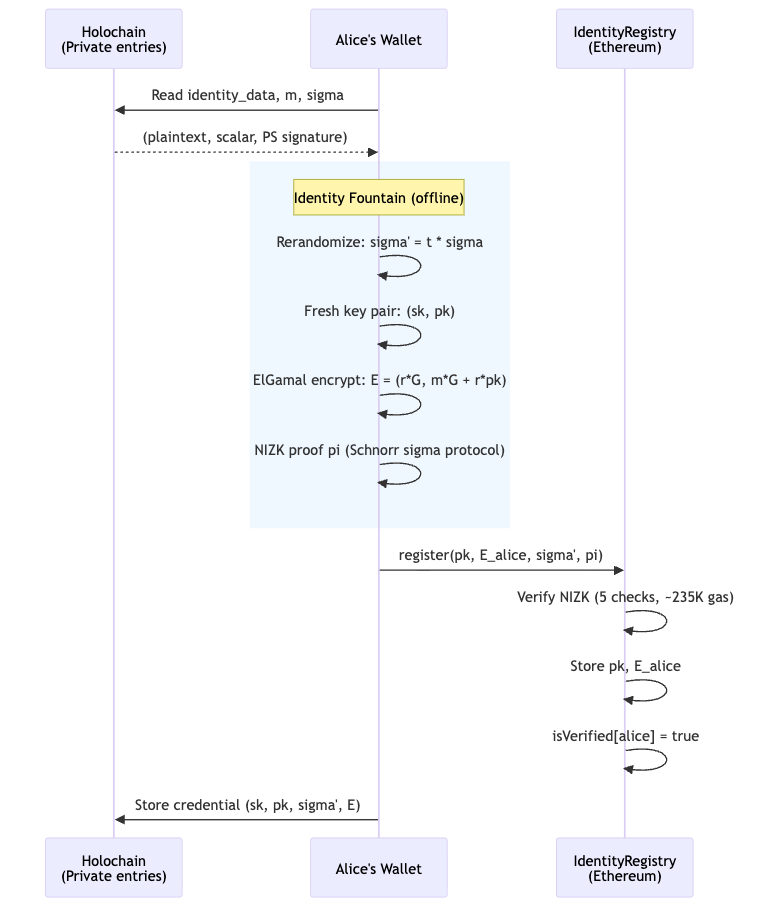
Approve: Re-Encryption with Trust Verification
When Alice wants to transact with Bob, her wallet first verifies Bob's credentials before re-encrypting. This is the critical trust checkpoint: Alice's wallet reads Bob's on-chain data, checks his PS signature (via the pairing equation) and public key, and only then produces the re-encrypted ciphertext.
If anything is wrong – invalid PS signature, mismatched NIZK proof, revoked credential – Alice simply does not call approve. No transaction, no risk. If Alice's wallet detects provable malfeasance (e.g., a forged PS signature from a revoked issuer), it can issue a Holochain Warrant against Bob's agent. Multiple independent wallets detecting the same fraud produce consensus: the warranted agent becomes untrusted on the DHT.
sequenceDiagram
    participant D as Holochain DHT<br/>(Public)
    participant P as Holochain<br/>(Private)
    participant W as Alice's Wallet
    participant IR as IdentityRegistry<br/>(Ethereum)
    participant B as BUCK ERC-20<br/>(Ethereum)

    W->>P: Read sk_alice
    W->>IR: Read E_alice, pk_bob, isPublicIdentity(bob)
    IR-->>W: E_alice=(R,C), pk_bob, isPublicIdentity=true

    rect rgb(255, 248, 240)
    Note over W: Trust checkpoint
    W->>W: Verify Bob's credentials<br/>(PS pairing, NIZK, revocation status)
    alt Bob's credentials invalid
        W->>D: Issue Warrant(bob_agent)
        W-->>W: ABORT (do not approve)
    end
    end

    W->>W: Decrypt: M = C - sk*R
    W->>W: Re-encrypt for Bob:<br/>E_bob = (r'*G, M + r'*pk_bob)
    W->>W: Chaum-Pedersen proof pi_cp

    W->>B: approve(bob, amount, E_bob, pi_cp)

    Note over B,IR: Contract reads E_alice from<br/>IdentityRegistry (NOT calldata)
    B->>IR: Read E_alice
    IR-->>B: E_alice=(R,C)

    B->>B: Verify Chaum-Pedersen<br/>(4 checks)
    B->>B: _receiptFragments[alice][bob] = H(E_bob)
    B->>B: _allowances[alice][bob] = amount
    B-->>W: ApproveReceipt event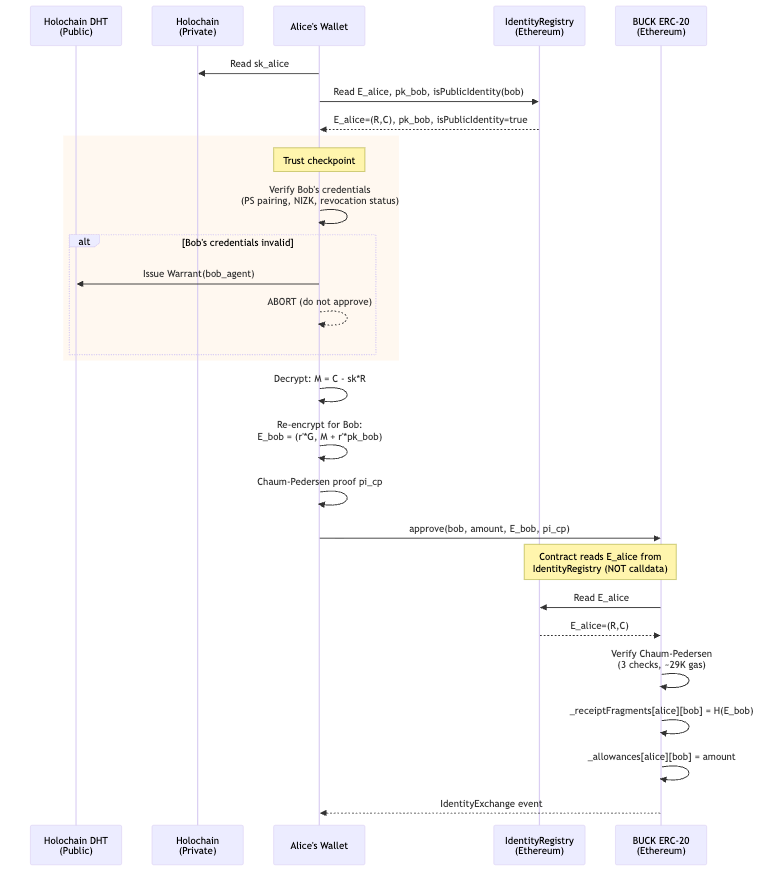
Transfer: Everything On-Chain
By the time transfer or transferFrom is called, all proofs have
already been verified. The EVM code only checks boolean flags and
stored receipt fragments – no cryptography runs during the transfer
itself. Public-Identity contracts (those bound via
bindContract(target, pk, E, isPublicIdentity_=true)) need not have a
per-pair receipt fragment: the receipt falls back to the bound
_identityHash for that side.
sequenceDiagram
    participant C as Caller
    participant B as BUCK ERC-20<br/>(Ethereum)
    participant IR as IdentityRegistry<br/>(Ethereum)

    C->>B: transfer(bob, 500) or<br/>transferFrom(alice, bob, 500)

    rect rgb(240, 255, 240)
    Note over B,IR: Bilateral identity check
    B->>IR: isVerified(alice) && isVerified(bob)?
    IR-->>B: true, true
    B->>B: _receiptFragments[alice][bob]<br/>exists? YES
    Note over B: aliceFrag = stored ciphertext-hash

    B->>B: _receiptFragments[bob][alice]<br/>exists? NO
    B->>IR: isPublicIdentity(bob)?
    IR-->>B: true
    B->>IR: _identityHash(bob)
    IR-->>B: H(pk_bob, E_bob)
    Note over B: bobFrag = _identityHash(bob)
    end

    B->>B: Standard ERC-20 checks<br/>(balance, allowance)
    B->>B: Execute transfer

    B-->>C: Transfer event + BuckTransferReceipt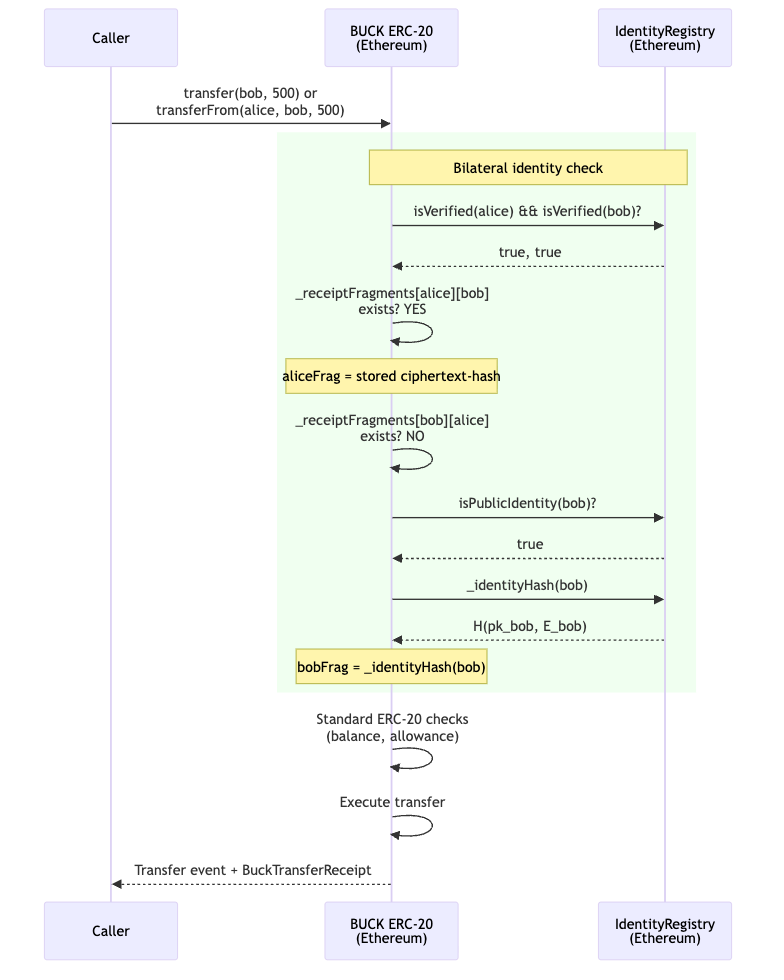
Two-Channel Verification and Malfeasance Detection
After the transfer, Bob verifies Alice's identity using two independent channels. Channel 1 (Ethereum) provides the binding proof; Channel 2 (Holochain) provides the content. Neither channel alone is sufficient – this is what makes the design tamper-evident.
If Bob detects that the off-chain identity_data doesn't match
the on-chain point \( M \), this is provable malfeasance: Bob
holds the ciphertext (on-chain, timestamped) and the mismatched
data (signed by Alice's Holochain agent). Bob issues a Warrant;
other agents independently verify the evidence. Since Holochain
agents sign their source chain entries, Alice cannot deny having
sent the bad data.
sequenceDiagram
    participant D as Holochain DHT<br/>(Public)
    participant BW as Bob's Wallet
    participant ETH as Ethereum

    BW->>ETH: Read E_bob from<br/>ApproveReceipt event
    ETH-->>BW: E_bob = (R', C')
    BW->>BW: Decrypt: M = C' - sk_bob * R'

    Note over BW,D: Channel 2: Holochain data delivery
    D-->>BW: Receive identity_data from Alice<br/>(Remote Signal, encrypted for Bob)

    BW->>BW: Verify: H(identity_data) * G == M?

    alt Match (honest)
        BW->>BW: Identity verified
        BW->>BW: Store receipt (Private entry)
    else Mismatch (malfeasance)
        BW->>D: Issue Warrant(alice_agent)<br/>with evidence: E_bob, identity_data
        Note over D: Other agents verify independently:<br/>decrypt E_bob, check H(data)*G != M
        Note over D: Multiple warrants = consensus<br/>Warranted agent loses DHT trust
    end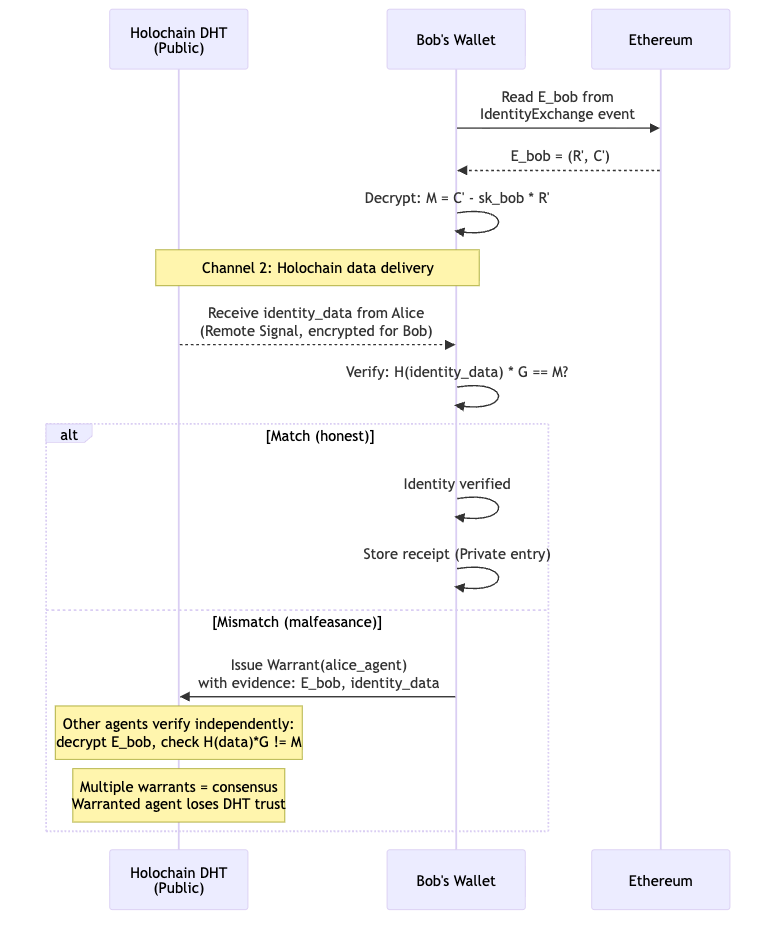
The Four Transfer Modes
The amount of pre-work depends on the visibility of each party:
| Sender | Receiver | Who Calls approve |
Holochain Work | On-Chain Gas |
|---|---|---|---|---|
| Private | Private | Both (Alice→Bob, Bob→Alice) | Both exchange via DHT | 2 x ~29K |
| Private | Public | Alice only | Alice sends via DHT | 1 x ~29K |
| Public | Private | Bob only | Bob sends via DHT | 1 x ~29K |
| Public | Public | Neither | None | 0 (standard ERC-20) |
In every case, the transfer / transferFrom call itself does no
cryptography – it only reads the boolean results of prior approve calls
and the isPublicIdentity flag bound at bindContract time. All proof
verification happens during approve.
The AMM Pool Scenario: Retroactive Identity Recovery
Consider Bob's AMM liquidity pool – a public BUCK account that
processes swaps automatically. Over its lifetime, a million private
accounts call approve(pool, amount, E_pool, proof) and then swap
via transferFrom. Bob's pool contract never examines any
counterparty's identity at the time of the swap. It doesn't need to:
the EVM already verified every proof.
Eighteen months later, a regulator subpoenas Bob for Alice's identity – account #500,000 – in connection with a fraud investigation. How does Bob comply, and how does the on-chain record prove his pool wasn't complicit?
What the Chain Already Guarantees
Every approve that succeeded is an immutable proof receipt. The
EVM verified the Chaum-Pedersen proof at that block height; the
IdentityRegistry verified Alice's NIZK at registration time. These
facts are encoded in the transaction receipts themselves – the
transactions could not have succeeded without valid proofs.
The chain of cryptographic commitments is:
- Issuance: A trusted issuer (trusted by the IdentityRegistry) signed Alice's identity scalar \( m \) with a PS signature \( \sigma \). The issuer's public key was trusted on chain at that block.
- Registration: The IdentityRegistry verified Alice's NIZK proof – binding the presentation \( (A, B) \) of her PS credential to \( E_{\text{alice}} \) (ElGamal ciphertext). The NIZK proves the same \( m \) appears in both. The transaction succeeded at block \( B_{\text{reg}} \); the NIZK was valid at that block.
- Approve: The BUCK contract verified Alice's Chaum-Pedersen proof – proving \( E_{\text{pool}} \) encrypts the same message point \( M \) as her registered \( E_{\text{alice}} \). The contract read \( E_{\text{alice}} \) from the IdentityRegistry (not from calldata), so Alice couldn't substitute a different ciphertext. The transaction succeeded at block \( B_{\text{approve}} \).
- Transfer: The bilateral identity check passed. The pool was bound
under a Public Identity (
isPublicIdentity(pool) = trueviaIdentityRegistry.bindContract), and Alice had a valid_receiptFragments[alice][pool]from herapprove. The pool side fell back to the bound_identityHash(pool). The swap executed at block \( B_{\text{transfer}} \).
None of these steps required Bob to be online, to run a Holochain node, or to examine Alice's identity. The EVM did it for him.
Bob Responds to the Subpoena
sequenceDiagram
    participant R as Regulator
    participant BW as Bob's Wallet
    participant ETH as Ethereum<br/>(archival node)
    participant HC as Holochain DHT

    R->>BW: Subpoena: identify account 0xAlice<br/>(transfer at block B_transfer)

    rect rgb(240, 248, 255)
    Note over BW,ETH: Step 1: Locate the proof chain
    BW->>ETH: Query ApproveReceipt events<br/>where spender=pool, owner=0xAlice
    ETH-->>BW: E_pool = (R', C') at block B_approve
    BW->>ETH: Query registration tx for 0xAlice
    ETH-->>BW: (A, B), E_alice, NIZK pi at block B_reg
    end

    rect rgb(255, 248, 240)
    Note over BW: Step 2: Decrypt
    BW->>BW: M = C' - sk_pool * R'
    end

    rect rgb(240, 255, 240)
    Note over BW,HC: Step 3: Recover plaintext
    alt identity_data in Bob's Private store
        BW->>BW: Read from local Holochain<br/>(if Bob verified at the time)
    else Retrieve from Alice or DHT
        BW->>HC: Request identity_data for agent<br/>(or regulator obtains from issuer)
    end
    BW->>BW: Verify: H(identity_data) * G == M
    end

    rect rgb(248, 240, 255)
    Note over BW,R: Step 4: Deliver evidence package
    BW->>R: Evidence package:<br/>1. identity_data (Alice's verified name)<br/>2. M = decrypted message point<br/>3. Block numbers: B_reg, B_approve, B_transfer<br/>4. On-chain tx hashes (independently verifiable)
    end

    Note over R: Regulator independently verifies:<br/>- Replay registration tx: NIZK valid at B_reg<br/>- Replay approve tx: Chaum-Pedersen valid at B_approve<br/>- Check issuer key was in TrustedIssuersRegistry at B_reg<br/>- Confirm H(identity_data) * G == M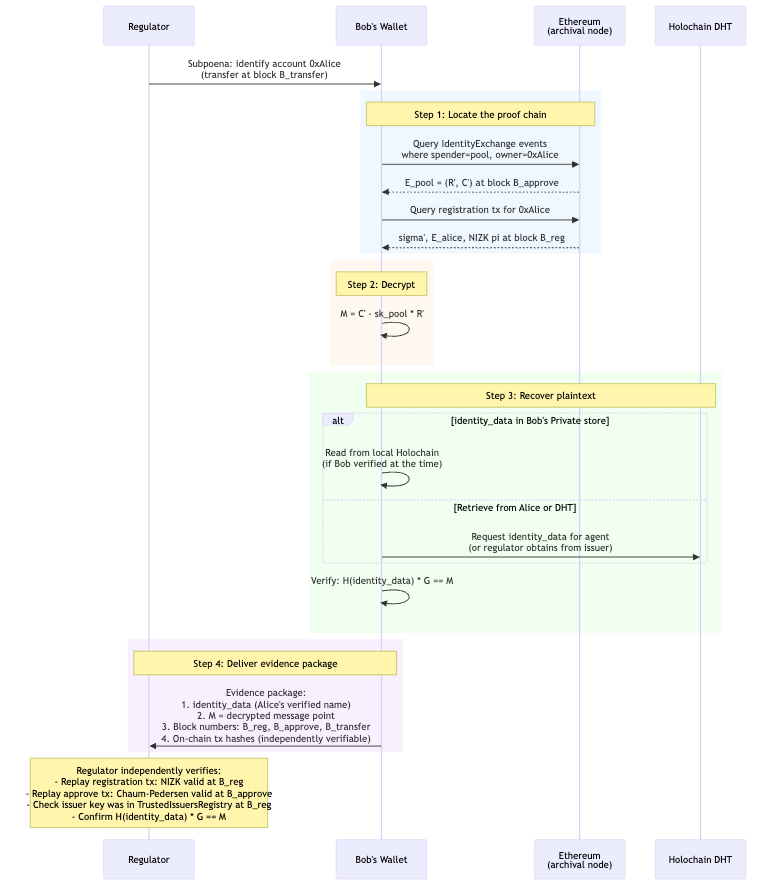
Why Bob Is Protected
Bob's defense is the proof chain itself. He doesn't need to argue that he checked Alice's identity – the contract checked it, and the Ethereum transaction log is the evidence:
- Registration tx succeeded \( \Rightarrow \) NIZK was valid \( \Rightarrow \) an issuer trusted at that block certified \( m \).
- Approve tx succeeded \( \Rightarrow \) Chaum-Pedersen was valid \( \Rightarrow \) \( E_{\text{pool}} \) encrypts the same \( M \) as \( E_{\text{alice}} \).
- Bob decrypts \( E_{\text{pool}} \) to \( M \); \( M = H(\text{identity\_data}) \cdot G \).
The regulator can independently replay these transactions against an archival node. No trust in Bob is required – the math is self-certifying.
Even in adversarial scenarios, Bob is covered:
| Scenario | Why Bob is protected |
|---|---|
| Alice used a stolen identity | The issuer certified it; Bob's contract verified |
| the issuer's PS signature under a key trusted at that block. | |
| Liability falls on the issuer's KYC process. | |
| Alice's issuer key was later revoked | The registration tx is timestamped. The issuer key |
| was trusted by the IdentityRegistry at block \( B_{\text{reg}} \). | |
| Alice's certification was revoked | Revocation clears her accumulator leaf; it does not unmake |
| a past registration or approval. The proof stands. | |
| Alice's Holochain agent is offline | Bob needs only \( E_{\text{pool}} \) (on-chain) and |
sk_pool (his own key). The plaintext can be |
|
| obtained from the issuer if Alice is uncooperative. | |
| Alice denies the transaction | The approve tx is signed by Alice's Ethereum account. |
| Non-repudiation is inherent in the blockchain. |
Data Availability Over Time
The critical question: will Bob still have what he needs 18 months later?
| Data | Availability | Notes |
|---|---|---|
| \( E_{\text{pool}} \) (R',C') | Permanent (Ethereum event log) | ApproveReceipt event |
| \( E_{\text{alice}} \) | Permanent (IdentityRegistry storage) | Until account is closed |
| \( (A, B) \), NIZK \( \pi \) | Permanent (registration tx calldata) | Archival node required |
| Chaum-Pedersen proof | Permanent (approve tx calldata) | Archival node required |
sk_pool (Bob's secret key) |
Bob's custody | Standard key management |
identity_data (plaintext) |
Holochain DHT (if agent is online) | May require issuer |
| or Bob's Private store (if he cached) | cooperation as fallback | |
| Issuer public key history | IdentityRegistry trusted-issuer table | Includes revocation timestamps |
Everything except the plaintext identity_data is permanently on-chain.
The plaintext is the one piece that lives off-chain – but Bob only needs
it to produce a human-readable name for the regulator. The
cryptographic proof chain stands without it: \( M \) is recoverable from
\( E_{\text{pool}} \) alone, and \( M \) is what the issuer certified.
If Alice's Holochain agent is long gone, the regulator can obtain
identity_data from the issuer (who has it from the original KYC
ceremony) and verify \( H(\text{identity\_data}) \cdot G = M \)
independently. The issuer doesn't need Bob's cooperation; the
regulator doesn't need Alice's.
Why \( M \) Is the Same Across All Accounts – And Why That's Correct
A natural concern: if Alice derives ten accounts from the Identity Fountain, and each counterparty who decrypts their re-encrypted ciphertext recovers the same \( M = m \cdot G \), doesn't that break unlinkability?
No. The Identity Fountain's guarantee is about on-chain unlinkability – what a passive observer (Eve) can learn from the public blockchain data alone, without any secret keys. That guarantee is airtight:
- the presentations \( (A_1, B_1) \) and \( (A_2, B_2) \) are uniform whatever the identity (information-theoretic, not merely computational)
- \( E_1 \) and \( E_2 \) are IND-CPA secure under independent keys
- \( pk_1 \) and \( pk_2 \) are independent random points
No algorithm, no amount of computation, can correlate Alice's accounts from on-chain data.
The identity scalar \( m = H(\text{identity\_data}) \) – keccak256
over the tag AlbertaBuck/Identity/Scalar/v2 and the canonical record –
is intentionally invariant because it is Alice's identity. If each
account used a different \( m \), the two-channel verification would
break: Bob couldn't verify that the identity_data he received
matches what the issuer certified. The Identity Fountain protects
the credential wrapping (\( (A, B) \), \( pk \), \( E \)), not the
identity itself.
Think of it as giving Alice a new disguise for each account –
different keys, different signature, different ciphertext. The
disguises fool passive surveillance (Eve). They don't fool someone
Alice voluntarily shows her face to (Bob, during approve).
| Observer | Can link accounts? | Why? |
|---|---|---|
| Eve (passive, on-chain) | NO | All public artifacts are independent random values |
| Bob (authorized) | Learns one account | By design – the point of approve |
| Bob + Carol (colluding) | Yes, via \( M \) | But both already know Alice's name |
| Issuer (on-chain only) | NO | Can't extract \( M \) without a secret key |
| Issuer (given \( M \)) | YES | By design – regulatory compliance path |
The privacy boundary is clear: before approve, Alice's accounts
are unlinkable to everyone. After approve, the specific
counterparty learns Alice's identity for that account – and only
that counterparty (plus anyone with whom they share \( M \), but they
already shared Alice's name via the identity_data exchange).
Alice Tries to Hide by Not Publishing identity_data
Alice might try to game the system: complete the on-chain approve
(re-encryption + Chaum-Pedersen proof), satisfying the ERC-20's
bilateral identity check, but never publish her identity_data to
the Holochain DHT. She hopes that if a subpoena arrives, Bob won't
be able to produce a human-readable name.
This doesn't work. Bob still holds the cryptographic thread:
- Bob decrypts \( E_{\text{pool}} \) to recover \( M = m \cdot G \). This requires only Bob's secret key and the on-chain ciphertext – Alice's cooperation is unnecessary.
- The regulator takes \( M \) to the issuer. The issuer computes
\( m_i \cdot G \) for each identity they have issued and finds the
match. The issuer has Alice's
identity_datafrom the original KYC ceremony. - The issuer confirms: this \( M \) belongs to Alice Johnson.
Alice's attempt to hide by not publishing is futile: the on-chain \( E_{\text{pool}} \) and the issuer's records are sufficient. Alice cannot retroactively alter either.
Bob's Wallet Detects Non-Publication
Bob's wallet (Holochain hApp) can proactively monitor for
counterparties who complete the on-chain approve but fail to
publish the required DHT entries. The expected protocol is:
- Alice calls
approve(pool, amount, E_pool, proof)on Ethereum. - Alice's wallet publishes a DHT entry containing her
identity_data, encrypted for Bob's Holochain agent, and keyed by theApproveReceiptevent hash. - Bob's wallet watches for the
ApproveReceiptevent and looks up the corresponding DHT entry within a grace period.
If step 2 never happens – the on-chain approve succeeded but no
DHT entry appears – Bob's wallet can:
- Flag the account as non-compliant (Alice approved on-chain but didn't complete the Holochain identity exchange).
- Issue a Holochain Warrant against Alice's agent, citing the on-chain tx hash as evidence of protocol violation.
- Report the account to pool operators or compliance systems.
- Optionally, Bob's contract could revoke the approval (reset
_receiptFragments[alice][pool]), blocking future swaps until Alice completes the full protocol.
The warrant is independently verifiable: any Holochain agent can
check that the ApproveReceipt event exists on Ethereum but the
corresponding DHT entry does not. Multiple independent warrants
produce DHT-level consensus that Alice's agent is non-compliant.
Even if Alice never publishes, Bob's regulatory position is
unchanged. He can still decrypt \( M \) from the on-chain
ciphertext and hand it to the regulator, who obtains identity_data
from the issuer. Alice's non-publication delays the human-readable
identification by one step (issuer lookup) but cannot prevent it.
Setup: The alt_bn128 Curve and Helpers
All operations use BN254, the curve behind Ethereum's ecAdd
(0x06), ecMul (0x07), and ecPairing (0x08) precompiles. The
alberta_buck.wallet.bn254 primitives provide exactly these
operations, executing on the compiled buck-identity kernel
(buck_core.buck_identity, arkworks BN254) – the first block asserts
it, so this worked example demonstrates the production cryptography.
The pure-Python py_ecc path remains the executable specification the
kernel is proven bit-identical against
(core/vectors/identity-kernel-vectors.json). Helper functions for
seeded random scalar generation (one deterministic transcript, so the
printed RESULTS reproduce byte for byte), keccak256 hashing, and
point formatting are defined here; all subsequent code blocks share a
single :session abid so that variables persist across steps.
  import random
  from web3 import Web3
  from alberta_buck.wallet import backend
  from alberta_buck.wallet.bn254 import (
      G1,       # Generator of G_1
      G2,       # Generator of G_2
      Z1,       # Point at infinity (G_1 identity)
      ORDER,    # Curve group order (prime)
      mul,      # Scalar multiplication in G_1 or G_2
      add,      # Point addition
      neg,      # Point negation
      eq,       # Point equality
      pairing,  # Optimal Ate pairing: G_2 x G_1 -> G_T
      is_inf,   # Point-at-infinity test
      FQ12_one, # G_T identity (pairing-product checks)
  )

  assert backend() == "kernel", "must run the production kernel: evaluate in the repo venv"

  _seed = random.Random(0xAB1DE7A1)   # ONE deterministic transcript

  def rand():
      """Random non-zero scalar mod ORDER (seeded; the transcript reproduces)."""
      while True:
          v = _seed.getrandbits(256) % ORDER
          if v:
              return v

  def keccak(*args):
      """keccak256 over concatenated big-endian 32-byte words, reduced mod ORDER."""
      data = b''.join(v.to_bytes(32, 'big') if isinstance(v, int)
                      else str(v).encode() for v in args)
      h = Web3.solidity_keccak(['bytes'], [data])
      return int.from_bytes(h, 'big') % ORDER

  # The identity scalar's domain tag: the same record hashed by anything else
  # yields something else, so a person's scalar is in no other protocol's range.
  ID_TAG = "AlbertaBuck/Identity/Scalar/v2"

  def pt(P, label=""):
      """Format a G_1 point for display."""
      if is_inf(P):
          return f"{label}O (infinity)"
      return f"{label}({int(P[0]) % 10**6:>6d}..., {int(P[1]) % 10**6:>6d}...)"

  print(f"wallet crypto backend: {backend()} (buck_core.buck_identity)")
  print(f"BN254 curve order: {ORDER}")
  print(f"G_1 generator:     {pt(G1)}")
  print(f"G_2 generator:     (pair of FQ2 elements)")
wallet crypto backend: kernel (buck_core.buck_identity) BN254 curve order: 21888242871839275222246405745257275088548364400416034343698204186575808495617 G_1 generator: ( 1..., 2...) G_2 generator: (pair of FQ2 elements)
Issuer Key Generation
The identity issuer (e.g., ATB Financial acting as Alberta's KYC
authority) generates a Pointcheval-Sanders key pair: secret key
\( (x, y) \) (two scalars), public key \( (X, Y, Y_1) \) (two points in
\( G_2 \) plus the \( G_1 \) image \( Y_1 = y \cdot G \) that holders
blind with, stored on-chain by IdentityRegistry.trustIssuer, which
checks \( e(Y_1, g_2) = e(G, Y) \) once). This
key pair is the root of trust for all identities the issuer certifies;
every credential in the system traces back to a PS signature under
this key.
  # Issuer's PS secret key
  isk_x = rand()
  isk_y = rand()

  # Issuer's PS public key: (X, Y) in G_2 plus Y1 = y*G in G_1, the base
  # holders blind with.  IdentityRegistry.trustIssuer stores all three and
  # checks e(Y1, g_2) == e(G, Y) once.
  IPK_X  = mul(G2, isk_x)
  IPK_Y  = mul(G2, isk_y)
  IPK_Y1 = mul(G1, isk_y)
  assert pairing(G2, IPK_Y1) == pairing(IPK_Y, G1)

  print("Issuer PS key pair generated.")
  print(f"  sk = (x, y)             -- two secret scalars")
  print(f"  PK = (X, Y, Y1)         -- X, Y in G_2; Y1 = y*G in G_1 (trustIssuer checks it against Y)")
Issuer PS key pair generated. sk = (x, y) -- two secret scalars PK = (X, Y, Y1) -- X, Y in G_2; Y1 = y*G in G_1 (trustIssuer checks it against Y)
Same Operation via the Wallet API
The reference implementation in alberta_buck.wallet.issuer packages
the same key generation behind a typed Issuer class. Wrapping the
scalars produced above into an Issuer lets every later step in this
document call the wallet API while keeping the keys identical to the
raw-crypto example.
  from alberta_buck.wallet import Issuer, PSKeyPair

  ATB_ADDR = 0xa7b00000000000000000000000000000000a7b00
  issuer_obj = Issuer(
      issuer_id="atb-financial-ca",
      issuer_addr=ATB_ADDR,
      keypair=PSKeyPair(sk_x=isk_x, sk_y=isk_y, pk_X=IPK_X, pk_Y=IPK_Y, pk_Y1=IPK_Y1),
  )
  from alberta_buck.wallet import ps_key_consistent
  assert ps_key_consistent(issuer_obj.pk_X, issuer_obj.pk_Y, issuer_obj.pk_Y1)
  print(f"Wallet API: {issuer_obj.issuer_id!r} @ 0x{issuer_obj.issuer_addr:040x}")
  print(f"  pk_X, pk_Y, pk_Y1 match the raw points above; ps_key_consistent: True")
Wallet API: 'atb-financial-ca' @ 0xa7b00000000000000000000000000000000a7b00 pk_X, pk_Y, pk_Y1 match the raw points above; ps_key_consistent: True
KYC Ceremony – Issuer Signs Alice's Identity
Alice presents her identity documents to the issuer, who verifies
them, constructs a canonical identity_data JSON structure (sorted
keys, compact separators, raw UTF-8 – the one canonical JSON dialect,
shared with the receipt envelope), and computes the identity scalar
\( m = \text{keccak256}(\text{identity\_data}) \mod \text{ORDER} \).
The issuer then produces a PS signature
\( \sigma = (h, (x + m \cdot y) \cdot h) \) binding \( m \) to the
issuer's secret key. The bilinear pairing equation verifies the
signature, and a counter-example confirms that any change to
identity_data (producing a different \( m \)) causes verification
to fail.
Alice's Plaintext Identity
  import json

  # Alice's verified identity (canonical encoding -- field order matters)
  alice_identity_data = json.dumps({
      "given_name":    "Alice",
      "family_name":   "Johnson",
      "jurisdiction":  "Alberta, Canada",
      "id_type":       "Alberta Identity Card",
      "id_number":     "AIC-2026-4839201",
      "date_of_birth": "1992-03-15",
      "issuer_id":     "atb-financial-ca",
      "issued_at":     "2026-01-20T14:30:00Z",
      "epoch":         42
  }, sort_keys=True, separators=(',', ':'))

  print("Alice's identity_data (canonical JSON):")
  print(f"  {alice_identity_data[:72]}...")
Alice's identity_data (canonical JSON):
  {"date_of_birth":"1992-03-15","epoch":42,"family_name":"Johnson","given_...
Compute Identity Scalar and PS Signature
The PS signature is \( \sigma = (h, (x + m \cdot y) \cdot h) \) where \( h \) is a random point in \( G_1 \).
  # Identity scalar: m = keccak256(ID_TAG || identity_data) mod ORDER
  m_alice = keccak(ID_TAG, alice_identity_data)

  # PS signature: pick random h, compute sigma = (h, (x + m*y) * h)
  t_h     = rand()
  h       = mul(G1, t_h)                     # random G_1 point
  sigma_2 = mul(h, (isk_x + m_alice * isk_y) % ORDER)
  sigma   = (h, sigma_2)

  print(f"Identity scalar m = H(identity_data):")
  print(f"  m = {m_alice}")
  print(f"PS signature sigma:")
  print(f"  sigma_1 = {pt(sigma[0])}")
  print(f"  sigma_2 = {pt(sigma[1])}")
Identity scalar m = H(identity_data): m = 2771514422476810872940980386877798997261510519897538008727794581922898236027 PS signature sigma: sigma_1 = (194876..., 629808...) sigma_2 = (909680..., 447485...)
Verify the PS Signature (Issuer Self-Check)
The PS verification equation uses a bilinear pairing:
\[ e(\sigma_1, X + m \cdot Y) = e(\sigma_2, g_2) \]
What this proves: The issuer's signature is mathematically valid – it binds the identity scalar \( m \) to the issuer's secret key. If the signature passes, Alice can be sure the issuer actually certified her identity (no one else knows \( (x, y) \)).
  # Verify: e(sigma_1, X + m*Y) == e(sigma_2, g_2)
  lhs = pairing(add(IPK_X, mul(IPK_Y, m_alice)), sigma[0])
  rhs = pairing(G2, sigma[1])
  assert lhs == rhs, "PS signature verification FAILED"
  print("PS signature verified: e(sigma_1, X + m*Y) == e(sigma_2, g_2)")

  # The issuer gives Alice: (m, sigma, identity_data)
  # Alice stores all three in her Holochain Private entry
  print(f"\nIssuer gives Alice:")
  print(f"  m              = {m_alice}")
  print(f"  sigma          = (sigma_1, sigma_2)  -- PS signature")
  print(f"  identity_data  = '{alice_identity_data[:40]}...'")
PS signature verified: e(sigma_1, X + m*Y) == e(sigma_2, g_2)

Issuer gives Alice:
  m              = 2771514422476810872940980386877798997261510519897538008727794581922898236027
  sigma          = (sigma_1, sigma_2)  -- PS signature
  identity_data  = '{"date_of_birth":"1992-03-15","epoch":42...'
How to read the output: "PS signature verified" means both sides of the pairing equation produce the same element in \( G_T \). If \( m \) were wrong (e.g., tampered identity data), the two pairings would produce different \( G_T \) elements and the assertion would fail. A counter-example follows.
Counter-example: Wrong Identity Scalar
If Eve tries to forge a signature using a different \( m \), the pairing equation fails. This is what a rejected verification looks like:
  # Tampered m -- what if someone changes one field in identity_data?
  m_fake = keccak(ID_TAG, "tampered_identity_data")
  lhs_bad = pairing(add(IPK_X, mul(IPK_Y, m_fake)), sigma[0])
  rhs_good = pairing(G2, sigma[1])
  ok = (lhs_bad == rhs_good)
  print(f"PS verify with wrong m: {ok}")
  print(f"  (The two G_T elements differ -- the pairing detects the mismatch.)")
  print(f"  Any change to identity_data produces a different m, which")
  print(f"  makes the pairing equation fail.  The signature is unforgeable.")
PS verify with wrong m: False (The two G_T elements differ -- the pairing detects the mismatch.) Any change to identity_data produces a different m, which makes the pairing equation fail. The signature is unforgeable.
Same Operation via the Wallet API
Issuer.issue(...) bundles the canonicalization, m computation, and
PS signing into one call. ps_verify(...) performs the same pairing
equation as the raw block above; the counter-example uses the same
primitive against a tampered m.
  from alberta_buck.wallet import ps_verify, identity_scalar
  ALICE_ADDR = 0xa11ce00000000000000000000000000000a11ce

  alice_fields = {
      "given_name":    "Alice",
      "family_name":   "Johnson",
      "jurisdiction":  "Alberta, Canada",
      "id_type":       "Alberta Identity Card",
      "id_number":     "AIC-2026-4839201",
      "date_of_birth": "1992-03-15",
      "issuer_id":     "atb-financial-ca",
      "issued_at":     "2026-01-20T14:30:00Z",
      "epoch":         42,
  }
  cred = issuer_obj.issue(alice_fields, ALICE_ADDR, rng=rand)   # seeded: the transcript reproduces
  # Wallet computes m the same way: m = keccak256(ID_TAG || canonical) mod ORDER
  assert cred.m == identity_scalar(cred.canonical) == m_alice
  # PS verification, same pairing equation as the raw block:
  ok      = ps_verify(issuer_obj.pk_X, issuer_obj.pk_Y, cred.sigma, cred.m)
  ok_bad  = ps_verify(issuer_obj.pk_X, issuer_obj.pk_Y, cred.sigma, m_fake)
  print(f"Wallet API: cred.m == m_alice : {cred.m == m_alice}")
  print(f"  ps_verify(sigma, m_alice)   : {ok}")
  print(f"  ps_verify(sigma, m_fake)    : {ok_bad}")
Wallet API: cred.m == m_alice : True ps_verify(sigma, m_alice) : True ps_verify(sigma, m_fake) : False
The Identity Fountain – Alice Derives a Fresh Account
Alice wants to create a new Ethereum account. Her Holochain wallet runs the Identity Fountain entirely offline, producing four artifacts: a presentation \( (A, B) \) of her PS credential that hides which credential – and which identity – it presents, a fresh key pair \( (sk, pk) \), an ElGamal encryption of \( m \) under \( pk \), and a NIZK proof binding the presentation to the ciphertext and to the key. Each step is demonstrated below. The first block shows why the wallet publishes a presentation and not a rerandomized signature: a rerandomized signature is still a signature on \( m \), so anyone holding \( m \) – the issuer, or any past counterparty – can test it; the presentation fails that test.
Present the Credential: \( (A, B) \) Hides \( m \)
Rerandomization, \( \sigma' = (t \sigma_1, t \sigma_2) \), yields a fresh valid signature on the same \( m \). It is the wallet's internal re-issuance step and nothing more: the pairing test \( e(\sigma'_1, X + m Y) = e(\sigma'_2, g_2) \) identifies it to anyone who knows \( m \). What the wallet publishes is the presentation
\[ A = a \cdot \sigma_1, \qquad B = a \cdot \sigma_2 + b \cdot Y_1 = (x + m y) \cdot A + b \cdot Y_1, \]
for fresh nonzero \( a, b \), where \( Y_1 = y \cdot G \) is the issuer's published \( G_1 \) key component. \( (A, B) \) satisfies the masked equation \( e(B, g_2) = e(A, X) \cdot e(mA + bG, Y) \) and no other: without \( b \) it is a uniform pair of points, the same distribution for every credential on every identity.
What this proves: the raw test succeeds on the rerandomized pair and fails on the presentation, for the true \( m \); the masked equation, which needs \( b \), holds for the presentation.
  from alberta_buck.wallet import ps_present

  # The raw test any holder of m can run on a published pair
  def raw_test(S1, S2, m):
      return pairing(add(IPK_X, mul(IPK_Y, m)), S1) == pairing(G2, S2)

  # Rerandomize (wallet-internal): still a signature on m_alice
  t_rerand = rand()
  sigma_p  = (mul(sigma[0], t_rerand), mul(sigma[1], t_rerand))
  print(f"Rerandomized pair: raw PS test with m_alice -> {raw_test(sigma_p[0], sigma_p[1], m_alice)}")
  print( "  (a candidate test for anyone holding m: never published)")

  # Present (published): (A, B) = (a*sigma_1, a*sigma_2 + b*Y1), fresh a, b
  pres_alice, a_alice, b_alice = ps_present(cred.sigma, issuer_obj.pk_Y1, rng=rand)
  A_alice, B_alice = pres_alice.A, pres_alice.B
  print(f"Presentation A = {pt(A_alice)}  B = {pt(B_alice)}")
  print(f"Presentation:      raw PS test with m_alice -> {raw_test(A_alice, B_alice, m_alice)}")

  # The masked equation holds -- but only with the blinding b
  P_alice = add(mul(A_alice, m_alice), mul(G1, b_alice))
  masked  = pairing(G2, B_alice) == pairing(IPK_X, A_alice) * pairing(IPK_Y, P_alice)
  print(f"Presentation:      masked equation with (m_alice, b) -> {masked}")
Rerandomized pair: raw PS test with m_alice -> True (a candidate test for anyone holding m: never published) Presentation A = (554544..., 429626...) B = (556214..., 843967...) Presentation: raw PS test with m_alice -> False Presentation: masked equation with (m_alice, b) -> True
How to read the output: Three lines to check. The rerandomized pair passes the raw test with Alice's \( m \): whoever holds \( m \) can identify it, which is why it stays in the wallet. The presentation fails the same test. The masked equation passes, but it needs \( b \), which only Alice's wallet holds for the instant of registration; the registration NIZK proves it without revealing it.
Generate Fresh Identity Key Pair and ElGamal Encryption
Alice generates a new key pair on alt_bn128 and encrypts her identity scalar \( m \) under her own public key using ElGamal:
\[ E_{\text{alice}} = (r \cdot G, \; m \cdot G + r \cdot pk_{\text{alice}}) \]
What this proves: Alice can encrypt her identity under her own public key and recover it. ElGamal decryption yields the point \( M = m \cdot G \), not the scalar \( m \) (solving the discrete log is infeasible).
  # Fresh identity key pair for this account
  sk_alice = rand()
  pk_alice = mul(G1, sk_alice)

  # ElGamal encryption of m under pk_alice
  r_enc   = rand()
  R_alice = mul(G1, r_enc)                           # R = r * G
  M_alice = mul(G1, m_alice)                          # M = m * G  (message point)
  C_alice = add(M_alice, mul(pk_alice, r_enc))        # C = m*G + r*pk
  E_alice = (R_alice, C_alice)

  print(f"Fresh key pair for this Ethereum account:")
  print(f"  sk_alice = {sk_alice}")
  print(f"  pk_alice = {pt(pk_alice)}")
  print(f"\nElGamal ciphertext E_alice = (R, C):")
  print(f"  R = r*G    = {pt(R_alice)}")
  print(f"  C = m*G+r*pk = {pt(C_alice)}")
  print(f"\nMessage point M = m*G:")
  print(f"  M = {pt(M_alice)}")

  # Verify Alice can decrypt her own ciphertext
  M_check = add(C_alice, neg(mul(R_alice, sk_alice)))  # C - sk*R = M
  assert eq(M_check, M_alice), "ElGamal self-decryption FAILED"
  print(f"\nAlice decrypts: C - sk*R = {pt(M_check)}  (matches M)")
Fresh key pair for this Ethereum account: sk_alice = 15971810906457614992647467534080057746179739969695951946612261292369424414341 pk_alice = (528456..., 822195...) ElGamal ciphertext E_alice = (R, C): R = r*G = (888939..., 711304...) C = m*G+r*pk = (334292..., 55846...) Message point M = m*G: M = (502436..., 889923...) Alice decrypts: C - sk*R = (502436..., 889923...) (matches M)
How to read the output: The last two lines show the decrypted point \( C - sk \cdot R \) and the original \( M \). Their coordinate fragments must match – this confirms the ciphertext is well-formed. If Alice used the wrong secret key, the decrypted point would be a random, unrelated point (shown in the counter-example below).
Counter-example: Wrong Secret Key
An attacker who doesn't know sk_alice cannot decrypt to the
correct \( M \). The result is an unrelated random point:
  sk_eve = rand()  # Eve's key, not Alice's
  M_wrong = add(C_alice, neg(mul(R_alice, sk_eve)))
  print(f"Eve decrypts with wrong key:")
  print(f"  M_wrong = {pt(M_wrong)}")
  print(f"  M_real  = {pt(M_alice)}")
  print(f"  Match: {eq(M_wrong, M_alice)}")
  print(f"  (Completely different point -- no information about m is leaked.)")
Eve decrypts with wrong key: M_wrong = (990549..., 173718...) M_real = (502436..., 889923...) Match: False (Completely different point -- no information about m is leaked.)
NIZK Proof: Binding the Presentation to the ElGamal Ciphertext
Alice must prove, without revealing \( m \), \( b \), \( r \) or \( sk \), that:
- (a') \( (A, B) \) presents a valid PS credential on \( m \): \( e(B, g_2) = e(A, X) \cdot e(mA + bG, Y) \)
- (b) \( E_{\text{alice}} \) encrypts the same \( m \)
- (k) she holds \( sk \) for \( pk \)
This is a Schnorr-family sigma protocol with four nonces
\( (\tilde m, \tilde b, \tilde r, \tilde{sk}) \) and four commitments:
\( C_1 = \tilde m A + \tilde b G \) (one commitment for both credential
exponents, so no proof field ever carries \( \tilde m A \) alone),
\( T_C = \tilde m G + \tilde r\,pk \), \( T_R = \tilde r G \) and
\( T_{key} = \tilde{sk}\,G \); the shared \( \tilde m \) is what joins
the credential to the ciphertext. The Fiat-Shamir challenge binds the
registrant address, the chain id, the registry address and the domain
AlbertaBuck/FiatShamir/IdentityRegistry/Register/v2, so a proof
cannot be replayed to another account, chain, registry or protocol
version. The wallet's registration_prove is the executable
specification – the Solidity, Rust and JavaScript verifiers are
checked against its vectors – and it is the single registration path
in this document.
  from alberta_buck.wallet import ElGamalCiphertext, registration_prove

  E_alice_w = ElGamalCiphertext(R=R_alice, C=C_alice)
  proof_w = registration_prove(
      pres_alice, b_alice, cred.m, r_enc, pk_alice, E_alice_w,
      ALICE_ADDR, sk_alice, rng=rand,
  )
  print("Registration proof pi = (e, s_m, s_b, s_r, s_sk, C1, T_C, T_R, T_key)")
  print(f"  e   = {proof_w.e}")
  print(f"  s_m = {proof_w.s_m}")
  print(f"  s_b = {proof_w.s_b}")
  print(f"  C1  = {pt(proof_w.C1)}   (m~*A + b~*G -- never m~*A on its own)")
Registration proof pi = (e, s_m, s_b, s_r, s_sk, C1, T_C, T_R, T_key) e = 10200229377849831398463058862895386310125326660709570565200621111745915639032 s_m = 9401951493053487559381785718431180115908812524446778252875344179764755185883 s_b = 8283906936137015224805851135143136584723697294825212450496097817152055903462 C1 = (752165..., 546410...) (m~*A + b~*G -- never m~*A on its own)
Registration – On-Chain Verification
Alice submits \( (\text{issuer}, pk, E_{\text{alice}}, (A, B), \pi) \)
to the IdentityRegistry contract. The contract runs six checks using
the ecPairing, ecMul and ecAdd precompiles (443,892 gas measured
on the A' branch with an in-process EVM, against 472,630 for the
pre-A' verifier): a guard on the points and scalars, a Fiat-Shamir
reconstruction, two ElGamal consistency checks, the account-key check,
and one three-pair pairing product. All six must pass for
isVerified[alice] to be set. The full verification runs below,
followed by two counter-examples: a ciphertext containing a different
\( m \) than the presented credential, and a replay of the proof to
another address.
What the Chain Sees, and What It Can Learn
Calldata is permanent and visible to every node, so the security of
the identity layer rests on one principle: nothing submitted to the
EVM is identity data, or a value that anyone – the issuer included
– can test against identity data. The plaintext identity_data,
the scalar \( m \), the point \( M = mG \), the raw credential
\( \sigma \), the account secret \( sk \) and the blinding \( b \)
never leave the wallet. Each of the five arguments of register is
a public key, a ciphertext, a blinded pair or a masked scalar, and
the contract only checks relations among them with pairings and
scalar multiplications; it holds no key and decrypts nothing.
| Argument | What it is | What the EVM (and every archive node) can learn from it |
|---|---|---|
issuer |
The issuer's Ethereum address | Which trust anchor certified the holder. Public by design; it |
| narrows the anonymity set to that issuer's clients, nothing more. | ||
pk |
A fresh account key \( sk \cdot G \) | Nothing about the identity: it is independent of \( m \). |
E_alice \( = (rG, mG + r\,pk) \) |
ElGamal ciphertext of the identity | The plaintext needs \( sk \), never sent. Testing whether it encrypts |
| point under the account's own key | a candidate \( M_i \) is the DDH plaintext-checking problem. | |
(A, B) \( = (a\sigma_1,\ a\sigma_2 + bY_1) \) |
The blinded presentation of the | A uniform pair of points, the same distribution for every identity. |
| credential | Not a signature anyone can verify; \( \sigma \) itself is never published. | |
pi \( = (e, s_m, s_b, s_r, s_{sk}, \) |
The zero-knowledge proof | Each response is a secret one-time nonce plus a multiple of the |
| \( C_1, T_C, T_R, T_{key}) \) | witness (\( s_m = \tilde m + e m \)), so it is uniform whatever \( m \) is; the | |
| commitments are simulatable from public values; the only | ||
| credential-side point derivable is \( P = mA + bG \), which every | ||
| candidate identity explains equally well. |
Two distinctions matter. The pre-A' design also kept identity_data
off chain, but it published a rerandomized signature and a commitment
\( \tilde m \sigma'_1 \) that were testable against a known \( m \);
for anyone holding a candidate list, above all the issuer, a testable
function of the identity is as revealing as the identity itself
(review findings R1 and R2). The presentation and the single
commitment \( C_1 \) remove that test; the appendix runs it both ways.
And the guarantees differ in kind: the presentation and the proof hide
\( m \) information-theoretically, while the ciphertext hides \( M \)
only computationally, under DDH – the harvest-now-decrypt-later
caveat the papers carry. The hiding of \( s_m \) also depends on the
nonce \( \tilde m \) being fresh for every proof, which the wallet's
sampler is responsible for; two proofs sharing a nonce would open
\( m \) by one subtraction.
Verify the NIZK Proof (What the Contract Computes)
What this proves: the same \( m \) is presented in \( (A, B) \) and encrypted in \( E_{\text{alice}} \), and the registrant holds \( sk \) – without revealing \( m \), \( b \), \( r \) or \( sk \). Six checks run:
- (g) Guards: \( A \neq O \), \( B \neq O \), \( pk \neq O \), \( R \neq O \); all points on the curve; scalars canonical. \( A \neq O \) is security critical: at \( A = O \) the pairing product below holds for every \( m \).
- (fs) Fiat-Shamir: the challenge was honestly derived over \( (A, B, R, C, pk, C_1, T_C, T_R, T_{key}) \), the registrant, the chain id, the registry and the domain
- (b) ElGamal C consistency: the committed \( m \) is inside \( C \)
- (c) ElGamal R consistency: the committed \( r \) is inside \( R \)
- (k) Account key: the committed \( sk \) is the logarithm of \( pk \)
- (a') Pairing product: \( e(s_m A + s_b G - C_1, Y) \cdot e(eA, X) \cdot e(-eB, g_2) = 1 \)
  from alberta_buck.wallet.bn254 import point_to_words
  from alberta_buck.wallet.nizk import REGISTER_DOMAIN
  from alberta_buck.wallet.transcript import keccak_scalar

  # === VERIFIER (IdentityRegistry contract, on-chain) ===
  e_v, s_m_v, s_b_v, s_r_v, s_sk_v = (proof_w.e, proof_w.s_m, proof_w.s_b,
                                      proof_w.s_r, proof_w.s_sk)
  C1_v, T_C_v, T_R_v, T_key_v = proof_w.C1, proof_w.T_C, proof_w.T_R, proof_w.T_key
  CHAINID, REGISTRY = 1, 0     # the wallet's defaults; the contract uses its own

  # --- (g) guards ---
  assert not any(is_inf(P) for P in (A_alice, B_alice, pk_alice, R_alice))
  assert all(0 <= s_ < ORDER for s_ in (e_v, s_m_v, s_b_v, s_r_v, s_sk_v))
  print("(g)  guards passed: A, B, pk, R != O; scalars canonical")

  # --- (fs) Fiat-Shamir over the same words the contract hashes ---
  words = []
  for P in (A_alice, B_alice, R_alice, C_alice, pk_alice, C1_v, T_C_v, T_R_v, T_key_v):
      words += list(point_to_words(P))
  e_recomputed = keccak_scalar(*words, ALICE_ADDR, CHAINID, REGISTRY, REGISTER_DOMAIN)
  assert e_recomputed == e_v, "Fiat-Shamir challenge mismatch"
  print("(fs) Fiat-Shamir challenge verified (A, B, E, pk, commitments, registrant, chain, registry, domain)")

  # --- (b) ElGamal C consistency: s_m*G + s_r*pk == e*C + T_C ---
  assert eq(add(mul(G1, s_m_v), mul(pk_alice, s_r_v)), add(mul(C_alice, e_v), T_C_v))
  print("(b)  ElGamal C check passed: s_m*G + s_r*pk == e*C + T_C")

  # --- (c) ElGamal R consistency: s_r*G == e*R + T_R ---
  assert eq(mul(G1, s_r_v), add(mul(R_alice, e_v), T_R_v))
  print("(c)  ElGamal R check passed: s_r*G == e*R + T_R")

  # --- (k) account key: s_sk*G == T_key + e*pk ---
  assert eq(mul(G1, s_sk_v), add(T_key_v, mul(pk_alice, e_v)))
  print("(k)  account-key check passed: s_sk*G == T_key + e*pk")

  # --- (a') pairing product (what ecPairing computes: three pairs) ---
  lhs = add(add(mul(A_alice, s_m_v), mul(G1, s_b_v)), neg(C1_v))   # = e*(m*A + b*G)
  check = (
      pairing(IPK_Y, lhs)                       # e(s_m*A + s_b*G - C1, Y)
    * pairing(IPK_X, mul(A_alice, e_v))         # e(e*A, X)
    * pairing(G2,    neg(mul(B_alice, e_v)))    # e(-e*B, g_2)
  )
  assert check == FQ12_one(), "presentation pairing check FAILED"
  print("(a') pairing product passed:")
  print("     e(s_m*A + s_b*G - C1, Y) * e(e*A, X) * e(-e*B, g_2) == 1")

  # The only credential-side point anyone can derive from the proof:
  P_derived = mul(lhs, pow(e_v, -1, ORDER))
  assert eq(P_derived, P_alice)
  print("     derivable point P = m*A + b*G: uniform, and the same for every candidate m")
  print("\n==> Registration PASSED. isVerified(alice) = true")
(g) guards passed: A, B, pk, R != O; scalars canonical (fs) Fiat-Shamir challenge verified (A, B, E, pk, commitments, registrant, chain, registry, domain) (b) ElGamal C check passed: s_m*G + s_r*pk == e*C + T_C (c) ElGamal R check passed: s_r*G == e*R + T_R (k) account-key check passed: s_sk*G == T_key + e*pk (a') pairing product passed: e(s_m*A + s_b*G - C1, Y) * e(e*A, X) * e(-e*B, g_2) == 1 derivable point P = m*A + b*G: uniform, and the same for every candidate m ==> Registration PASSED. isVerified(alice) = true
How to read the output: All six checks must print "passed". If any assertion fires, the proof is invalid. The last line before the verdict names the one credential-side value an observer can compute from the proof: \( P = mA + bG \), which every candidate \( m_i \) explains equally well (as \( m_i A + (P - m_i A) \)), so the proof fields support no test on the identity. The pre-A' proof published \( \tilde m A \) as a separate commitment, from which \( mA \) followed by one subtraction.
Counter-example: ElGamal Encrypts a Different \( m \)
If Alice (or an attacker) encrypts one \( m \) in ElGamal but
presents a credential on a different \( m \), the shared nonce
\( \tilde m \) forces the two relations apart and the ElGamal
consistency check fails. The wallet's registration_verify runs
the same six checks as the contract (on the compiled kernel), and
also rejects a replay of the honest proof to another registrant.
  from alberta_buck.wallet import registration_verify

  # Forge: encrypt a fake m in ElGamal, but present the real credential
  r_fake  = rand()
  E_fake  = ElGamalCiphertext(R=mul(G1, r_fake),
                              C=add(mul(G1, m_fake), mul(pk_alice, r_fake)))
  proof_f = registration_prove(pres_alice, b_alice, cred.m, r_fake, pk_alice,
                               E_fake, ALICE_ADDR, sk_alice, rng=rand)
  ok_honest = registration_verify(pres_alice, E_alice_w, pk_alice,
                                  issuer_obj.pk_X, issuer_obj.pk_Y, proof_w, ALICE_ADDR)
  ok_forged = registration_verify(pres_alice, E_fake, pk_alice,
                                  issuer_obj.pk_X, issuer_obj.pk_Y, proof_f, ALICE_ADDR)
  # Replay of the honest proof to a different registrant address
  ok_replay = registration_verify(pres_alice, E_alice_w, pk_alice,
                                  issuer_obj.pk_X, issuer_obj.pk_Y, proof_w, ALICE_ADDR ^ 1)
  print(f"registration_verify(honest E_alice)             : {ok_honest}")
  print(f"registration_verify(E_fake encrypts m_fake)     : {ok_forged}")
  print(f"registration_verify(replayed to another address): {ok_replay}")
registration_verify(honest E_alice) : True registration_verify(E_fake encrypts m_fake) : False registration_verify(replayed to another address): False
Bob Binds His Pool as a Public-Identity Contract
Bob operates a Uniswap-style AMM liquidity pool. Bob himself is a
registered EOA, but the pool contract is the entity that holds and
moves BUCK on his behalf. The governance-approved adapter for the
particular Uniswap factory checks that Bob is its registered
feeToSetter (V2) or owner (V3), creates or locates the canonical
pool, and calls IdentityRegistry.bindContractFromAdapter atomically,
publishing Bob's (pk, E) against the pool's address and marking the
pool isPublicIdentity = true. Bob's identity_data remains
world-readable in the IdentityRegistry under his own EOA.
Counterparties of the pool need not wait for the pool to call approve
back: when no per-pair receipt fragment exists for the pool side,
transfer falls back to the bound _identityHash(pool) for the
receipt event. The bilateral identity check still requires both
parties to be isVerified; the public-side fallback only relaxes the
receipt-fragment requirement, not the verification requirement.
  # Bob's identity (public pool operator)
  bob_identity_data = json.dumps({
      "given_name":    "Bob",
      "family_name":   "Smith",
      "jurisdiction":  "Alberta, Canada",
      "id_type":       "Corporate Registration",
      "id_number":     "AB-CORP-2026-00182",
      "date_of_birth": "1985-07-22",
      "issuer_id":     "atb-financial-ca",
      "issued_at":     "2026-02-01T09:00:00Z",
      "epoch":         42
  }, sort_keys=True, separators=(',', ':'))

  m_bob = keccak(ID_TAG, bob_identity_data)

  # Bob also gets a PS signature (same issuance ceremony)
  t_h_bob    = rand()
  h_bob      = mul(G1, t_h_bob)
  sigma_bob  = (h_bob, mul(h_bob, (isk_x + m_bob * isk_y) % ORDER))

  # Bob generates key pair and ElGamal encryption
  sk_bob = rand()
  pk_bob = mul(G1, sk_bob)
  r_bob  = rand()
  R_bob  = mul(G1, r_bob)
  M_bob  = mul(G1, m_bob)
  C_bob  = add(M_bob, mul(pk_bob, r_bob))
  E_bob_reg = (R_bob, C_bob)

  # Bob registers as an EOA (same PS+NIZK verification as Alice -- omitted for brevity)
  # His pool is then bound under a Public Identity through the audited
  # adapter for its canonical Uniswap factory.
  POOL_ADDR = 0xa11ce0fa11ce0fa11ce0fa11ce0fa11ce0fa1100  # illustrative
  print("Bob registered (EOA), pool bound as PUBLIC-IDENTITY contract:")
  print(f"  pk_bob = {pt(pk_bob)}")
  print(f"  E_bob  = (R, C) -- ElGamal ciphertext on-chain")
  print(f"  identity_data = '{bob_identity_data[:50]}...'")
  print(f"  isVerified(bob)             = true")
  print(f"  isVerified(pool)            = true   (set by bindContract)")
  print(f"  isPublicIdentity(pool)      = true   (set by bindContract)")
  print(f"\nThe pool's identity hash falls back into receipts when no per-pair")
  print(f"fragment exists.  Bob himself never needs to approve his own pool.")
Bob registered (EOA), pool bound as PUBLIC-IDENTITY contract:
  pk_bob = (957915..., 428654...)
  E_bob  = (R, C) -- ElGamal ciphertext on-chain
  identity_data = '{"date_of_birth":"1985-07-22","epoch":42,"family_n...'
  isVerified(bob)             = true
  isVerified(pool)            = true   (set by bindContract)
  isPublicIdentity(pool)      = true   (set by bindContract)

The pool's identity hash falls back into receipts when no per-pair
fragment exists.  Bob himself never needs to approve his own pool.
Same Operation via the Wallet API
Bob's KYC is the identical ceremony as Alice's, just with corporate
fields and a different applicant address. Issuer.issue(...)
produces a fresh sigma each call (random h per the PS spec) but
verifies under the same issuer key.
  BOB_ADDR = 0x0b0b000000000000000000000000000000000b0b

  bob_fields = {
      "given_name":    "Bob",
      "family_name":   "Smith",
      "jurisdiction":  "Alberta, Canada",
      "id_type":       "Corporate Registration",
      "id_number":     "AB-CORP-2026-00182",
      "date_of_birth": "1985-07-22",
      "issuer_id":     "atb-financial-ca",
      "issued_at":     "2026-02-01T09:00:00Z",
      "epoch":         42,
  }
  cred_bob = issuer_obj.issue(bob_fields, BOB_ADDR, rng=rand)
  assert cred_bob.m == m_bob
  assert ps_verify(issuer_obj.pk_X, issuer_obj.pk_Y, cred_bob.sigma, cred_bob.m)
  print(f"Wallet API: cred_bob.m == m_bob    : {cred_bob.m == m_bob}")
  print(f"  ps_verify(cred_bob.sigma, m_bob) : True")
  print(f"  Issuer log now has 2 entries: {len(issuer_obj.issuance_log())}")
Wallet API: cred_bob.m == m_bob : True ps_verify(cred_bob.sigma, m_bob) : True Issuer log now has 2 entries: 2
Alice Approves Bob – Re-Encryption + Chaum-Pedersen Proof
Alice wants to swap BUCK for USDT on Bob's pool. She calls
approve(pool, amount, E_pool, proof) to re-encrypt her identity
under the pool's bound public key (Bob's pk_bob) and prove the
re-encryption is correct via a Chaum-Pedersen proof.
Approve always requires CP, even though the pool is a Public-Identity
contract – this captures Alice's per-pair consent, not just the
registry-derivable identity hash; see Why approve Is Always
CP-Bound for the full rationale. The pool itself need not
reciprocate with its own approve; the bilateral identity check in
transfer passes both guards because isPublicIdentity(pool) == true
satisfies the public-side fallback, and the receipt carries Alice's
per-pair CP fragment alongside the deterministic identity hashes.
Below: the re-encryption, the four-check Chaum-Pedersen
verification, a counter-example showing that re-encrypting a
different message point causes Check 3 to fail, and the
false-identity forgery that only the key-binding Check 1 stops.
Re-Encrypt Alice's Identity for Bob
Alice decrypts her own ciphertext to recover \( M = m \cdot G \), then re-encrypts under Bob's public key with fresh randomness.
What this proves: Re-encryption preserves the message point \( M \). Bob can decrypt the new ciphertext with his own secret key and recover the same \( M \) that was in Alice's original ciphertext.
  # Alice decrypts her own credential
  M_decrypted = add(C_alice, neg(mul(R_alice, sk_alice)))  # C - sk*R = M
  assert eq(M_decrypted, M_alice), "Self-decryption failed"

  # Re-encrypt M under Bob's public key with fresh randomness r'
  r_prime   = rand()
  R_for_bob = mul(G1, r_prime)                         # R' = r' * G
  C_for_bob = add(M_alice, mul(pk_bob, r_prime))       # C' = M + r' * pk_bob
  E_for_bob = (R_for_bob, C_for_bob)

  print("Alice re-encrypts her identity for Bob:")
  print(f"  E_bob = (R', C') where:")
  print(f"    R' = r'*G     = {pt(R_for_bob)}")
  print(f"    C' = M+r'*pk  = {pt(C_for_bob)}")

  # Verify Bob can decrypt
  M_bob_decrypts = add(C_for_bob, neg(mul(R_for_bob, sk_bob)))
  assert eq(M_bob_decrypts, M_alice), "Bob cannot decrypt E_bob"
  print(f"\nBob decrypts: C' - sk_bob*R' = {pt(M_bob_decrypts)}")
  print(f"Matches Alice's M:             {pt(M_alice)}")
Alice re-encrypts her identity for Bob:
  E_bob = (R', C') where:
    R' = r'*G     = (550025..., 305708...)
    C' = M+r'*pk  = (544151..., 273588...)

Bob decrypts: C' - sk_bob*R' = (502436..., 889923...)
Matches Alice's M:             (502436..., 889923...)
How to read the output: The last two lines show Bob's decrypted point and Alice's original \( M \). The coordinate fragments must be identical – same point, different ciphertext wrapping it.
Chaum-Pedersen Proof of Correct Re-Encryption
Alice proves that \( E_{\text{bob}} \) encrypts the same message point \( M \) as her registered \( E_{\text{alice}} \) – without revealing \( m \), \( sk_{\text{alice}} \) or the re-encryption randomness \( r' \). The statement has three relations, and all three are load-bearing:
\[ pk_{\text{alice}} = sk \cdot G, \qquad R_{\text{bob}} = r' \cdot G, \qquad C_{\text{alice}} - C_{\text{bob}} = sk \cdot R_{\text{alice}} - r' \cdot pk_{\text{bob}} . \]
The first binds the witness to Alice's registered key. Without it
(the two-relation form an earlier version of this document showed)
a sender who knows her own \( sk \) and \( r \) can choose a fake
\( sk^\ast \) that makes \( C_{\text{alice}} - sk^\ast R_{\text{alice}} \)
equal a third party's identity point, and hand Bob a ciphertext of
that identity with an accepting proof (review finding 3). The
wallet's chaum_pedersen_prove is the executable specification; its
transcript binds (sender, spender, chainid, registry).
  from alberta_buck.wallet import chaum_pedersen_prove, chaum_pedersen_verify

  E_for_bob_w = ElGamalCiphertext(R=R_for_bob, C=C_for_bob)
  proof_cp = chaum_pedersen_prove(
      E_alice_w, E_for_bob_w, pk_alice, pk_bob,
      sk_alice, r_prime, ALICE_ADDR, BOB_ADDR, 1, rng=rand,
  )
  print("Chaum-Pedersen proof (e, s1, s2, T1, T2, T3):")
  print(f"  e  = {proof_cp.e}")
  print(f"  s1 = {proof_cp.s1}   (= a + e*sk)")
  print(f"  s2 = {proof_cp.s2}   (= b + e*r')")
Chaum-Pedersen proof (e, s1, s2, T1, T2, T3): e = 19251208828704041191386349386691118550618987755341496292582267517772516785850 s1 = 3741148286159627806704244734234946457958404415002544516963060844931866092536 (= a + e*sk) s2 = 20731108472805330455409911001868816179299309458904060820503057379286911627455 (= b + e*r')
Verify Chaum-Pedersen Proof (What the Contract Computes)
The BUCK contract reads \( E_{\text{alice}} \) and \( pk_{\text{alice}} \) from the IdentityRegistry (never from calldata), then verifies the proof. (Its gas is not re-measured on this branch; the identity paper's figure of roughly 29K predates the three-relation repair.)
What this proves: \( E_{\text{alice}} \) and \( E_{\text{bob}} \) encrypt the same \( M \), and the prover holds the key registered as \( pk_{\text{alice}} \). Four checks:
- Check 1: \( s_1 G = T_1 + e\,pk_{\text{alice}} \) – the witness is Alice's registered key
- Check 2: \( s_2 G = T_3 + e\,R_{\text{bob}} \) – \( r' \) is consistent with \( R_{\text{bob}} \)
- Check 3: \( s_1 R_{\text{alice}} - s_2 pk_{\text{bob}} = T_2 + e (C_{\text{alice}} - C_{\text{bob}}) \) – same \( M \)
- Check 4: the Fiat-Shamir challenge was honestly derived
  # === VERIFIER (BUCK contract, on-chain) ===
  e_v, s1_v, s2_v = proof_cp.e, proof_cp.s1, proof_cp.s2
  T1, T2, T3 = proof_cp.T1, proof_cp.T2, proof_cp.T3

  assert eq(mul(G1, s1_v), add(T1, mul(pk_alice, e_v))), "check 1 FAILED"
  print("Check 1 passed: s1*G == T1 + e*pk_alice          (witness is the registered key)")
  assert eq(mul(G1, s2_v), add(T3, mul(R_for_bob, e_v))), "check 2 FAILED"
  print("Check 2 passed: s2*G == T3 + e*R_bob              (r' consistent with R_bob)")
  lhs = add(mul(R_alice, s1_v), neg(mul(pk_bob, s2_v)))
  rhs = add(T2, mul(add(C_alice, neg(C_for_bob)), e_v))
  assert eq(lhs, rhs), "check 3 FAILED"
  print("Check 3 passed: s1*R_a - s2*pk_b == T2 + e*(C_a - C_b)   (same M)")
  ok = chaum_pedersen_verify(E_alice_w, E_for_bob_w, pk_alice, pk_bob,
                             proof_cp, ALICE_ADDR, BOB_ADDR, 1)
  assert ok
  print(f"Check 4 passed: Fiat-Shamir challenge verified (wallet verifier agrees: {ok})")
  print("\n==> approve() PASSED. Alice's re-encrypted identity stored for Bob.")
  print("    _receiptFragments[alice][bob] = keccak256(E_bob)")
Check 1 passed: s1*G == T1 + e*pk_alice          (witness is the registered key)
Check 2 passed: s2*G == T3 + e*R_bob              (r' consistent with R_bob)
Check 3 passed: s1*R_a - s2*pk_b == T2 + e*(C_a - C_b)   (same M)
Check 4 passed: Fiat-Shamir challenge verified (wallet verifier agrees: True)

==> approve() PASSED. Alice's re-encrypted identity stored for Bob.
    _receiptFragments[alice][bob] = keccak256(E_bob)
How to read the output: All four "passed" lines must appear. The two counter-examples below each break exactly one of them.
Counter-example: Re-Encryption with Wrong Message
If Alice tries to pass off a different identity point in the re-encrypted ciphertext, Check 3 catches the discrepancy:
  # Alice tries to re-encrypt a DIFFERENT M (e.g., someone else's identity)
  m_other = rand()
  M_other = mul(G1, m_other)
  r_bad   = rand()
  R_bad   = mul(G1, r_bad)
  C_bad   = add(M_other, mul(pk_bob, r_bad))     # encrypts M_other, not M_alice
  E_bad_w = ElGamalCiphertext(R=R_bad, C=C_bad)
  proof_bad = chaum_pedersen_prove(E_alice_w, E_bad_w, pk_alice, pk_bob,
                                   sk_alice, r_bad, ALICE_ADDR, BOB_ADDR, 1, rng=rand)
  lhs = add(mul(R_alice, proof_bad.s1), neg(mul(pk_bob, proof_bad.s2)))
  rhs = add(proof_bad.T2, mul(add(C_alice, neg(C_bad)), proof_bad.e))
  print(f"Forged re-encryption -- Check 3 (same M)   : {eq(lhs, rhs)}")
  ok_bad = chaum_pedersen_verify(E_alice_w, E_bad_w, pk_alice, pk_bob,
                                 proof_bad, ALICE_ADDR, BOB_ADDR, 1)
  print(f"Forged re-encryption -- wallet verifier    : {ok_bad}")
  print( "  (FAILS: C_bad encrypts a different M than C_alice; approve() reverts.)")
Forged re-encryption -- Check 3 (same M) : False Forged re-encryption -- wallet verifier : False (FAILS: C_bad encrypts a different M than C_alice; approve() reverts.)
Counter-example: A Third Party's Identity Under a Fake Key
The forgery the three-relation statement exists to stop. Alice
knows her own \( sk \) and \( r \), so she can solve for a fake key
\( sk^\ast \) with \( C_{\text{alice}} - sk^\ast R_{\text{alice}} = M_{\text{victim}} \)
and encrypt the victim's point for Bob. Checks 2 and 3 pass – the
prover is honest about its witnesses – and only Check 1, the
binding to her registered key, rejects it. The counter-example is
the review suite's own (alberta_buck.review.examples).
  from alberta_buck.review.examples import false_identity_approval
  from alberta_buck.wallet import elgamal_decrypt

  alice_r, bob_r, victim_m, fake_sk, r_star, forged, proof_x = false_identity_approval(
      ALICE_ADDR, BOB_ADDR, 1)
  # Bob would decrypt the forged ciphertext to the VICTIM's identity point
  print(f"forged E decrypts (under sk_bob) to victim's M : "
        f"{eq(elgamal_decrypt(forged, bob_r.sk), mul(G1, victim_m))}")
  print(f"fake witness sk* is Alice's registered key     : {eq(mul(G1, fake_sk), alice_r.pk)}")
  c2 = eq(mul(G1, proof_x.s2), add(proof_x.T3, mul(forged.R, proof_x.e)))
  c3 = eq(add(mul(alice_r.E.R, proof_x.s1), neg(mul(bob_r.pk, proof_x.s2))),
          add(proof_x.T2, mul(add(alice_r.E.C, neg(forged.C)), proof_x.e)))
  c1 = eq(mul(G1, proof_x.s1), add(proof_x.T1, mul(alice_r.pk, proof_x.e)))
  print(f"Checks 2 and 3 (the two-relation protocol)     : {c2 and c3}")
  print(f"Check 1 (witness == registered key)            : {c1}")
  ok_x = chaum_pedersen_verify(alice_r.E, forged, alice_r.pk, bob_r.pk, proof_x,
                               ALICE_ADDR, BOB_ADDR, 1)
  print(f"wallet verifier (three relations)              : {ok_x}")
forged E decrypts (under sk_bob) to victim's M : True fake witness sk* is Alice's registered key : False Checks 2 and 3 (the two-relation protocol) : True Check 1 (witness == registered key) : False wallet verifier (three relations) : False
Transfer – Bilateral Identity Check
With Alice's approve completed and the pool bound under a Public
Identity, the transfer can proceed. The contract performs a
bilateral identity check: both parties must be isVerified, and the
receipt event must carry a fragment for each side. Per-pair receipt
fragments stored at approve time are the primary source. When a
side has no fragment and that side is isPublicIdentity = true, the
bound _identityHash falls in for that side's receipt slot. No
cryptography runs at transfer time – only state lookups. We
simulate the check for our Private-to-Public-Identity scenario.
  # Simulating the contract's bilateral identity check
  # Alice (private EOA) -> Pool (public contract)
  is_verified_alice         = True
  is_verified_pool          = True
  is_public_alice           = False  # EOA, not public-identity
  is_public_pool            = True   # bindContract(pool, ..., true)
  receipt_alice_to_pool     = True   # set during approve() above
  receipt_pool_to_alice     = False  # pool never CP-approved alice

  assert is_verified_alice and is_verified_pool

  # toHash = _receiptFragments[from][to]  -- Alice->Pool direction
  if receipt_alice_to_pool:
      toHash = "H(E_pool)"               # Alice's per-pair CP fragment
  elif is_public_alice or is_public_pool:
      toHash = "_identityHash(pool)"     # fallback (pool is public)
  else:
      raise Exception("sender must identity-approve recipient")
  # fromHash = _receiptFragments[to][from]  -- Pool->Alice direction
  if receipt_pool_to_alice:
      fromHash = "H(E_alice)"            # Pool's CP fragment (doesn't exist)
  elif is_public_alice or is_public_pool:
      fromHash = "_identityHash(alice)"  # fallback (pool is public)
  else:
      raise Exception("recipient must identity-approve sender")

  print("Bilateral identity check:")
  print(f"  toHash   (Alice->Pool): {toHash}")
  print(f"  fromHash (Pool->Alice): {fromHash}")
  print(f"\n  both hashes present => transfer SUCCEEDS")
  print(f"\n==> transfer(alice, pool, 500 BUCK) SUCCEEDS")
  print(f"    BuckTransferReceipt(fromHash={fromHash}, toHash={toHash})")
Bilateral identity check:
  toHash   (Alice->Pool): H(E_pool)
  fromHash (Pool->Alice): _identityHash(alice)

  both hashes present => transfer SUCCEEDS

==> transfer(alice, pool, 500 BUCK) SUCCEEDS
    BuckTransferReceipt(fromHash=_identityHash(alice), toHash=H(E_pool))
Bob Verifies Alice's Identity (Two-Channel Design)
This is the two-channel design in action. Channel 1 (Ethereum): Bob
decrypts \( E_{\text{pool}} \) with his secret key to recover the
message point \( M \). Channel 2 (Holochain): Bob receives Alice's
identity_data and verifies the binding
\( H(\text{identity\_data}) \cdot G = M \). Neither channel alone is
sufficient – the Ethereum ciphertext proves which identity was
registered, while the Holochain data provides the human-readable
content. A counter-example shows that changing even one character of
identity_data in transit (e.g., "Alice" to "Mallory") produces a
completely different point that doesn't match \( M \), so Bob detects
tampering immediately.
  # === Bob's side ===

  # Channel 1 (Ethereum proof chain): Bob decrypts E_bob
  M_from_bob = add(C_for_bob, neg(mul(R_for_bob, sk_bob)))
  print("Bob decrypts E_bob from on-chain ApproveReceipt event:")
  print(f"  M = C' - sk_bob * R' = {pt(M_from_bob)}")

  # Channel 2 (Holochain data channel): Bob receives identity_data
  received_identity_data = alice_identity_data   # <-- via Holochain, encrypted for Bob
  print(f"\nBob receives identity_data via Holochain:")
  print(f"  '{received_identity_data[:60]}...'")

  # Verify binding: H(identity_data) * G == M
  m_check = keccak(ID_TAG, received_identity_data)
  M_check = mul(G1, m_check)
  assert eq(M_check, M_from_bob), "Identity binding FAILED"

  print(f"\nTwo-channel verification:")
  print(f"  m = H(identity_data) = {m_check}")
  print(f"  m * G = {pt(M_check)}")
  print(f"  M     = {pt(M_from_bob)}")
  print(f"  H(identity_data) * G == M : True")
  print(f"\n==> Bob has cryptographic proof that the identity_data")
  print(f"    he received is the same identity the issuer certified")
  print(f"    and Alice registered on-chain.")
Bob decrypts E_bob from on-chain ApproveReceipt event:
  M = C' - sk_bob * R' = (502436..., 889923...)

Bob receives identity_data via Holochain:
  '{"date_of_birth":"1992-03-15","epoch":42,"family_name":"John...'

Two-channel verification:
  m = H(identity_data) = 2771514422476810872940980386877798997261510519897538008727794581922898236027
  m * G = (502436..., 889923...)
  M     = (502436..., 889923...)
  H(identity_data) * G == M : True

==> Bob has cryptographic proof that the identity_data
    he received is the same identity the issuer certified
    and Alice registered on-chain.
How to read the output: The coordinate fragments of m * G and
M (decrypted from on-chain) must be identical. A counter-example
follows showing what Bob sees if the Holochain data is tampered.
Counter-example: Tampered Identity Data
If a man-in-the-middle alters the identity data in transit, Bob detects it immediately – the hash no longer matches the on-chain point:
  # Someone tampers with the identity data in transit
  tampered = alice_identity_data.replace("Alice", "Mallory")
  m_tampered = keccak(ID_TAG, tampered)
  M_tampered = mul(G1, m_tampered)

  print(f"Tampered identity_data: ...given_name: 'Mallory'...")
  print(f"  H(tampered) * G = {pt(M_tampered)}")
  print(f"  M (from chain)  = {pt(M_from_bob)}")
  print(f"  Match: {eq(M_tampered, M_from_bob)}")
  print(f"  (Bob rejects: the off-chain data doesn't match the on-chain point.)")
Tampered identity_data: ...given_name: 'Mallory'... H(tampered) * G = (953842..., 633816...) M (from chain) = (502436..., 889923...) Match: False (Bob rejects: the off-chain data doesn't match the on-chain point.)
Receipt Construction
After the transfer, both parties hold each other's plaintext
identity_data (Alice has Bob's from the public IdentityRegistry;
Bob has Alice's from Holochain) and the transfer metadata from
on-chain events. Either party can independently construct a canonical
receipt – deterministic JSON with sorted keys and no whitespace –
and compute its keccak256 hash. Alice's and Bob's independently
constructed receipts produce identical hashes without coordination.
This canonical form is what makes dispute resolution
possible: both parties hold the same evidence, and neither can alter
their copy without breaking the hash.
  # Both parties construct the same canonical receipt
  def canonical_receipt(sender_id, receiver_id, amount, tx_hash, block):
      return json.dumps({
          "sender":   json.loads(sender_id),
          "receiver": json.loads(receiver_id),
          "amount":   amount,
          "tx_hash":  tx_hash,
          "block":    block,
      }, sort_keys=True, separators=(',', ':'))

  # Stand-in transaction data (would come from on-chain Transfer event)
  tx_hash = "0xabcdef1234567890"
  block   = 19400000
  amount  = 500

  # Alice constructs her copy
  receipt_alice = canonical_receipt(
      alice_identity_data, bob_identity_data, amount, tx_hash, block)

  # Bob constructs his copy
  receipt_bob = canonical_receipt(
      alice_identity_data, bob_identity_data, amount, tx_hash, block)

  h_alice = keccak(receipt_alice)
  h_bob   = keccak(receipt_bob)

  print("Receipt construction (independent, canonical):")
  print(f"  Alice's H(receipt) = {h_alice}")
  print(f"  Bob's   H(receipt) = {h_bob}")
  print(f"  Match: {h_alice == h_bob}")
  print(f"\nReceipt stored (encrypted) on each party's Holochain source chain.")
  print(f"The receipt hash anchors the off-chain record to the on-chain transfer.")
Receipt construction (independent, canonical): Alice's H(receipt) = 21535858141339728776948445993719093154923735092821067258494283187515610795617 Bob's H(receipt) = 21535858141339728776948445993719093154923735092821067258494283187515610795617 Match: True Receipt stored (encrypted) on each party's Holochain source chain. The receipt hash anchors the off-chain record to the on-chain transfer.
Summary: What Each Party Knows
After a complete Private-to-Public transfer, the information
landscape is sharply partitioned. Eve (a passive on-chain observer)
learns nothing about Alice's identity from any public artifact. Bob
learns Alice's identity only because Alice explicitly authorized it
via approve. The issuer, and Bob once he has learned \( m \), hold
a candidate they could test against public transcripts – and the
presentation \( (A, B) \) is built so that the test fails: it is a
uniform pair, the same distribution for every identity, and the only
point derivable from its proof is explained by every candidate. What
remains is the ElGamal ciphertext, whose lock is computational (DDH),
and the credential itself, which Bob never sees: knowing \( m \) does
not let him register under it (that needs \( \sigma \) and a fresh
\( b \)), only the issuer can certify it again.
  [
      ["Artifact", "Alice", "Bob", "Eve", "Issuer"],
      None,
      ["identity_data (Alice)", "YES (owns it)", "YES (Holochain)", "NO", "YES (issued it)"],
      ["identity_data (Bob)",   "YES (public)",  "YES (owns it)",   "YES (public)", "YES (issued it)"],
      ["m = H(identity_data)",  "YES",           "YES (computes)",  "NO", "YES"],
      ["M = m*G",               "YES",           "YES (decrypts)",  "NO", "YES (computes)"],
      ["E_alice (registered)",  "YES",           "sees on-chain",   "sees on-chain", "sees on-chain"],
      ["E_bob (re-encrypted)",  "YES (created)",  "YES (decrypts)", "sees on-chain", "sees on-chain"],
      ["sk_alice",              "YES",           "NO",              "NO", "NO"],
      ["sk_bob",                "NO",            "YES",             "NO", "NO"],
      ["PS credential sigma",   "YES",           "NO",              "NO", "YES (created)"],
      ["Presentation (A, B)",   "YES (created)",  "sees on-chain",  "sees on-chain", "sees on-chain"],
      ["Blinding b",            "YES (then discards)", "NO",        "NO", "NO"],
      ["Registration proof",    "YES (created)",  "sees on-chain",  "sees on-chain", "sees on-chain"],
      ["Chaum-Pedersen proof",  "YES (created)",  "verified on-chain", "sees on-chain", "N/A"],
      ["Full receipt",          "YES",           "YES",             "NO", "NO"],
      ["Test (A, B) against m", "trivially",     "NO (fails for every m)", "NO", "NO (fails for every m)"],
      ["Test E against m*G",    "trivially",     "NO (DDH)",        "NO (DDH)", "NO (DDH)"],
      ["Register under m",      "YES (holds sigma)", "NO (needs sigma, b)", "NO", "YES (may re-certify)"],
]| Artifact | Alice | Bob | Eve | Issuer |
|---|---|---|---|---|
| identity_data (Alice) | YES (owns it) | YES (Holochain) | NO | YES (issued it) |
| identity_data (Bob) | YES (public) | YES (owns it) | YES (public) | YES (issued it) |
| m = H(identity_data) | YES | YES (computes) | NO | YES |
| M = m*G | YES | YES (decrypts) | NO | YES (computes) |
| E_alice (registered) | YES | sees on-chain | sees on-chain | sees on-chain |
| E_bob (re-encrypted) | YES (created) | YES (decrypts) | sees on-chain | sees on-chain |
| sk_alice | YES | NO | NO | NO |
| sk_bob | NO | YES | NO | NO |
| PS credential sigma | YES | NO | NO | YES (created) |
| Presentation (A, B) | YES (created) | sees on-chain | sees on-chain | sees on-chain |
| Blinding b | YES (then discards) | NO | NO | NO |
| Registration proof | YES (created) | sees on-chain | sees on-chain | sees on-chain |
| Chaum-Pedersen proof | YES (created) | verified on-chain | sees on-chain | N/A |
| Full receipt | YES | YES | NO | NO |
| Test (A, B) against m | trivially | NO (fails for every m) | NO | NO (fails for every m) |
| Test E against m*G | trivially | NO (DDH) | NO (DDH) | NO (DDH) |
| Register under m | YES (holds sigma) | NO (needs sigma, b) | NO | YES (may re-certify) |
Appendix: The Identity Fountain – The Two-Sided Linkability Test
Alice derives a second account from the same credential. The question is not whether the two accounts' public artifacts "look different" (any two random points do) but whether a party holding the identity scalar \( m \) – the issuer, or a past counterparty – can test them. The block runs that test both ways. On what the pre-A' protocol published (a rerandomized signature) it identifies both accounts as Alice's. On what the A' protocol publishes (the presentations, and the one point derivable from their proofs) it identifies nothing, because every candidate explains every account equally well. The remaining lock, on the ElGamal ciphertexts, is computational (DDH), as the identity paper's privacy-boundary table states; the credential lock is information-theoretic.
  from alberta_buck.wallet.nizk import presentation_point

  # === Alice creates a SECOND account: same credential, fresh (a, b, sk, r) ===
  pres_2, a_2, b_2 = ps_present(cred.sigma, issuer_obj.pk_Y1, rng=rand)
  sk_2 = rand(); pk_2 = mul(G1, sk_2); r_2 = rand()
  E_2  = ElGamalCiphertext(R=mul(G1, r_2), C=add(M_alice, mul(pk_2, r_2)))
  proof_2 = registration_prove(pres_2, b_2, cred.m, r_2, pk_2, E_2,
                               ALICE_ADDR ^ 2, sk_2, rng=rand)
  assert registration_verify(pres_2, E_2, pk_2, issuer_obj.pk_X, issuer_obj.pk_Y,
                             proof_2, ALICE_ADDR ^ 2)
  print("Second account registered (same identity, fresh presentation and keys).\n")

  # The candidate list an issuer (or a counterparty who learned m) holds
  candidates = {"alice": m_alice, "bob": m_bob, "stranger": m_fake}

  # Side 1: what the pre-A' protocol published -- rerandomized signatures
  t_2 = rand(); sigma_p2 = (mul(sigma[0], t_2), mul(sigma[1], t_2))
  print("Pre-A' publication (rerandomized signatures): raw PS test per candidate")
  for name, m_i in candidates.items():
      hit = [raw_test(S[0], S[1], m_i) for S in (sigma_p, sigma_p2)]
      print(f"  {name:9s}: account 1 {str(hit[0]):5s}  account 2 {str(hit[1]):5s}")

  # Side 2: what the A' protocol publishes -- presentations
  print("A' publication (presentations): raw PS test per candidate")
  for name, m_i in candidates.items():
      hit = [raw_test(p.A, p.B, m_i) for p in (pres_alice, pres_2)]
      print(f"  {name:9s}: account 1 {str(hit[0]):5s}  account 2 {str(hit[1]):5s}")

  # The proof fields: the derivable point P = m*A + b*G satisfies the
  # masked equation on its own, and P - m_i*A is a well-formed b_i*G
  # for EVERY candidate m_i -- the relation discriminates nothing.
  print("A' proof fields: the derivable point P explains every candidate")
  for k, (p, pf) in enumerate(((pres_alice, proof_w), (pres_2, proof_2)), 1):
      P = presentation_point(p, pf)
      masked = pairing(G2, p.B) == pairing(IPK_X, p.A) * pairing(IPK_Y, P)
      print(f"  account {k}: masked equation with derived P -> {masked}; "
            f"P - m_i*A is a point for all {len(candidates)} candidates")
  assert not eq(pres_alice.A, pres_2.A) and not eq(pres_alice.B, pres_2.B)
  print("Two presentations of one credential share no point.")
Second account registered (same identity, fresh presentation and keys). Pre-A' publication (rerandomized signatures): raw PS test per candidate alice : account 1 True account 2 True bob : account 1 False account 2 False stranger : account 1 False account 2 False A' publication (presentations): raw PS test per candidate alice : account 1 False account 2 False bob : account 1 False account 2 False stranger : account 1 False account 2 False A' proof fields: the derivable point P explains every candidate account 1: masked equation with derived P -> True; P - m_i*A is a point for all 3 candidates account 2: masked equation with derived P -> True; P - m_i*A is a point for all 3 candidates Two presentations of one credential share no point.
How to read the output: In the first table every account lights up under Alice's \( m \) and no other: the pre-A' pair was a candidate test, which is exactly review finding R1. In the second table no account lights up under any candidate, including the true one. The proof fields then confirm that the point they expose is consistent with every candidate. This is the two-sided witness the A' plan asks for; the hiding argument behind it is Theorem 2' of the proofs document, and its independent review is still outstanding.
Appendix: Small-Group Proofs
The BN254 examples above prove the cryptography at production scale, but 77-digit numbers resist hand-verification. These demonstrations use modulus \( p = 23 \) working in an order-11 subgroup where every value fits in two digits.
| EC (additive) | Modular (multiplicative) |
|---|---|
| Scalar mult \( m \cdot G \) | Exponentiation \( g^m \bmod p \) |
| Point addition \( P + Q \) | Multiplication \( P \cdot Q \bmod p \) |
Schnorr proofs require prime-order groups, so we use \( g = 4 \), which generates the order-11 subgroup (the quadratic residues mod 23). All exponent arithmetic is mod \( q = 11 \).
Setup and ElGamal
ElGamal encryption of a group element \( M = g^m \) under public key \( pk = g^{sk} \) with randomness \( r \):
\begin{align*} E = (R,\, C) &= (g^r,\ M \cdot pk^r) \pmod{p} \\ \text{Decrypt: } M &= C \cdot (R^{sk})^{-1} \pmod{p} \end{align*} import hashlib
p = 23; q = 11; g = 4 # safe prime, prime-order subgroup
def mod_exp(base, exp, mod):
result = 1
base = base % mod
while exp > 0:
if exp & 1:
result = (result * base) % mod
base = (base * base) % mod
exp >>= 1
return result
def mod_inv(a, mod):
def egcd(a, b):
if a == 0: return b, 0, 1
g, x, y = egcd(b % a, a)
return g, y - (b // a) * x, x
_, x, _ = egcd(a % mod, mod)
return x % mod
def fs_hash(*args):
"""Fiat-Shamir: H(args...) mod q"""
h = hashlib.sha256()
for a in args:
h.update(str(a).encode())
return int(h.hexdigest(), 16) % q
# Identity
m = 3; M = mod_exp(g, m, p)
# Keys
sk_a = 5; pk_a = mod_exp(g, sk_a, p)
sk_b = 7; pk_b = mod_exp(g, sk_b, p)
# Encrypt for Alice (r_a=2) and Bob (r_b=9)
r_a = 2; R_a = mod_exp(g, r_a, p)
C_a = (M * mod_exp(pk_a, r_a, p)) % p
r_b = 9; R_b = mod_exp(g, r_b, p)
C_b = (M * mod_exp(pk_b, r_b, p)) % p
# Decrypt both
dec_a = (C_a * mod_inv(mod_exp(R_a, sk_a, p), p)) % p
dec_b = (C_b * mod_inv(mod_exp(R_b, sk_b, p), p)) % p
[
["", "m", "M=g^m", "sk", "pk", "r", "R=g^r", "C=M*pk^r", "Decrypted"],
None,
["Alice", m, M, sk_a, pk_a, r_a, R_a, C_a, dec_a],
["Bob", m, M, sk_b, pk_b, r_b, R_b, C_b, dec_b],
]| m | M=g^m | sk | pk | r | R=g^r | C=M*pk^r | Decrypted | |
|---|---|---|---|---|---|---|---|---|
| Alice | 3 | 18 | 5 | 12 | 2 | 16 | 16 | 18 |
| Bob | 3 | 18 | 7 | 8 | 9 | 13 | 1 | 18 |
Same message \( M = 18 \) in both ciphertexts: \( (16, 16) \) for Alice, \( (13, 1) \) for Bob. Different randomness makes them unlinkable.
NIZK: Proof of Knowledge (Registration)
At registration, Alice proves she knows the plaintext \( m \) and randomness \( r \) inside her ElGamal ciphertext – without revealing either. (In the full protocol, a Pointcheval-Sanders pairing check additionally binds \( m \) to the issuer's signature; this demonstration isolates the sigma-protocol core.)
\begin{align*} \text{Statement:}\quad & R = g^r,\quad C = g^m \cdot pk^r \\[4pt] \text{Commit:}\quad & T_R = g^{k_r},\quad T_C = g^{k_m} \cdot pk^{k_r} \\ \text{Challenge:}\quad & e = H(g,\, pk,\, R,\, C,\, T_R,\, T_C) \bmod q \\ \text{Respond:}\quad & s_m = k_m - e \cdot m \pmod{q},\quad s_r = k_r - e \cdot r \pmod{q} \\[4pt] \text{Verify 1:}\quad & g^{s_r} \cdot R^e \stackrel{?}{=} T_R \\ \text{Verify 2:}\quad & g^{s_m} \cdot pk^{s_r} \cdot C^e \stackrel{?}{=} T_C \end{align*} # Prove knowledge of (m=3, r=2) in E_alice = (16, 16)
k_m = 1; k_r = 1 # random nonces
T_R = mod_exp(g, k_r, p) # 4
T_C = (mod_exp(g, k_m, p) * mod_exp(pk_a, k_r, p)) % p # 2
e = fs_hash(g, pk_a, R_a, C_a, T_R, T_C) # 8
s_m = (k_m - e * m) % q # 10
s_r = (k_r - e * r_a) % q # 7
chk1 = (mod_exp(g, s_r, p) * mod_exp(R_a, e, p)) % p
chk2 = (mod_exp(g, s_m, p) * mod_exp(pk_a, s_r, p) * mod_exp(C_a, e, p)) % p
print(f"Commit: T_R = {T_R}, T_C = {T_C}")
print(f"Challenge: e = {e}")
print(f"Respond: s_m = {s_m}, s_r = {s_r}")
print(f"Verify 1: g^s_r * R^e = {chk1:2} == T_R={T_R:2} {'PASS' if chk1 == T_R else 'FAIL'}")
print(f"Verify 2: g^s_m * pk^s_r * C^e = {chk2:2} == T_C={T_C:2} {'PASS' if chk2 == T_C else 'FAIL'}")
# Counter-example: Alice claims m'=5 (wrong identity)
m_fake = 5
s_m_fake = (k_m - e * m_fake) % q
chk2_f = (mod_exp(g, s_m_fake, p) * mod_exp(pk_a, s_r, p) * mod_exp(C_a, e, p)) % p
print(f"\nCounter-example (m'={m_fake}):")
print(f" Verify 2: {chk2_f} == T_C={T_C} {'PASS' if chk2_f == T_C else 'FAIL'}")
print(f" The ciphertext encrypts m={m}, not m'={m_fake}.")
print(f" No response value can bridge the gap.")Commit: T_R = 4, T_C = 2 Challenge: e = 8 Respond: s_m = 10, s_r = 7 Verify 1: g^s_r * R^e = 4 == T_R= 4 PASS Verify 2: g^s_m * pk^s_r * C^e = 2 == T_C= 2 PASS Counter-example (m'=5): Verify 2: 4 == T_C=2 FAIL The ciphertext encrypts m=3, not m'=5. No response value can bridge the gap.
How it works: The prover commits to random nonces \( k_m, k_r \) before seeing the challenge \( e \). Only someone who knows the real \( m \) and \( r \) can produce responses that satisfy both equations for the specific \( e \) the Fiat-Shamir hash generates. Check 1 confirms knowledge of \( r \); Check 2 confirms knowledge of \( m \) and its consistency with the ciphertext. A wrong \( m' \) produces a wrong \( s_m \), which ripples through the multi-exponentiation in Check 2.
Chaum-Pedersen: Proof of Same Plaintext (Approve)
At approve time, Alice re-encrypts her identity for Bob and proves
both ciphertexts contain the same \( M \) – without revealing it.
Three independent checks verify her key ownership, her knowledge of
the new randomness, and the binding constraint that the decrypted
values match.
  # Prove E_alice=(16,16) and E_bob=(13,1) encrypt the same M
  k1 = 1;  k2 = 1
  T1 = mod_exp(g, k1, p)                                            # 4
  T2 = mod_exp(g, k2, p)                                            # 4
  T3 = (mod_exp(pk_b, k2, p) * mod_exp(R_a, (q - k1) % q, p)) % p  # 12

  e_cp = fs_hash(g, pk_a, pk_b, R_a, C_a, R_b, C_b, T1, T2, T3)   # 4

  s1 = (k1 - e_cp * sk_a) % q                                      # 3
  s2 = (k2 - e_cp * r_b) % q                                       # 9

  v1 = (mod_exp(g, s1, p) * mod_exp(pk_a, e_cp, p)) % p
  v2 = (mod_exp(g, s2, p) * mod_exp(R_b, e_cp, p)) % p
  cb_ca = (C_b * mod_inv(C_a, p)) % p
  v3 = (mod_exp(pk_b, s2, p) * mod_exp(R_a, (q - s1) % q, p)
        * mod_exp(cb_ca, e_cp, p)) % p

  print(f"Commit:    T1={T1},  T2={T2},  T3={T3}")
  print(f"Challenge: e = {e_cp}")
  print(f"Respond:   s1={s1},  s2={s2}")
  print(f"Verify 1 (owns pk_a):    {v1:2} == T1={T1:2}  {'PASS' if v1 == T1 else 'FAIL'}")
  print(f"Verify 2 (knows r_b):    {v2:2} == T2={T2:2}  {'PASS' if v2 == T2 else 'FAIL'}")
  print(f"Verify 3 (same M):       {v3:2} == T3={T3:2}  {'PASS' if v3 == T3 else 'FAIL'}")

  # Counter-example: Alice encrypts M'=g^7=8 instead of M=g^3=18
  m_bad = 7;  M_bad = mod_exp(g, m_bad, p)
  C_b_bad = (M_bad * mod_exp(pk_b, r_b, p)) % p
  e_bad = fs_hash(g, pk_a, pk_b, R_a, C_a, R_b, C_b_bad, T1, T2, T3)
  s1_b = (k1 - e_bad * sk_a) % q
  s2_b = (k2 - e_bad * r_b) % q
  v1_b = (mod_exp(g, s1_b, p) * mod_exp(pk_a, e_bad, p)) % p
  v2_b = (mod_exp(g, s2_b, p) * mod_exp(R_b, e_bad, p)) % p
  cb_ca_b = (C_b_bad * mod_inv(C_a, p)) % p
  v3_b = (mod_exp(pk_b, s2_b, p) * mod_exp(R_a, (q - s1_b) % q, p)
          * mod_exp(cb_ca_b, e_bad, p)) % p

  print(f"\nCounter-example (M'=g^{m_bad}={M_bad}, C_b'={C_b_bad}):")
  print(f"  Verify 1 (owns pk_a):  {v1_b:2} == T1={T1:2}  {'PASS' if v1_b == T1 else 'FAIL'}")
  print(f"  Verify 2 (knows r_b):  {v2_b:2} == T2={T2:2}  {'PASS' if v2_b == T2 else 'FAIL'}")
  print(f"  Verify 3 (same M):     {v3_b:2} == T3={T3:2}  {'PASS' if v3_b == T3 else 'FAIL'}")
  print(f"  Alice owns her key and knows r_b -- checks 1,2 pass.")
  print(f"  But E_alice encrypts M={M} while E_bob encrypts M'={M_bad}.")
Commit: T1=4, T2=4, T3=12 Challenge: e = 4 Respond: s1=3, s2=9 Verify 1 (owns pk_a): 4 == T1= 4 PASS Verify 2 (knows r_b): 4 == T2= 4 PASS Verify 3 (same M): 12 == T3=12 PASS Counter-example (M'=g^7=8, C_b'=3): Verify 1 (owns pk_a): 4 == T1= 4 PASS Verify 2 (knows r_b): 4 == T2= 4 PASS Verify 3 (same M): 1 == T3=12 FAIL Alice owns her key and knows r_b -- checks 1,2 pass. But E_alice encrypts M=18 while E_bob encrypts M'=8.
How it works: Check 3 is the binding constraint. Expanding the
verification equation, it passes only when \( C_a / R_a^{sk_a} = C_b /
pk_b^{r_b} \) – i.e., decrypting E_alice with Alice's key yields
the same \( M \) as de-randomizing E_bob with \( r_b \). A different
message breaks this equality, producing a mismatch that no choice of
responses can hide, because the commitments were fixed before the
challenge was known.