

Alberta is one of the wealthiest jurisdictions on Earth. Our farms, homes, energy infrastructure, and natural resources are worth trillions. Yet every dollar circulating in our province was borrowed into existence – and we pay $23 billion a year in interest for the privilege of using money that was created from our own wealth.
The Alberta Buck lets Albertans access liquidity backed by the real assets and natural resources of their province. It requires neither independence nor government backing to begin. It works within Confederation, under existing property and contract law. And it can start saving Alberta families money within a year.
This article presents the transition roadmap. At each phase, we follow what ordinary Albertans – a young family buying their first home, a grain farmer bridging to sale, a plumbing contractor growing his crew, a corporate CFO managing working capital – actually experience. We also explain how a broad coalition of citizens, credit unions, insurers, and forward-thinking banks will build and defend this infrastructure against predictable institutional opposition.
The Alberta Prosperity Project's Value of Freedom1 proposes an Alberta Dollar backed by gold, Bitcoin and oil reserves, established after independence. The Alberta Buck is complementary: it can begin now, is denominated in a diversified basket of commodities and labour rather than a single volatile asset class, and is issued by citizens – not by government. (PDF, Text)
The Starting Point: Where Does $23 Billion a Year Go?
Here's something most Albertans don't know. When a bank approves your mortgage, it does not take money out of a vault and hand it to you. The Bank of England confirmed this in 20142, and Professor Richard Werner proved it by examining actual bank accounting3: the bank creates new money on the spot, backed by your house, your income, and your insurance. The bank's cost is near zero. Your cost is decades of interest payments.
Banks built this system, and it works. But the question for Alberta is simple: if the money is created from our wealth, should we have to pay $23 billion a year in interest to access it4?
| Sector | Debt Outstanding | Annual Interest | Share |
|---|---|---|---|
| Residential mortgages | $197B5 | ~$10B | 43% |
| Farm debt | $37B6 | ~$1.9B | 8% |
| Small business | $40B | ~$3.0B | 13% |
| Corporate and other commercial | $145B | ~$5.5B | 24% |
| Provincial government | $83B7 | ~$3.2B | 14% |
| Total | ~$500B | ~$23B | 100% |
That is $5,000 per Albertan, every year -- man, woman, and child. Over 30 years, the present value exceeds $400 billion: nearly Alberta's entire GDP.
The Alberta Buck doesn't fight the banks or challenge Ottawa. It simply extends the same financial tool that banks already use – creating liquidity from real assets – directly to Alberta's families, farmers, businesses, and provincial government. You already own the wealth. The BUCK lets you use it.
Comparison: The Value of Freedom's Alberta Dollar
The Alberta Prosperity Project's Value of Freedom1 proposes a sovereign Alberta Dollar (ABD) backed by gold, Bitcoin and oil reserves, established after independence and temporarily denominated in USD during a transition period. This is a bold vision, but it carries several structural risks:
- Independence prerequisite: The ABD requires full sovereignty – a multi-year political process with uncertain outcome. Alberta's families cannot wait.
- Single-class backing: Gold, Bitcoin and oil are all volatile commodity assets. A currency backed by three correlated commodities inherits their combined volatility.
- Government-backed: The ABD is issued by the state, creating the same moral hazard and political manipulation risks that plague all fiat currencies.
- USD transition dependency: Temporary USD adoption exposes Alberta to Federal Reserve policy decisions and USD inflation during the critical transition period.
The Alberta Buck addresses each of these:
| Dimension | Alberta Dollar (ABD) | Alberta Buck (BUCK) |
|---|---|---|
| Prerequisites | Independence + sovereignty | Provincial property/contract law |
| Timeline to benefit | Years after independence | Months after prototype |
| Backing | Gold + BTC + Oil reserves | All attested, insured private wealth |
| Denomination | Single commodity class | Diversified commodity basket + labour |
| Issuer | Government (political risk) | Citizens (market-driven) |
| Supply management | Central bank discretion | Algorithmic PID control |
| Legal foundation | New sovereign framework | Existing property + contract law |
| Transition currency | USD (foreign dependency) | CAD$ → BUCK (organic, market-driven) |
The two proposals are not contradictory. If Alberta achieves independence, the BUCK provides a proven, stable monetary infrastructure for the new state. If independence does not occur, the BUCK still delivers its benefits under existing constitutional authority. The BUCK is the pragmatic path that works in either scenario.
The remainder of this article assumes the BUCK transition – which can begin immediately, within Confederation, under Section 92 provincial jurisdiction over property and civil rights8.
Phase 0: Foundation (Months 1-12)
R&D, prototype, legal classification, coalition formation, and initial pilot deployment.
What Is Built
The R&D program builds the Alberta Buck as an open protocol – published software, not a company. Nobody "runs" the Alberta Buck any more than anybody "runs" email. The system works in three layers:
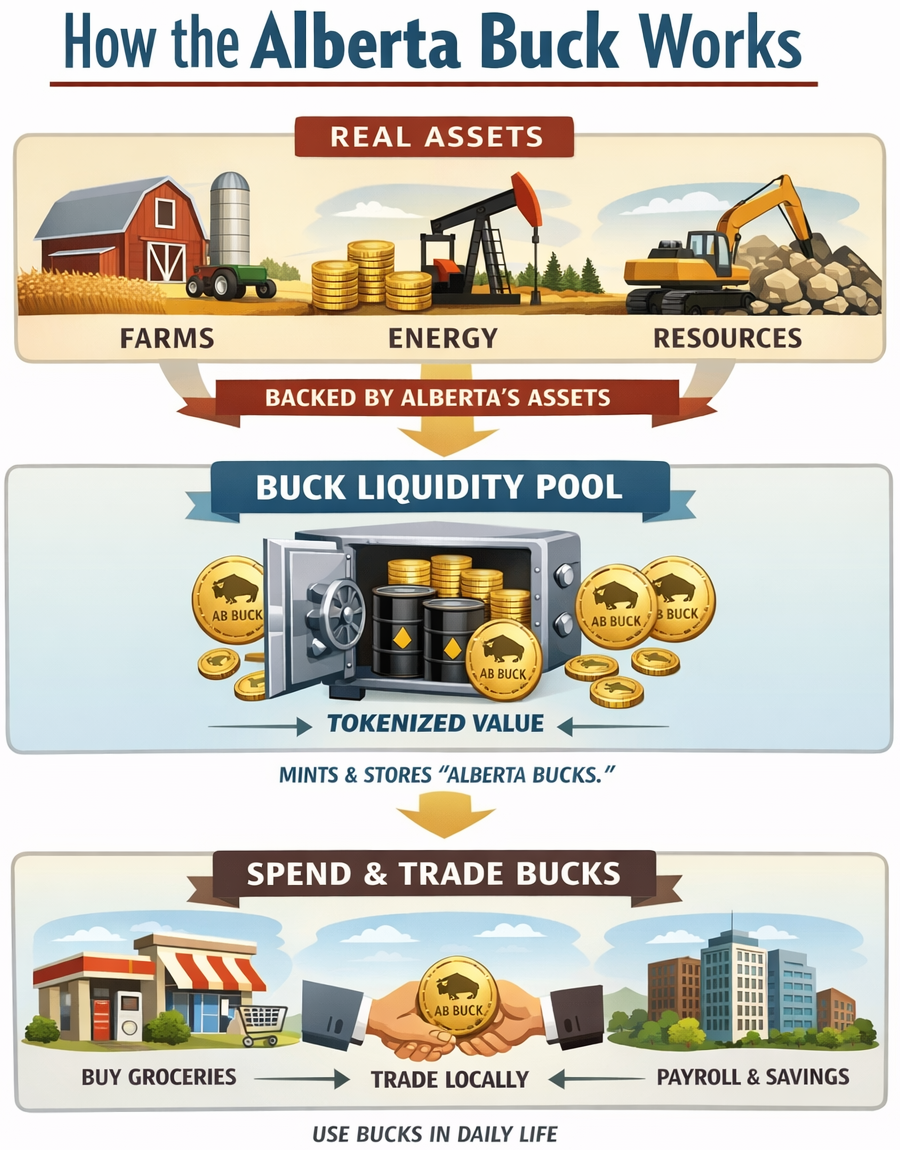
Layer 1 – Real Assets: Alberta's farms, homes, equipment, energy infrastructure, and natural resources. These are the real wealth that backs every BUCK.
Layer 2 – BUCK Liquidity Protocol: Randomly assigned underwriters and insurers attests and insure
your asset's value. You lock the attestation into an BUCK_CREDIT smart contract and mint BUCKs – digital tokens
worth a fixed amount of real goods. No bank approval needed. No central authority. The rules are
enforced by the software itself.
Layer 3 – Spend and Trade: You spend BUCKs at local businesses, trade them on exchanges, pay employees, or swap them for Canadian dollars. When you're done, you buy back BUCKs and release your asset (or for long-term assets like homes and land, or if everything goes wrong, wait and it is released automatically).
Two design decisions make this system resilient:
Protocol, not organization: There is no foundation, company, or board to shut down. Anyone can mint BUCKs by locking insured collateral into published software – just as anyone can send Bitcoin without asking permission from a Bitcoin corporation.
Privacy with accountability: Each transaction records the verified identities of both parties, encrypted so only they can read it. Your neighbours can't see your transactions. But if a court issues an order, law enforcement can compel you to decrypt your receipts – revealing exactly who you paid and who paid you. More private than a bank account; more enforceable than cash.
The BUCK's value is defined by a basket of real commodities – energy, agriculture, minerals, and labour – measured by a Commodity Price Index. This basket has been demonstrably more stable than the Canadian dollar over 50 years.
Legal Classification: Before Launch
Before the first BUCK is minted, we answer the question every skeptic will ask: "Is this even legal?" Yes. And we get that answer in writing, from independent lawyers, before launch.
In plain terms: the BUCK is a modern version of a grain elevator receipt – a token proving you own real, insured stuff, that other people can accept as payment. Canadian farmers have used these for over a century. The legal framing draws on well-established commercial instruments:
- Asset-backed commercial paper: BUCKs represent tokenized claims on attested, insured assets – analogous to warehouse receipts that Canadian grain elevators have issued since the 19th century9.
- Collateralized factoring: The asset owner converts illiquid wealth to liquid form, paying an insurance premium rather than interest. No deposit is taken. No maturity transformation occurs. No leverage beyond collateral value is created.
- Commodity tokens: Like PAX Gold (PAXG) or Kinesis (KAU), BUCKs represent fractional claims on real assets – not investment contracts.
The most predictable response from Ottawa will be: "This is unlicensed banking." The legal opinion pre-empts this by showing three ways the BUCK is nothing like a bank:
- Banks take your deposits and owe you the money back. BUCK issuers don't take deposits from anyone. A BUCK is a token backed by your own insured asset – nobody owes anybody anything.
- Banks borrow short and lend long. That temporal mismatch is what causes bank runs. With BUCKs, your asset and your token exist at the same time. No mismatch. No run.
- Banks create money far exceeding their reserves. BUCKs can only be minted up to half the insured value of the underlying asset. You cannot mint more than you own.
The BUCK is also not a security – not a stock, not a bond, not an investment10. Nobody buys BUCKs expecting them to go up in value. Nobody invests in a "BUCK venture." You mint BUCKs from your own stuff, spend them, and buy them back when you're done. That's closer to selling grain than buying shares.
And because the BUCK is a protocol – published software, not a company – there is no organization to shut down. Nobody "issues" BUCKs. You lock your own insured asset into published software and mint them yourself. The message to regulators is simple: "We didn't issue a currency. We published infrastructure that lets Albertans access liquidity from their own wealth."
What about crime? The BUCK handles this better than either cash or banking. Every transaction creates an encrypted receipt containing both parties' verified identities. You can read your own receipts. Your neighbours cannot. But if a court issues an order, police can compel you to decrypt the chain – revealing exactly who paid whom, with cryptographic proof. No central database to hack. No bank to subpoena. No hidden government actions or secret court orders forcing banks to give up your information or lock your account – just math that works for privacy and law enforcement.
Every BUCK in circulation traces to an attested, insured real-world asset owned by an identified person. No bank can make that claim about its deposits.
For detailed constitutional and legal analysis, see Alberta Buck – Legal Foundation and Addressing Common Objections.
The Coalition: Multi-Sector Partnership
The single most powerful defence of any new financial infrastructure is the breadth of its participants. A system used only by crypto enthusiasts can be dismissed. A system used by farmers, municipalities, small businesses, credit unions, and insurers becomes politically untouchable.
The Phase 0 coalition includes:
- Agricultural cooperatives: Farmers facing acute seasonal debt stress are natural first participants. Their need is immediate, their collateral (stored grain, equipment, land) is well understood by existing insurers, and rural communities understand the cost of bank intermediation viscerally.
- Credit unions: Alberta's credit union sector – Servus Credit Union, Connect First, and others – already competes with the Big Five banks and operates under provincial regulation. ATB Financial has operated for 87 years with provincial deposit guarantees and no CDIC participation – a de facto parallel financial system already functioning within Confederation11. Credit unions can participate as collateral validators, BUCK custodians, and liquidity pool operators, turning potential competitors into partners.
- Insurers: Property and casualty insurers already assess and price the risks that back BUCK issuance. Parametric insurance products extend their existing business into a new revenue stream. Insurers become the attestation backbone of the system – with capital at risk on every valuation.
- Small businesses: Local merchants and service providers who accept BUCKs gain a customer base saving thousands annually. Their participation deepens the circulation network.
- Municipal governments: Towns and counties with infrastructure assets can access liquidity without issuing debt. Their participation legitimises the system politically and economically.
This coalition serves a strategic purpose beyond economics. If OSFI or the Bank of Canada attempts to characterize BUCK issuance as unlicensed banking, the political cost of shutting down a system used by Alberta farmers, credit unions, and municipalities becomes prohibitive. The coalition is not a shield – it is a constituency.
The Pilot Communities
Agricultural communities facing acute debt stress are ideal initial participants. A farming cooperative near Grande Prairie or Lethbridge, plus a small business district in one urban centre, form the initial deployment. A participating credit union provides custody and fiat on-ramp services.
The Grain Farmer – Month 8
Jake Fehr farms 2,400 acres near Beaverlodge. His operation holds $3.2M in land, $900K in equipment, and $400K in stored canola. He carries $1.8M in farm debt at 5.2%, paying $94,000 annually in interest – more than his family's living expenses.
Jake's insurer attests his stored canola at 380,000 BUCKs. He receives a
BUCK_CREDITNFT from the insurer and mints 190,000 BUCKs (50% of attested value). He swaps 190,000 BUCKs for Canadian dollars on an exchange to pay his equipment loan installment.Nothing changes about Jake's daily operations. His canola is still in the bins. His insurer still covers it. But instead of borrowing $190K at 5.2% to bridge until sale, he accessed liquidity from his own grain. Savings: $9,880 in avoided interest this season.
When he sells the canola in April at a better price, he buys back BUCKs and redeems them, releasing his
BUCK_CREDIT. Simple. No debt incurred.
At the Credit Terminal
During Phase 0, BUCKs circulate primarily among pilot participants and crypto-savvy early adopters. The typical experience:
- Gas station: Pay in CAD$ (debit/credit) or BTC (Lightning). BUCK not yet accepted.
- Farm supply dealer (pilot participant): Pay in CAD$, BUCK, or BTC Lightning. The dealer's POS terminal shows prices in CAD$ with BUCK equivalent displayed.
- Online exchanges: BUCKs freely tradeable for US dollars, Canadian dollars, Bitcoin, and gold.
BUCK liquidity is thin. Spreads are wide. But the infrastructure works, the insurance holds, and the first participants are saving real money.
The Credit Union Manager – Month 10
Lisa Flett manages the Beaverlodge branch of a regional credit union. She's watched farm clients struggle with bridge financing costs for twenty years. When her board evaluates the BUCK pilot, she sees what the Big Five banks' head offices won't: a way to offer her members liquidity services that no credit union charter currently allows.
Her branch becomes a BUCK custody provider and fiat on-ramp. Members attest grain through their existing crop insurer and mint BUCKs at the credit union's terminal. The credit union earns custody and conversion fees – modest per transaction, but meaningful in aggregate. More importantly, her members stop leaving for the Big Five's bridge financing.
"We're not replacing the banks," she tells her board. "We're offering our members a tool the banks never gave them access to."
Phase 1: Private Debt Retirement (Years 1-3)
Mortgages, farm debt, and small business financing begin shifting to wealth-backed issuance. Institutional defences mature.
The Economics of Mortgage Retirement
Alberta's 580,000 mortgaged households12 represent $197 billion in debt and ~$10 billion in annual interest. Each family refinancing through BUCKs saves the difference between their mortgage interest rate and the BUCK insurance cost (~0.5% annually for residential property).
At a 5% mortgage rate on $380,000:
- Mortgage: ~$19,000/year interest in early years; $286,433 total interest over 25 years
- BUCK: ~$1,900/year insurance; $47,500 total insurance over 25 years
- Savings: $238,933 per family over 25 years
If even 10% of mortgaged households (58,000 families) transition in the first three years, the aggregate annual interest savings exceed $1 billion – money that recirculates through Alberta's local economy rather than flowing to distant bank shareholders.
The Adoption Curve
Adoption follows a natural S-curve, driven by the financial incentive. Early adopters are crypto-literate homeowners comfortable with digital wallets. The mass market follows once institutional infrastructure – insurer APIs, real estate lawyer integration, title office compatibility – matures.
| Year | Mortgage Adoption | Farm Adoption | Business Adoption | Annual Interest Saved |
|---|---|---|---|---|
| 1 | 2% (11,600) | 5% | 2% | ~$400M |
| 2 | 5% (29,000) | 10% | 5% | ~$1.0B |
| 3 | 10% (58,000) | 20% | 10% | ~$2.2B |
These are conservative estimates. The incentive – saving $17,000+ per year on a typical mortgage – is powerful enough to drive rapid adoption once the infrastructure is trusted.
What Families Experience
The Young Family – Year 2
Priya and Marcus Redcrow are buying their first home in Airdrie. $505,000, with $125,000 down. Their mortgage broker presents two options:
Option A: Conventional mortgage. $380,000 at 4.8%. Monthly payment: $2,167. Total cost over 25 years: $650,000.
Option B: Alberta Buck issuance. Their home insurer attests the property at 505,000 BUCKs. They receive a
BUCK_CREDITNFT and mint 380,000 BUCKs, swapping immediately for CAD$ to pay the seller. Annual insurance: $1,900. No interest. No monthly principal payments – just insurance and eventual redemption when they sell.They choose Option B. First year savings: $17,100. They put it into their daughter's RESP.
At the grocery store, their debit card still works in CAD$. At the farmer's market, they notice a few vendors showing BUCK prices alongside CAD$. The BUCK is starting to feel normal.
Farm Debt Transformation
The agricultural sector demonstrates the most dramatic transformation. Alberta's farms carry $37.4 billion in debt6, with interest consuming a third of farm cash income13. The cruel seasonal mismatch – harvest costs due in fall, grain revenue arriving months later – forces farmers into bridge financing at the worst possible time.
With BUCKs, farmers attest stored inventory and equipment, mint BUCKs for operational needs, and redeem when revenue arrives. No bridge loan interest. No forced sale at harvest-low prices.
The Equipment Dealer – Year 2
Brandt Falkenberg runs a Case IH dealership outside Red Deer. His lot holds $8 million in new and used equipment, financed at $5.2M in floor plan debt costing $312,000/year in interest.
Once equipment insurance adapts its parametric interface, Brandt attests his inventory and mints BUCKs against it. His floor plan debt is retired over 18 months as each unit sells. Annual savings: $290,000 after insurance costs. He hires two more technicians.
His customers increasingly want to buy equipment with BUCKs minted against their farm assets. No bank approval process. No credit check beyond the insurer's attestation. Sale closed in days, not weeks.
At the Credit Terminal – Year 3
Acceptance has broadened significantly:
- Gas station: CAD$ (debit/credit), BTC (Lightning). Some stations show BUCK prices.
- Grocery chain: CAD$ only. Corporate head office is "evaluating" BUCK acceptance.
- Farm supply: CAD$, BUCK, BTC Lightning. 10% of transactions in BUCKs.
- Local restaurant: CAD$, BUCK. The owner minted BUCKs against her building; she's happy to receive them.
- Online: Exchange spreads between BUCKs and Canadian dollars have narrowed to under 0.5%.
- Rent: Some landlords accept BUCK. Tenants who minted BUCKs against vehicles or savings find this convenient.
The complementary liquidity infrastructure is emerging organically. No mandate. No legal tender decree. Just better access to a financial tool that was always backed by Albertans' own wealth.
Defending the Infrastructure: The Institutional Response
By Year 2, BUCK adoption is visible enough to provoke institutional responses. These responses are predictable, and the roadmap prepares for each.
The framing matters: the BUCK does not create purchasing power from nothing. It unlocks existing asset value. That is fundamentally different from bank credit expansion or deficit spending. If explained clearly, this distinction disarms most opposition – because it is true.
The "Unlicensed Banking" Challenge
The first institutional response comes from OSFI or the Bank of Canada, arguing that BUCK issuance is deposit-taking or banking without a charter. "You are creating money and holding collateral – that looks like banking."
This challenge is pre-empted by the legal classification work completed in Phase 0. The response is factual and structural:
- Banks take demand deposits (short-term liabilities) and make long-term loans (maturity transformation). BUCK issuers do neither.
- Banks create money in excess of their capital reserves (leverage). BUCK issuance is bounded by attested, insured collateral at conservative ratios.
- Banks owe depositors on demand. BUCK issuers owe nothing to BUCK holders – BUCKs are bearer tokens backed by the issuer's own assets, not institutional liabilities.
The BUCK is collateralized factoring – the same financial operation that companies use when they sell receivables for immediate cash. It is asset-backed commercial paper. It is a digital warehouse receipt. These are well-understood instruments that operate outside banking regulation because they are not banking.
And critically: there is no entity to shut down. BUCK is a protocol – published software that anyone can use to lock attested collateral and mint tokens. There is no foundation to enjoin, no company to debank, no DAO leadership to subpoena. Regulators can target institutions; they cannot un-publish a protocol any more than they can un-publish the TCP/IP specification. The participants – insurers, credit unions, individual citizens – operate under existing provincial law.
The coalition built in Phase 0 provides the political dimension: shutting down a system used by farmers, credit unions, and municipalities is not merely a regulatory action – it is an attack on rural Alberta's financial autonomy.
The Regulatory Counsel – Year 2
The Alberta Crown's external regulatory counsel receives OSFI's preliminary inquiry. She reviews the legal classification opinions secured during Phase 0, the protocol's cryptographic identity architecture, and the on-chain collateral audit data.
Her response is 14 pages. The summary: "BUCK is a protocol, not a financial institution. No entity issues BUCKs – citizens lock their own insured collateral into published smart contracts. The instrument involves no demand deposit liability, no maturity transformation, and no leverage beyond attested collateral value. OSFI's jurisdiction does not extend to published software that private citizens use to monetize their own insured property under provincial contract and property law."
She cc's the Alberta Securities Commission, which had already completed its own review. Their conclusion: "BUCK is not a security. It is a commodity token with no expectation of profit, no reliance on promoter efforts, and no capital-raising function."
OSFI does not pursue the matter further. There is, in any case, no entity to pursue.
The Securities Classification Challenge
The Alberta Securities Commission (ASC) may receive complaints arguing that BUCK is an investment contract – especially once BUCKs trade on exchanges. The investment contract test asks whether there is (1) an investment of money, (2) in a common enterprise, (3) with expectation of profit, (4) from the efforts of others.
BUCK issuance fails every element:
- No investment of money: Issuers monetize their own existing wealth. They do not invest capital in a venture.
- No common enterprise: Each BUCK is backed by the individual issuer's attested asset. There is no pooled fund or shared enterprise.
- No expectation of profit: BUCKs are stabilized at commodity-basket par. Holders expect purchasing-power stability, not appreciation.
- No reliance on others: BUCK value derives from the commodity basket definition and the underlying insured asset, not from any promoter's management efforts.
BUCKs behave more like tokenized credit lines than investment assets. The early engagement with the ASC during Phase 0 – and the dedicated legal opinion on "Why BUCK Is Not a Security" – provides the foundation for this defence.
The AML/Crime Narrative
FINTRAC or political opponents may argue that the system enables money laundering, tax evasion, or sanctions avoidance. This narrative has been used against every crypto system since Bitcoin's inception – but BUCK's architecture defeats it structurally, not bureaucratically.
The protocol's cryptographic identity receipts provide something neither cash nor conventional banking offers: privacy with enforceability.
- Every BUCK in circulation traces to an identified person who attested a specific, insured real-world asset. Money laundering requires obscuring the source of funds; BUCK issuance requires proving it.
- Every transaction generates an encrypted receipt containing both parties' verified identities. Private by default – but decryptable under court order, providing law enforcement with a cryptographic chain of custody that cash can never offer.
- There is no central database to hack or politically abuse. Identity information is distributed across participants, accessible only through due legal process.
The honest claim: "The BUCK protocol is more private than your bank account and more enforceable than cash. Every unit of liquidity is permanently linked to an attested, insured real-world asset owned by an identified person – and every transaction has a cryptographic receipt that the courts can compel."
Liquidity Suppression by Banks
The Big Five Canadian banks may not rely solely on regulators. They may attempt to starve the system of liquidity by blocking fiat on-ramps, refusing settlement accounts, restricting exchange access, or closing accounts of BUCK participants. This has already happened to Canadian crypto businesses.
The roadmap builds bank-independent liquidity from Phase 0:
- Decentralized exchanges: BUCK exchange pools operate on international platforms outside any bank's control. Anyone can trade BUCKs for US dollars, Canadian dollars, Bitcoin, or gold tokens.
- International markets: BUCK holders can access US dollar liquidity through stablecoin exchanges without touching a Canadian bank.
- Credit union on-ramps: Provincial credit unions (Servus, Connect First, ATB Financial) provide CAD$ conversion outside the Big Five's infrastructure.
- Direct merchant loops: As more merchants accept BUCKs, the need for CAD$ conversion diminishes. A farmer who mints BUCKs against grain and spends them at a farm supply dealer who pays employees in BUCKs has exited the banking system entirely for that loop.
By Year 3, multiple independent liquidity channels ensure that no single institution – bank or regulator – can choke the system by restricting a single access point.
The Credit Union CEO – Year 3
David Blackwater, CEO of a mid-size Alberta credit union, watches Royal Bank close the operating accounts of three BUCK-participating farm supply dealers. He calls an emergency board meeting.
His pitch is simple: every account RBC closes is a potential credit union member. His board authorizes BUCK custody and settlement services. Within six months, 1,200 new business accounts open. The credit union's deposit base grows 8%.
"RBC handed us a competitive advantage," he tells the Alberta Credit Union Association. "Every time a big bank tries to suppress BUCK, they push participants toward institutions that want their business."
Three other credit unions launch BUCK services within the year.
The Political Narrative
The most powerful institutional attack is political: BUCK "undermines national monetary policy," "threatens financial stability," or resembles "private currency." The Bank of Canada, federal politicians, or media commentators may invoke these narratives.
The messaging discipline established in Phase 0 counters with a simple, true claim:
BUCK is complementary liquidity infrastructure, not alternative currency.
- BUCK does not replace Canadian dollars. Albertans still pay federal taxes in CAD$, trade with other provinces in CAD$, and hold CAD$ for cross-border transactions.
- BUCK monetizes idle assets that currently sit unproductive. A home worth $505,000 backing a BUCK issuance of $380,000 is not "creating money" – it is making existing wealth accessible.
- BUCK reduces debt dependence, which improves financial stability by reducing the systemic risk of cascading defaults during economic downturns.
The correct framing: extending the financial architecture that banks already use to the real economy. Banks already create liquidity from citizens' wealth. BUCKs simply allows citizens to do the same thing directly, at insurance cost instead of interest cost. This is an infrastructure upgrade, not a revolution.
The coalition built in Phase 0 provides the political shield: when farmers, credit unions, municipalities, and small businesses all depend on BUCK infrastructure, attacking it becomes attacking rural Alberta. No federal politician wants that fight.
Phase 2: The $10 Billion Threshold (Years 3-5)
BUCK economy reaches critical mass. Forward-thinking banks join. Provincial bond retirement begins.
Why $10 Billion Matters
At $10 billion in circulating BUCKs, several qualitative transitions occur:
- Liquidity depth: Exchange pools are deep enough that large transactions don't move the price.
- Price discovery: BUCK pricing against the commodity basket is robust, with multiple independent price feeds and active competition among traders.
- Insurer maturity: Parametric insurance products cover residential, agricultural, commercial and industrial assets.
- Network effects: Enough merchants accept BUCKs that holders can meet a substantial portion of daily spending needs without converting to CAD$.
- Bank-independent liquidity: The system can circulate without relying on any single institution for CAD$ conversion.
At this threshold, the Province of Alberta can begin its own transition – and forward-thinking banks begin joining rather than fighting the system.
Banks as Partners
The BUCK transition is not anti-bank. It is pro-citizen. Banks that recognize this distinction early find profitable roles within the new infrastructure:
- Attestation services: Banks with deep underwriting expertise offer
BUCK_CREDITattestation, competing with insurers on valuation accuracy. - Custody and settlement: Banks provide institutional-grade BUCK custody, competing with credit unions for business accounts.
- Exchange services: Banks operate exchange pools, earning trading fees when customers convert between BUCKs and dollars.
- Advisory: Wealth management divisions advise clients on optimal BUCK issuance strategies, earning fees on expertise rather than interest on credit creation.
The economics are straightforward: banks currently earn interest on money created from citizens' wealth. In the BUCK economy, they earn fees on services delivered to citizens managing their own wealth. The revenue per transaction is lower, but the addressable market is larger – because citizens who could never qualify for bank credit can still attest insured assets.
The Bank Branch Manager – Year 4
Michael Torres manages a TD branch in Lethbridge. His head office in Toronto still views the BUCK as a competitive threat. But Michael watches his commercial clients shrink: three farm equipment dealers, two construction companies, and a grain elevator have all retired their lines of credit.
Rather than losing them entirely, he proposes a pilot: TD Lethbridge offers BUCK custody accounts and attestation services. Head office approves – reluctantly – as a "market intelligence" exercise.
Within a year, his branch is the highest-growing in the region. Not from lending, but from fees: BUCK custody, attestation, conversion, and advisory. Revenue per client is lower. Number of clients is much higher. Total branch revenue exceeds the prior year.
"The infrastructure is going to exist whether we participate or not," he writes in his quarterly report. "The question is whether TD earns fees inside it or watches from outside."
At this threshold, the Province of Alberta can also begin its own transition.
Provincial Bond Retirement
Alberta carries $83 billion in bond debt[fn:6], paying $3.2 billion annually in interest14. Just as a family can access liquidity from their home equity instead of borrowing, the province can access its own asset base instead of rolling bonds.
And Alberta's asset base is enormous. Not the Heritage Savings Trust Fund – that stays invested, earning returns, untouched. The assets that back provincial BUCK issuance are the ones Alberta already owns but can't easily monetize:
- Hospitals and healthcare facilities: Worth tens of billions. Currently, the only way to "monetize" a hospital is to sell it to a private operator and rent the services back – politically unthinkable. With BUCKs, the province attests the insured value and accesses liquidity while keeping the hospital fully public.
- Highways, bridges, and transportation infrastructure: Could theoretically become toll roads under private partnership. Nobody wants that. BUCK attestation lets the province access the value without privatizing the road.
- Schools, courthouses, and public buildings: Worth billions in aggregate, impossible to sell without gutting public services. Perfect collateral for BUCK issuance.
- Crown lands: Over $100 billion in assessed value[fn:12]. Resource royalty streams of $21B/year15 provide ongoing revenue backing.
The principle is straightforward: these assets are valuable but difficult to monetize through conventional means. The only traditional options – selling to private operators, creating toll systems, or entering public-private partnerships – are politically unpalatable because they convert public goods into private profit centres. BUCK attestation is the third option: access the value while keeping the asset public.
Under wealth-backed issuance, the province can:
- Attest provincial infrastructure through qualified insurers
- Mint BUCKs against attested value (at conservative ratios)
- Swap BUCKs for CAD$ on deep liquidity pools
- Use CAD$ proceeds to retire maturing bonds
- Not re-issue the retired debt
Each bond retired and not replaced saves Alberta the coupon payment in perpetuity. A $1 billion bond at 4% saves $40 million annually. Retiring $10 billion in bonds over 3 years saves $400 million annually – funds redirected to healthcare, education, or tax reduction.
The Provincial Treasurer – Year 4
The quarterly bond maturity schedule shows $2.1 billion coming due. Historically, Alberta would roll this into new bonds at current rates. Today, the Treasury attests $4 billion in provincial hospital and highway infrastructure, mints 2.1 billion BUCKs, converts to Canadian dollars through exchange pools over several weeks to minimize market impact, and retires the bonds at par.
The coupon payments – $84 million annually at 4% -- are permanently eliminated. Insurance on the attested infrastructure costs approximately $10 million per year. Net annual savings: $74 million. Redirected to the Alberta Child Benefit.
The bond market notices. Alberta's credit rating is upgraded: the province is reducing debt while keeping its infrastructure fully public. The Heritage Fund continues earning compound returns unencumbered. The hospitals and highways haven't been sold or privatized – they've simply been recognized as the valuable public assets they always were.
Left-leaning Albertans note: public assets stay public. Right-leaning Albertans note: debt is eliminated without raising taxes. Both note: their children inherit a province with world-class infrastructure and zero debt.
The Self-Reinforcing Dynamic
Bond retirement creates a virtuous cycle:
- Each retired bond reduces annual interest costs
- Reduced interest costs improve the province's fiscal position
- Improved fiscal position supports higher credit ratings
- Higher ratings reduce the cost of any remaining conventional debt
- Freed fiscal capacity funds infrastructure, reducing reliance on future borrowing
Simultaneously, private BUCK adoption accelerates as institutional trust deepens:
- The province using BUCKs validates the instrument
- Vendors who see provincial acceptance adopt BUCKs
- Broader acceptance deepens liquidity pools
- Deeper pools attract larger participants
- Larger participants deepen pools further
What the Economy Looks Like – Year 5
The Plumbing Contractor – Year 5
Rob Makokis runs a 12-person plumbing company in Edmonton. Five years ago, his $400K line of credit cost $28,000/year in interest. Today, he mints BUCKs against his fleet ($280K), his accounts receivable ($150K via a new receivables attestation product), and his shop ($320K). Insurance: $3,750/year. Savings: $24,250. He hired an apprentice with the difference.
His invoices show prices in both CAD$ and BUCKs. About 30% of his residential clients pay in BUCKs. Commercial clients are 50/50. The general contractor on his current project, a provincial school renovation, pays him entirely in BUCKs minted by the province against the building being constructed.
At the coffee shop, he taps his phone. The terminal shows: "CAD$ 4.25 | BUCK 4.19 | BTC 42,500 Sats". He pays in BUCKs. The barista doesn't care which – the POS terminal settles everything to the owner's preferred currency mix.
At the Credit Terminal – Year 5
The multi-currency terminal is now standard:
- All retail: CAD$ (debit/credit), BUCK (tap/QR), BTC Lightning (tap/QR). Merchants choose their settlement preference.
- Real estate: Lawyers handle BUCK issuance as routinely as mortgage registration. Title offices
record
BUCK_CREDITliens alongside conventional mortgages. - Payroll: Some employers offer partial BUCK salary. Employees who hold BUCKs-against-assets can spend directly without conversion.
- Provincial services: Property tax payable in BUCK or CAD$. Vehicle registration in either.
- USD transactions: Cross-border trade converts BUCKs to US dollars through exchange pools. Energy sector invoicing settles directly in BUCK/USD.
Phase 3: Accelerating Transition (Years 5-10)
The BUCK becomes Alberta's primary unit of account. CAD$ recedes to cross-border settlement.
The Monetary Tipping Point
At some point, people stop thinking in Canadian dollars and start thinking in BUCKs. Not because anyone mandated it, but because BUCKs are cheaper to use. Gresham's Law16 works in reverse when the better money is also the cheaper money: people prefer to pay in BUCKs because they avoid interest costs, and merchants prefer to receive BUCKs because their suppliers feel the same way.
By Year 7, an estimated $50-80 billion in BUCKs are circulating – comparable to all the Canadian dollars currently flowing through Alberta. At this scale:
- Prices are increasingly quoted primarily in BUCKs, with CAD$ as the conversion
- Wage negotiations reference BUCK purchasing power
- Provincial budgets are prepared in BUCKs
- The Heritage Savings Trust Fund continues growing, untouched, as debt service costs vanish
Provincial Bond Retirement – Complete
The systematic retirement of Alberta's bond debt proceeds as bonds mature:
| Year | Bonds Retired (Cumulative) | Annual Interest Saved | Insurance Cost | Net Annual Savings |
|---|---|---|---|---|
| 4 | $5B | $200M | $25M | $175M |
| 5 | $12B | $480M | $60M | $420M |
| 6 | $22B | $880M | $110M | $770M |
| 7 | $35B | $1.4B | $175M | $1.2B |
| 8 | $50B | $2.0B | $250M | $1.75B |
| 10 | $75B | $3.0B | $375M | $2.6B |
By Year 10, most provincial debt is retired. The $2.6 billion in net annual savings – formerly transferred to bondholders – is available for productive investment, tax reduction, or citizen dividends.
The Macroeconomic Transformation
The transition produces several macroeconomic effects that reinforce stability:
Money Supply Dynamics
In the current system, every dollar in circulation was borrowed into existence. Paying off debt destroys money, so the economy needs continuous new borrowing just to stay afloat – which is why public and private debt keep growing.
BUCKs work differently. The money supply is tied to the real, insured assets behind it. A built-in stabilization mechanism adjusts how much can be issued, keeping BUCK prices steady against the commodity basket – without requiring anyone to borrow more.
What Happens to Interest Rates
As more Albertans use BUCKs, fewer need to borrow Canadian dollars. Banks face a choice: lower their interest rates to compete with interest-free BUCK issuance, or watch their market share shrink. Either way, Alberta borrowers win.
This isn't a disorderly disruption. Banks keep their expertise in risk assessment, custody, and payment processing. What changes is where the money comes from: citizen wealth instead of bank credit. Banks that adapt can earn fees on BUCK custody, insurance attestation, and exchange services.
Alberta Controls Its Own Finances
A province that can access liquidity from its own wealth doesn't need to beg bond markets for permission to build a hospital. Budget decisions reflect Albertans' priorities, not Bay Street's. Infrastructure is funded at insurance cost instead of interest. Alberta isn't walking away from its obligations – it's using a better tool to meet them.
The CFO – Year 8
Sarah Chen runs finance for a mid-size oilfield services company in Calgary. Revenue: $120M.
Her U.S. clients pay in USD, which she holds for American equipment purchases. Her Alberta operations – payroll, suppliers, insurance, provincial taxes – run primarily in BUCKs. For cross-border invoicing, exchange pools convert BUCKs to US dollars instantly.
The company's $15M in equipment and $8M in receivables back BUCK issuance for working capital. No line of credit needed. No banker reviewing her books quarterly to decide whether to renew. The insurer's attestation is automated and continuous.
She keeps a small Canadian dollar account for federal taxes and the occasional Ontario supplier. The CAD$ is becoming what the USD used to be: something you convert to when you need it, not what you operate in every day.
The annual report shows $1.8M in eliminated interest costs. That's two more field crews hired.
Phase 4: Maturity (Year 10+)
Alberta's financial infrastructure serves its citizens directly. Banks, credit unions, and insurers all participate.
The New Normal
A decade in, Alberta looks fundamentally different:
- Private debt: Alberta mortgage debt has declined from $197B to under $50B as families transition to BUCK issuance. Remaining mortgages are held by those who prefer conventional financing or own assets not yet covered by parametric insurance.
- Farm debt: Reduced from $37B to under $10B. Seasonal bridge financing is almost entirely BUCK-based. Farm bankruptcy rates have dropped by 60%. Rural communities are stabilizing as farmers access liquidity from their own assets instead of borrowing against them.
- Provincial debt: Effectively zero. The $3.2B annual interest payment is history. The Heritage Fund has doubled – once the province stopped raiding it to cover debt payments, compound returns did the rest.
- Payment terminals: Every terminal accepts Canadian dollars, BUCKs, and US dollars. Merchants choose what they want to receive. Cross-border trade converts automatically through exchange pools. International buyers increasingly prefer BUCKs because the commodity-basket backing makes them more predictable than any single government's currency.
What $23 Billion Per Year Buys
That $23 billion doesn't disappear. It stays in Alberta instead of flowing to Toronto and New York:
| Capital Retained | Annual Amount | Impact |
|---|---|---|
| Mortgage interest saved | $10B | Household consumption, education, small business |
| Farm interest saved | $1.9B | Equipment modernization, succession, rural revival |
| Business interest saved | $8.5B | Hiring, R&D, export growth |
| Provincial interest saved | $3.2B | Healthcare, education, infrastructure, tax relief |
| Total retained | $23B | Recirculates locally |
When money stays local, it circulates. The farmer buys equipment, the dealer hires mechanics, the mechanics eat at restaurants, the restaurants buy Alberta beef. Economists estimate this multiplier at 1.5-2.0x17, which means the real GDP impact exceeds $35 billion annually – for a province of 4.6 million people.
The Banking Sector Transformation
By Year 10, Alberta's banking sector has transformed rather than contracted. Banks and credit unions that adapted early are thriving in new roles:
- ATB Financial operates the largest BUCK custody and attestation platform in the province, processing $2B monthly in BUCK transactions. Its provincial mandate made it a natural first mover.
- Servus Credit Union and Connect First collectively serve 400,000 BUCK-active members, earning attestation, custody, and advisory fees.
- TD and RBC Alberta branches offer BUCK services alongside conventional products, having recognized that fee-based revenue on wealth management exceeds interest income on a shrinking loan book.
- A new category of BUCK-native fintechs provides specialized attestation for niche asset classes: heavy equipment, accounts receivable, intellectual property, resource royalties.
The transition didn't destroy Alberta's financial sector. It extended the infrastructure to citizens and forced the sector to compete on service quality rather than on exclusive access to money creation. The best institutions adapted and prospered.
Global Implications
A currency backed by real commodities – grain, oil, land, cattle – is more stable than one backed by government debt. International buyers figure this out. As the Value of Freedom1 envisions, Alberta's commodity and energy wealth can become a global reserve asset – not by government decree, but because people choose it.
Corporate treasuries, international commodity traders, and even sovereign wealth funds begin holding BUCKs as a stable store of value that doesn't depend on any single government's printing press18. Alberta's exchange pools become major international trading hubs.
Alberta's insurance and attestation expertise becomes a globally exportable service industry – the "Alberta Advantage" applied to the next generation of financial infrastructure.
Institutional Response Preparedness
Any roadmap that ignores pushback is naive. The BUCK gives ordinary people a capability that has historically been restricted to chartered banks: creating liquidity from real wealth. The banks and their regulators will respond. Here's how the system is designed to withstand it.
Two design decisions make the system resilient:
- BUCK is a protocol, not an organization. There is no foundation, company, or DAO to shut down. Citizens lock their own insured collateral into published smart contracts. Regulators can target institutions, but they cannot un-publish software.
- Identity is cryptographic, not centralized. Every transaction records verified counterparty identities, encrypted so only participants can read them. Courts can compel decryption; no one else can. This is simultaneously more private than banking and more enforceable than cash.
The roadmap's defensive architecture is summarized here:
| Attack Vector | Institution | Defence | Phase |
|---|---|---|---|
| "Unlicensed banking" | OSFI, BoC | Protocol, not institution; factoring, not banking | 0 |
| "Security token" | ASC | Commodity token opinion; no profit expectation | 0 |
| AML/crime narrative | FINTRAC | Cryptographic receipts; more enforceable than cash | 0 |
| Liquidity suppression | Big Five banks | Exchange pools, credit union on-ramps, merchants | 0-2 |
| Political narrative | Fed. gov., media | Coalition of farmers, municipalities, businesses | 0-3 |
| "Monetary policy" claims | Bank of Canada | Complementary infrastructure, not currency | 2-4 |
| International obligations | Fed. gov. | No treaty prohibits private RWA tokens | 3-4 |
The common thread: BUCK does not create purchasing power from nothing. It unlocks existing asset value. This structural fact is the single most powerful defence against every attack, because it is true.
The second most powerful defence is broad participant diversity. A system used by farmers, credit unions, municipalities, insurers, and forward-thinking banks cannot be shut down without shutting down a significant portion of Alberta's economy. The coalition is not a tactic – it is the natural consequence of building infrastructure that serves everyone.
The Path Not Taken: What Delay Costs
Every day of delay costs Alberta $63 million in intermediation costs that could be avoided. Every year, $23 billion. Over the ten-year transition period outlined above, the cumulative cost of inaction exceeds $200 billion that could have been retained by Alberta families, farmers, businesses, and the provincial government.
The technology exists. The legal foundation is sound. The architecture is designed and the commodity-basket valuation has been empirically tested. The defences against predictable opposition are built into the system from the ground up.
What remains is the political will to fund a $6 million R&D program that could save Alberta $23 billion a year.
The choice is simple: give Alberta's citizens the same financial tools that banks already use, or keep paying $23 billion a year for the privilege of borrowing money that was created from our own wealth.
The roadmap is clear. The first step is to begin.
Footnotes
Value of Freedom – Draft Fiscal Plan, Alberta Prosperity Project, July 2025. "Currency Consideration and Discussion" and "Swap and Credit Lines Discussion" sections.
Money in the Modern Economy Bank of England, 2014. "When a bank makes a loan, it simultaneously creates a matching deposit in the borrower's bank account, thereby creating new money."
How do banks create money, and why can other firms not do the same? Werner, Richard A., International Review of Financial Analysis, 2014.
Seigniorage: A Transfer of Wealth to the Privileged, in The Alberta Buck – Architecture.
CMHC Mortgage and Consumer Credit Trends, 2024. Alberta outstanding residential mortgage credit ~$197B.
Farm Debt Outstanding, 2020-2024, Statistics Canada Table 32-10-0051-01.
Alberta 2025-28 Fiscal Plan, Alberta Budget 2025. Total taxpayer-supported debt ~$82.8B.
Constitution Act, 1867, Section 92(13): "Property and Civil Rights in the Province" is exclusively provincial jurisdiction. See also Addressing Common Objections and Alberta Buck – Legal Foundation for detailed constitutional analysis.
Canadian grain elevator receipts circulated as negotiable instruments from the 1880s onward, representing physical grain in storage. These were not "currency" – they were commodity-backed bearer instruments regulated under provincial law. See the Canada Grain Act (historical) and Alberta Warehouse Receipts Act.
The Canadian investment contract test follows Pacific Coast Coin Exchange v. Ontario Securities Commission [1978] 2 SCR 112, which adopted the Howey test from U.S. law. An investment contract requires: (1) an investment of money, (2) in a common enterprise, (3) with expectation of profit, (4) primarily from the efforts of others. BUCK issuance fails all four elements. See Addressing Common Objections for detailed analysis.
ATB Financial, established in 1938 as Alberta Treasury Branches, is a Crown corporation operating as a full-service financial institution under provincial authority with no CDIC participation. Its 87-year history demonstrates that provincial financial infrastructure can operate effectively within Confederation. See Addressing Common Objections, "Provincial Sanction Equals Currency" section.
Number of properties with a mortgage, Statistics Canada. Alberta ~580,000 properties with outstanding mortgages.
Alberta Farm Cash Receipts, Expenses 2024, Alberta Economic Dashboard. Farm cash income ~$5.7B; farm debt interest ~$1.9B (~33%).
Albertans will pay their government's budget deficits, Fraser Institute, 2025. Provincial debt servicing ~$3.2B annually, or ~$700/Albertan.
Alberta Historical Royalty Revenue Data, Government of Alberta. Non-renewable resource revenue ~$21B (2024-25 estimate).
Gresham's Law states that "bad money drives out good" when both circulate at a fixed exchange rate – the inferior currency is spent while the superior is hoarded. When the good money is also cheaper to use (zero interest vs. borrowing costs), the dynamic reverses: the superior instrument is preferred for transactions. See Selgin, G. (1996) Salvaging Gresham's Law.
Local multiplier effects on retained spending are well-documented in regional economics. See Civic Economics (2012) Indie Impact Study, which found local recirculation multipliers of 1.5-3.0x depending on sector and community size. The 1.5-2.0x estimate is conservative for a resource-rich economy like Alberta's.
Stablecoin market capitalization exceeded $200B in 2025, with Tether (USDT) alone processing more daily transaction volume than Visa. See Visa Onchain Analytics. A commodity-basket-backed stablecoin offers diversified backing vs. the USD debt instruments behind USDT and USDC.